QUESTION IMAGE
Question
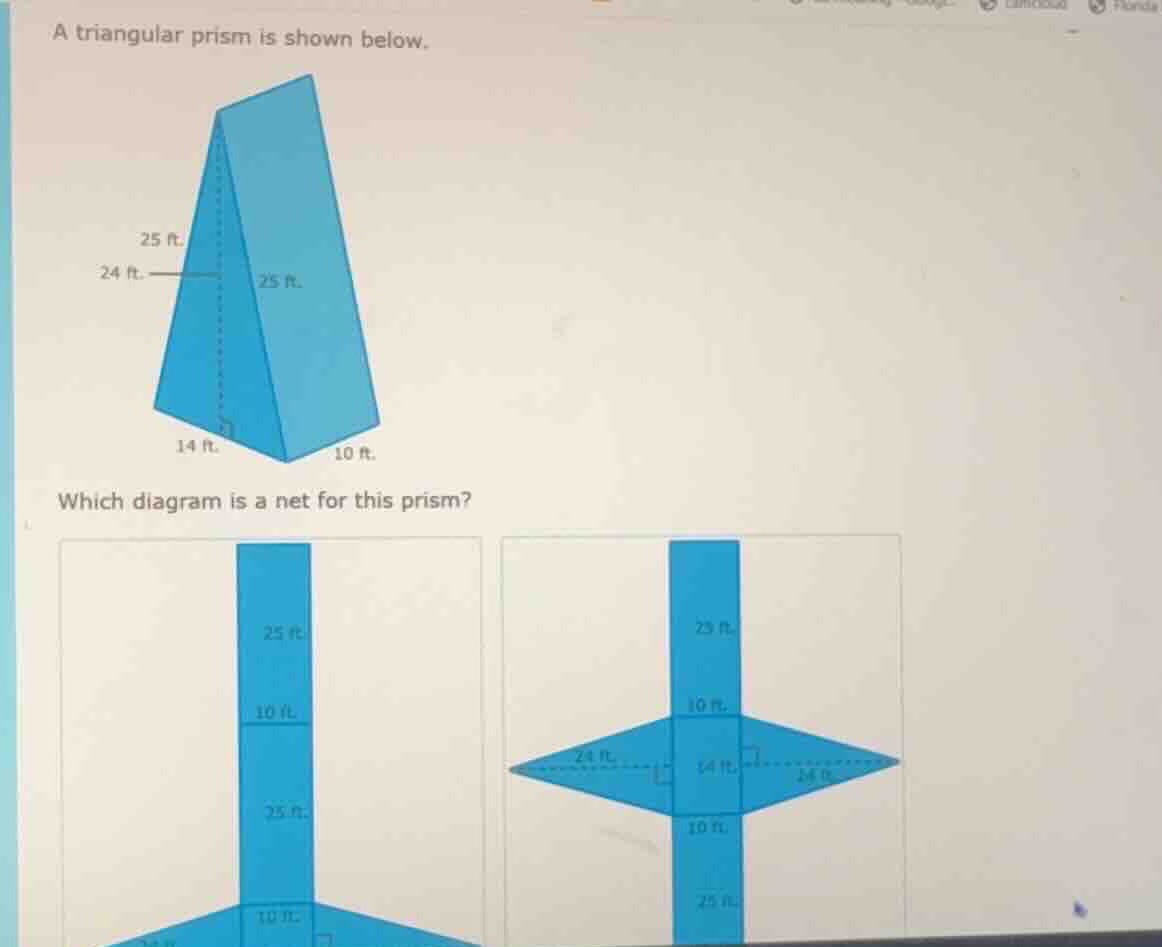
a triangular prism is shown below.
which diagram is a net for this prism?
To determine the net of the triangular prism, we analyze the prism's components:
Step 1: Identify the Prism’s Faces
A triangular prism has 2 triangular bases and 3 rectangular lateral faces.
- Triangular Bases: The triangle has a base of \( 14 \, \text{ft} \), height of \( 24 \, \text{ft} \), and hypotenuse \( 25 \, \text{ft} \) (since \( 14^2 + 24^2 = 196 + 576 = 772 \)? Wait, no—wait, \( 14^2 + 24^2 = 196 + 576 = 772 \), but \( 25^2 = 625 \). Wait, maybe the triangle has sides \( 14 \, \text{ft} \), \( 25 \, \text{ft} \), and height \( 24 \, \text{ft} \)? Wait, the prism’s lateral edge (length of the prism) is \( 10 \, \text{ft} \).
- Rectangular Faces: The rectangles have dimensions:
- One with \( 14 \, \text{ft} \times 10 \, \text{ft} \),
- Two with \( 25 \, \text{ft} \times 10 \, \text{ft} \) (since the triangular sides are \( 25 \, \text{ft} \), and the prism length is \( 10 \, \text{ft} \)).
Step 2: Analyze the Net Options
A net of a triangular prism must have:
- 2 congruent triangles (bases) with height \( 24 \, \text{ft} \), base \( 14 \, \text{ft} \), and hypotenuse \( 25 \, \text{ft} \).
- 3 rectangles: one \( 14 \times 10 \), two \( 25 \times 10 \).
Looking at the second diagram (the one with the central \( 14 \times 10 \) rectangle, flanked by triangles with height \( 24 \, \text{ft} \), and rectangles of \( 25 \times 10 \)):
- The triangles match the prism’s triangular bases (height \( 24 \, \text{ft} \), base \( 14 \, \text{ft} \), hypotenuse \( 25 \, \text{ft} \)).
- The rectangles match the lateral faces (\( 14 \times 10 \) and \( 25 \times 10 \)).

Snap & solve any problem in the app
Get step-by-step solutions on Sovi AI
Photo-based solutions with guided steps
Explore more problems and detailed explanations
The second diagram (with the central \( 14 \, \text{ft} \times 10 \, \text{ft} \) rectangle, flanked by triangles with height \( 24 \, \text{ft} \) and rectangles of \( 25 \, \text{ft} \times 10 \, \text{ft} \)) is the net.