QUESTION IMAGE
Question
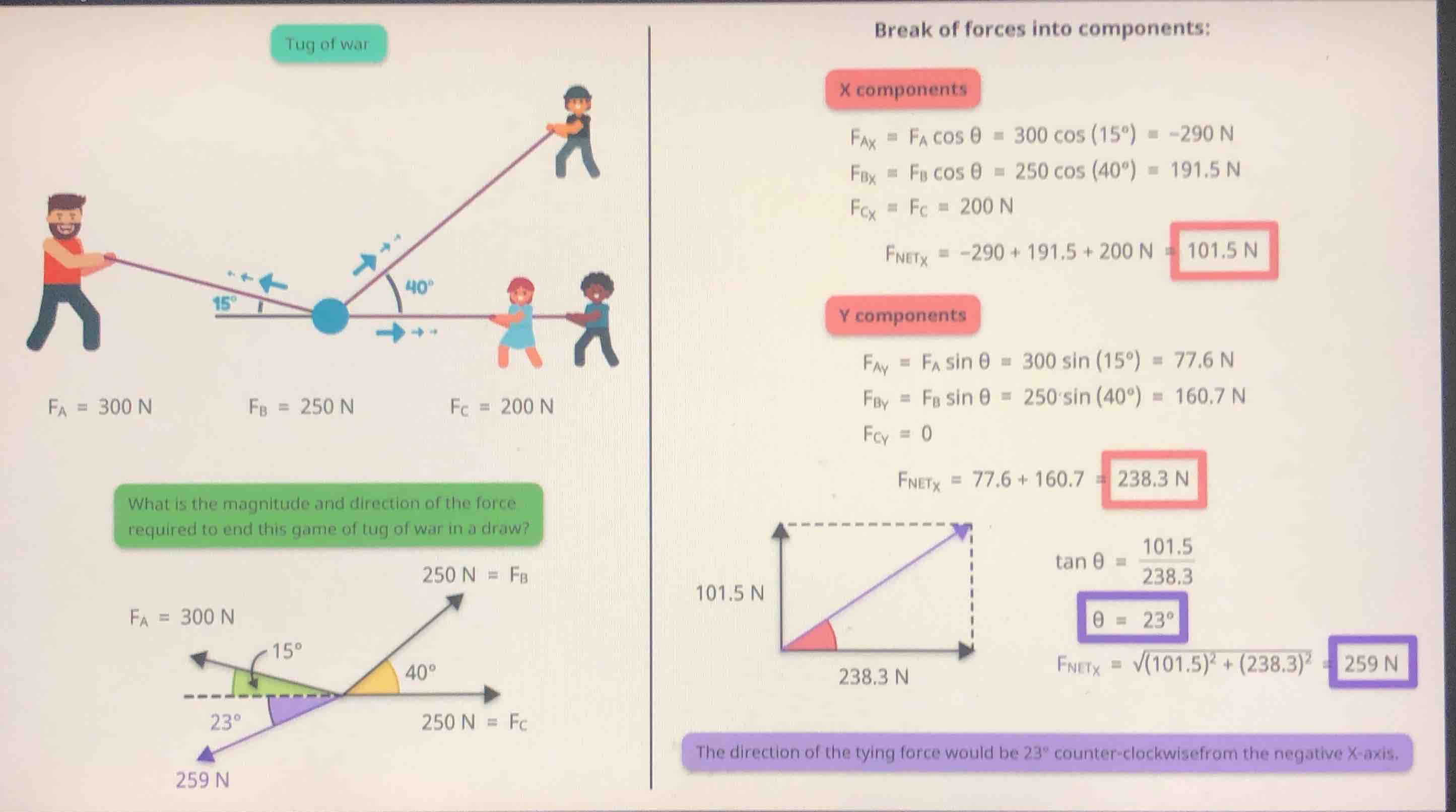
tug of war
$f_a = 300\\ n$ $f_b = 250\\ n$ $f_c = 200\\ n$
what is the magnitude and direction of the force required to end this game of tug of war in a draw?
break of forces into components:
x components
$f_{ax} = f_a \cos \theta = 300 \cos (15^\circ) = -290\\ n$
$f_{bx} = f_b \cos \theta = 250 \cos (40^\circ) = 191.5\\ n$
$f_{cx} = f_c = 200\\ n$
$f_{netx} = -290 + 191.5 + 200\\ n = 101.5\\ n$
y components
$f_{ay} = f_a \sin \theta = 300 \sin (15^\circ) = 77.6\\ n$
$f_{by} = f_b \sin \theta = 250 \sin (40^\circ) = 160.7\\ n$
$f_{cy} = 0$
$f_{netx} = 77.6 + 160.7 = 238.3\\ n$
$\tan \theta = \frac{101.5}{238.3}$
$\theta = 23^\circ$
$f_{netx} = \sqrt{(101.5)^2 + (238.3)^2} = 259\\ n$
the direction of the tying force would be $23^\circ$ counter - clockwise from the negative x - axis.
Step1: Recall the condition for equilibrium
For the tug - of - war to end in a draw, the net force on the knot must be zero. This means that the force we apply, let's call it \(F_{app}\), must be equal in magnitude and opposite in direction to the net force of the existing forces (\(F_{NET}\)).
We already know from the given data that the magnitude of the net force of the three forces \(F_A\), \(F_B\), and \(F_C\) is \(F_{NET}=\sqrt{(101.5)^{2}+(238.3)^{2}} = 259\space N\) and the direction of this net force is \(\theta = 23^{\circ}\) counter - clockwise from the negative \(x\) - axis.
Step2: Determine the magnitude of the required force
Since the net force of the three forces is \(F_{NET} = 259\space N\) at an angle of \(23^{\circ}\) counter - clockwise from the negative \(x\) - axis, the force required to balance it (so that the net force on the knot is zero) must have the same magnitude as \(F_{NET}\) and the opposite direction. So the magnitude of the required force \(F_{app}\) is equal to the magnitude of the net force of the three forces, which is \(259\space N\).
Step3: Determine the direction of the required force
The direction of the net force of \(F_A\), \(F_B\), and \(F_C\) is \(23^{\circ}\) counter - clockwise from the negative \(x\) - axis. The force required to balance it will be in the opposite direction. So the direction of the required force will be \(23^{\circ}\) clockwise from the positive \(x\) - axis (or equivalently, \(180^{\circ}- 23^{\circ}=157^{\circ}\) from the positive \(x\) - axis in the standard position, but more simply, it is opposite to the direction of the net force of the three forces). If we consider the direction of the net force of \(F_A\), \(F_B\), \(F_C\) as \(23^{\circ}\) counter - clockwise from the negative \(x\) - axis, the opposite direction (for the balancing force) will be \(23^{\circ}\) clockwise from the positive \(x\) - axis (or \(23^{\circ}\) counter - clockwise from the positive \(x\) - axis on the other side, which is equivalent to a direction that cancels the net force).

Snap & solve any problem in the app
Get step-by-step solutions on Sovi AI
Photo-based solutions with guided steps
Explore more problems and detailed explanations
The magnitude of the force required is \(259\space N\) and the direction is opposite to the direction of the net force of \(F_A\), \(F_B\), and \(F_C\) (i.e., if the net force of \(F_A\), \(F_B\), \(F_C\) is \(23^{\circ}\) counter - clockwise from the negative \(x\) - axis, the required force is \(23^{\circ}\) clockwise from the positive \(x\) - axis or \(23^{\circ}\) counter - clockwise from the positive \(x\) - axis on the opposite side to balance the net force). In terms of magnitude, it is \(259\space N\) and the direction is such that it cancels the net force of the three given forces. The magnitude is \(259\space N\) and the direction is \(23^{\circ}\) clockwise from the positive \(x\) - axis (or equivalent opposite direction to the net force of \(F_A\), \(F_B\), \(F_C\)).