QUESTION IMAGE
Question
- two cars with a mass of 3,800 kg are racing down a drag strip. car a has 25,000 j of energy and car b has 21,000 j of energy. if they maintain this level of energy? which car will finish the race first
a. car a
b. car b
c. according to newton’s third law, they will finish at the same time.
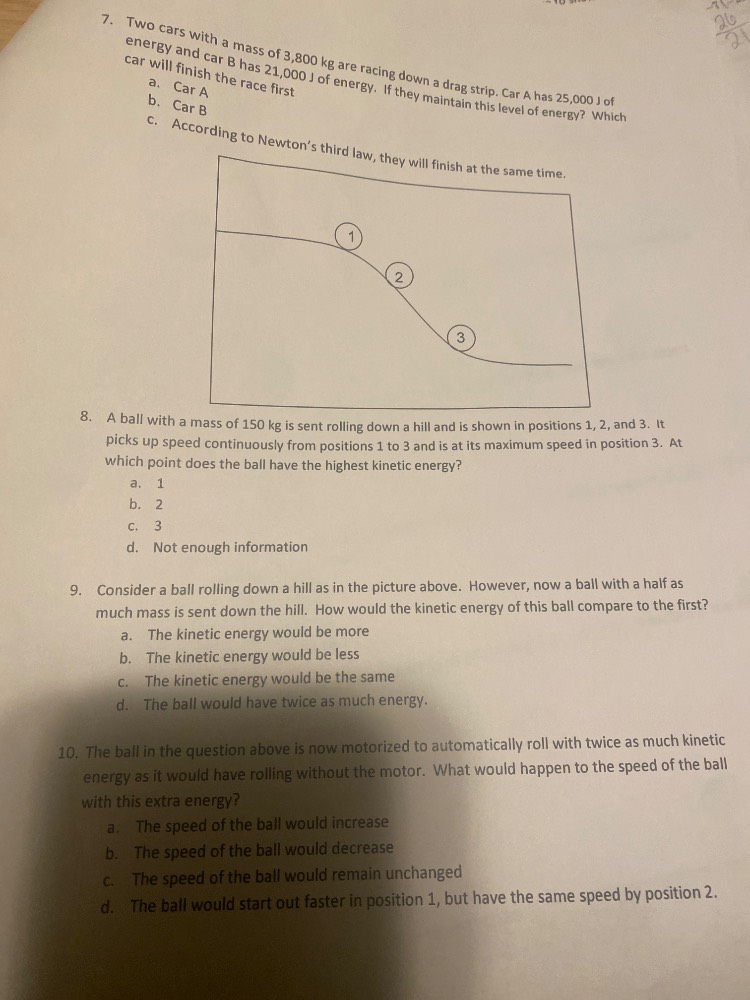
- a ball with a mass of 150 kg is sent rolling down a hill and is shown in positions 1, 2, and 3. it picks up speed continuously from positions 1 to 3 and is at its maximum speed in position 3. at which point does the ball have the highest kinetic energy?
a. 1
b. 2
c. 3
d. not enough information
- consider a ball rolling down a hill as in the picture above. however, now a ball with a half as much mass is sent down the hill. how would the kinetic energy of this ball compare to the first?
a. the kinetic energy would be more
b. the kinetic energy would be less
c. the kinetic energy would be the same
d. the ball would have twice as much energy.
- the ball in the question above is now motorized to automatically roll with twice as much kinetic energy as it would have rolling without the motor. what would happen to the speed of the ball with this extra energy?
a. the speed of the ball would increase
b. the speed of the ball would decrease
c. the speed of the ball would remain unchanged
d. the ball would start out faster in position 1, but have the same speed by position 2.
Question 7
Step1: Recall Kinetic Energy Formula
Kinetic energy formula is \( KE = \frac{1}{2}mv^2 \), where \( m \) is mass and \( v \) is velocity. For two objects with the same mass, higher kinetic energy means higher velocity (since \( m \) is constant, \( KE \propto v^2 \)).
Step2: Compare Energies of Car A and B
Both cars have the same mass (3800 kg). Car A has 25,000 J of energy, Car B has 21,000 J. Since \( KE \propto v \) (for same \( m \)), higher \( KE \) means higher \( v \). So Car A has higher speed.
Step3: Determine Which Finishes First
Higher speed means less time to cover the drag strip. So Car A, with higher kinetic energy (and thus higher speed), will finish first.
Step1: Recall Kinetic Energy Formula
Kinetic energy \( KE = \frac{1}{2}mv^2 \). Kinetic energy depends on mass (constant here, 150 kg) and speed (\( v \)). Higher speed means higher \( KE \).
Step2: Analyze Speed at Each Position
The ball picks up speed from position 1 to 3 and is at maximum speed in position 3. So speed at 3 is highest.
Step3: Relate Speed to Kinetic Energy
Since \( KE \propto v^2 \) (mass constant), highest speed (at 3) means highest kinetic energy.
Step1: Recall Kinetic Energy Formula
Kinetic energy \( KE = \frac{1}{2}mv^2 \). When rolling down a hill, assuming same height (so same potential energy converted, but here we consider mass change). For a ball rolling down, at the same point (same speed, since same hill, same path), if mass is halved (\( m' = \frac{m}{2} \)), and speed \( v \) is same (same hill, so acceleration due to gravity, speed at a point depends on height, not mass), then \( KE' = \frac{1}{2}(\frac{m}{2})v^2 = \frac{1}{2}(\frac{1}{2}mv^2) = \frac{KE}{2} \). So kinetic energy is less.
Step2: Compare Kinetic Energies
Original mass \( m \), new mass \( \frac{m}{2} \), same speed (since same hill, speed at a position depends on height, not mass). So \( KE \) is proportional to mass. Halving mass halves \( KE \) (at same speed). Thus new \( KE \) is less than original.

Snap & solve any problem in the app
Get step-by-step solutions on Sovi AI
Photo-based solutions with guided steps
Explore more problems and detailed explanations
a. Car A