QUESTION IMAGE
Question
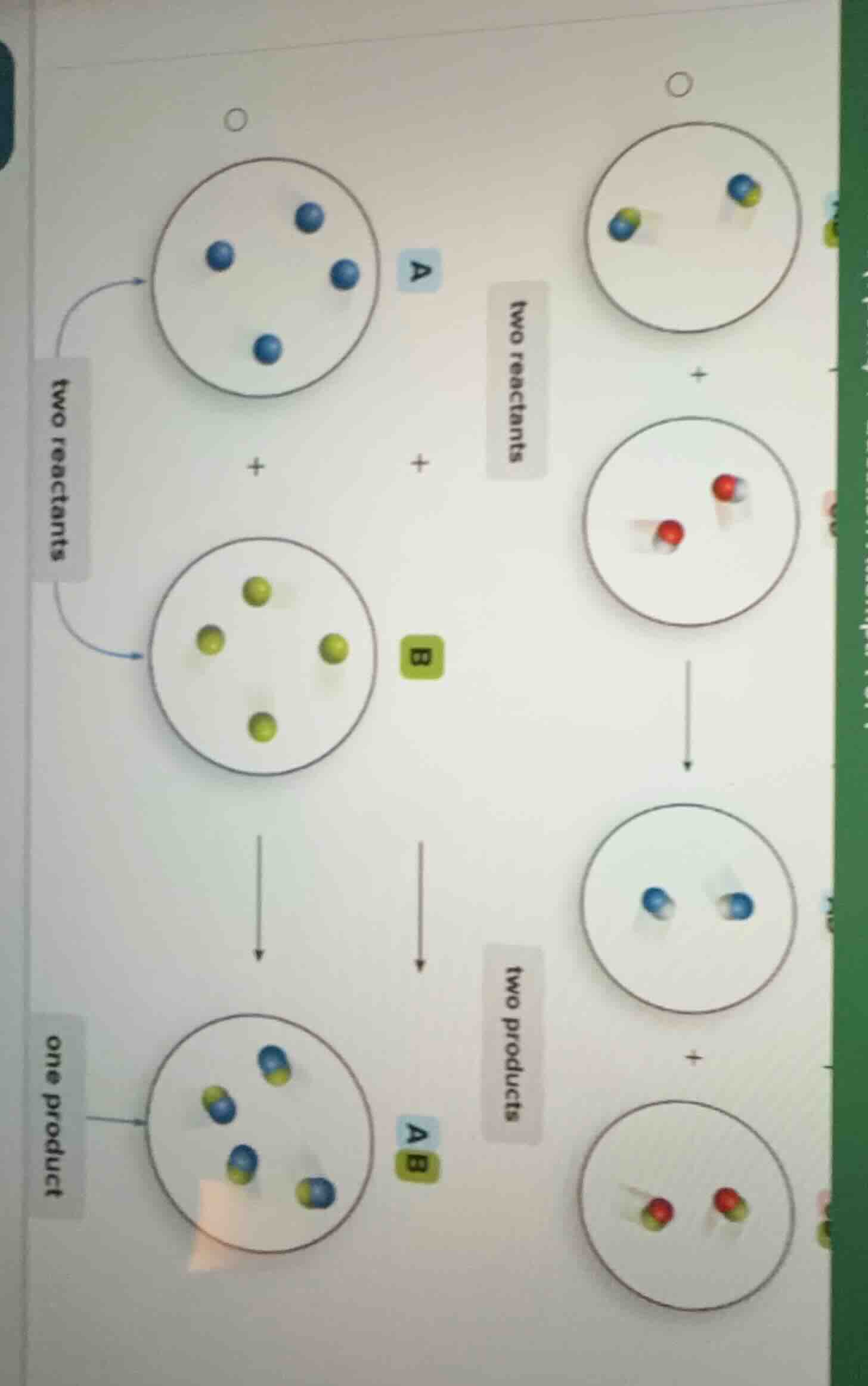
two reactants + two reactants → one product + two products (diagrams of particle arrangements for reactants and products)
Step1: Analyze left reaction (A + B → AB)
Reactant A: 4 blue atoms (let's say A atoms). Reactant B: 4 green atoms (let's say B atoms). Product AB: 4 molecules, each with 1 A and 1 B. So it's a combination reaction: \( A + B
ightarrow AB \) (4 A + 4 B → 4 AB), all atoms used, 1 product.
Step2: Analyze right reaction (AB + C → A + BC, assuming red is C)
Reactant 1: 2 AB molecules (2 A - B). Reactant 2: 2 C atoms (red). Product 1: 2 A atoms (blue). Product 2: 2 BC molecules (B - C, green - red). This is a single - replacement or double - replacement? Wait, AB (A - B) and C (red) react, A is replaced by C? No, product is A and BC. So \( AB + C
ightarrow A + BC \) (2 AB + 2 C → 2 A + 2 BC). Here, reactants are two (AB and C), products are two (A and BC).
Step3: Identify reaction types
Left reaction: Combination (synthesis), 2 reactants → 1 product. Right reaction: Decomposition? No, it's a replacement. Wait, the key is to see the number of reactants and products. Left: 2 reactants (A and B) → 1 product (AB) (synthesis). Right: 2 reactants (AB and C) → 2 products (A and BC) (maybe single - replacement or double - replacement, but the main difference is left is synthesis (2→1), right is not.
If the question is to identify which is a synthesis reaction (2 reactants → 1 product), the left one (A + B → AB) is synthesis.

Snap & solve any problem in the app
Get step-by-step solutions on Sovi AI
Photo-based solutions with guided steps
Explore more problems and detailed explanations
The left reaction (with reactants A and B forming product AB) is a synthesis (combination) reaction, where two reactants combine to form one product. The right reaction has two reactants forming two products (likely a replacement reaction). If identifying the synthesis reaction, it's the left - hand reaction: \( A + B
ightarrow AB \) (represented by the left set of circles with two reactants (A: blue atoms, B: green atoms) forming one product (AB molecules)).