QUESTION IMAGE
Question
type the correct answer in each box. use numerals instead of words. if necessary, use / for the fraction bar(s)
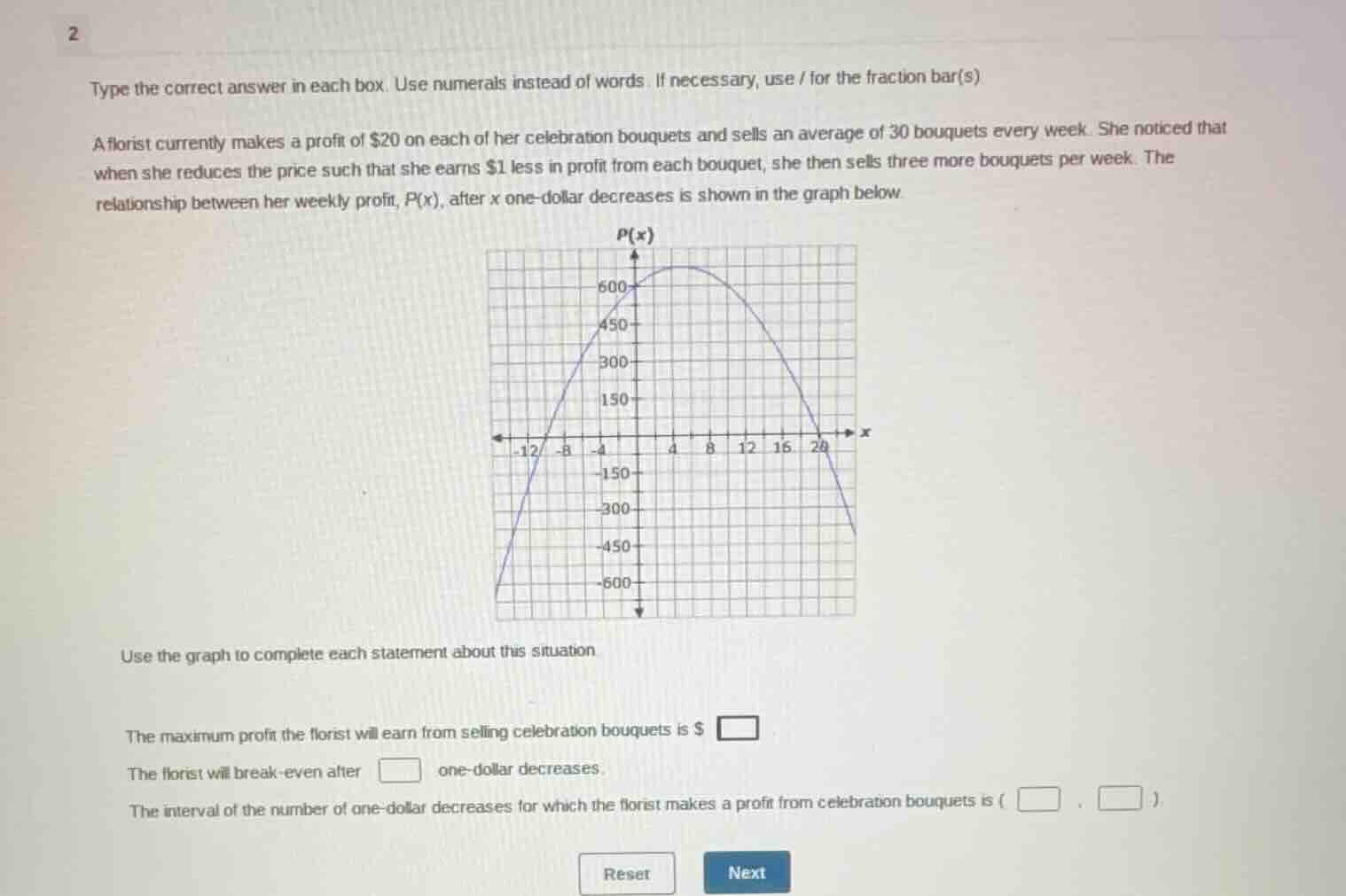
a florist currently makes a profit of $20 on each of her celebration bouquets and sells an average of 30 bouquets every week. she noticed that when she reduces the price such that she earns $1 less in profit from each bouquet, she then sells three more bouquets per week. the relationship between her weekly profit, p(x), after x one - dollar decreases is shown in the graph below
graph of p(x) with x - axis from - 12 to 20 and y - axis from - 600 to 600, passing through some points and having a peak
use the graph to complete each statement about this situation
the maximum profit the florist will earn from selling celebration bouquets is $ square
the florist will break - even after square one - dollar decreases.
the interval of the number of one - dollar decreases for which the florist makes a profit from celebration bouquets is ( square, square ).
First Question: Maximum Profit
Step1: Identify the vertex of the parabola
The graph of \( P(x) \) is a parabola, and the maximum profit occurs at the vertex (highest point) of the parabola. From the graph, we can see that the peak of the parabola is above the y - axis, and by looking at the grid, we can estimate the y - value (profit) at the vertex.
Looking at the graph, the maximum value of \( P(x) \) (the y - coordinate of the vertex) is 675? Wait, no, wait. Wait, let's re - examine. Wait, the initial profit is \( 20\times30 = 600 \). But the graph: let's see the vertex. Wait, maybe I made a mistake. Wait, the function for profit: \( P(x)=(20 - x)(30 + 3x)=- 3x^{2}+30x + 600 \). The vertex of a parabola \( ax^{2}+bx + c \) is at \( x=-\frac{b}{2a} \). Here, \( a=-3 \), \( b = 30 \), so \( x =-\frac{30}{2\times(-3)}=5 \). Then \( P(5)=(20 - 5)(30+3\times5)=15\times45 = 675 \). But from the graph, let's check the y - axis. Wait, the graph has a peak. Wait, maybe the graph's vertex is at y = 675? Wait, but the initial point when x = 0 is \( P(0)=20\times30 = 600 \), which matches the graph (when x = 0, P(x)=600). Then when x = 5, P(x)=675. So the maximum profit is 675? Wait, no, maybe the graph is drawn with a vertex at, let's see the grid. Wait, the y - axis has 600, 450, 300, etc. Wait, maybe I miscalculated. Wait, the function is \( P(x)=(20 - x)(30 + 3x)=-3x^{2}+30x + 600 \). The vertex of a parabola \( y = ax^{2}+bx + c \) is at \( x=-\frac{b}{2a} \), so \( x =-\frac{30}{2\times(-3)} = 5 \). Then \( P(5)=-3\times25+30\times5 + 600=-75 + 150+600 = 675 \). So the maximum profit is 675.
Step2: Confirm from the graph
Looking at the graph, the highest point (vertex) of the parabola representing \( P(x) \) has a y - coordinate (profit) of 675.
Second Question: Break - even point (Profit = 0)
Step1: Find x - intercepts
The florist breaks even when \( P(x)=0 \). From the graph, we can see the x - intercepts (where the graph crosses the x - axis). We know the function \( P(x)=(20 - x)(30 + 3x) \). Setting \( P(x)=0 \), we have \( 20 - x = 0 \) or \( 30+3x = 0 \). \( 20 - x=0\Rightarrow x = 20 \); \( 30 + 3x=0\Rightarrow x=-10 \). But since x represents the number of one - dollar decreases, x cannot be negative. So the positive x - intercept is at x = 20. So the florist will break - even after 20 one - dollar decreases.
Third Question: Interval of x for which profit is positive (P(x)>0)
Step1: Find the roots of P(x)=0
We know that \( P(x)=(20 - x)(30 + 3x) \). Setting \( P(x)=0 \), we get \( x = 20 \) (from \( 20 - x = 0 \)) and \( x=-10 \) (from \( 30 + 3x = 0 \)). Since x represents the number of one - dollar decreases, and profit is positive when the graph is above the x - axis, the interval of x for which \( P(x)>0 \) is between the two roots. But since x cannot be negative (we can't have a negative number of price decreases), the interval is \( (- 10,20) \), but in the context of x (number of one - dollar decreases, which is a non - negative quantity in practical terms, but mathematically, the interval where profit is positive is when \( - 10

Snap & solve any problem in the app
Get step-by-step solutions on Sovi AI
Photo-based solutions with guided steps
Explore more problems and detailed explanations
s:
- The maximum profit the florist will earn from selling celebration bouquets is $ \boldsymbol{675} $.
- The florist will break - even after \( \boldsymbol{20} \) one - dollar decreases.
- The interval of the number of one - dollar decreases for which the florist makes a profit from celebration bouquets is \( (\boldsymbol{-10},\boldsymbol{20}) \).