QUESTION IMAGE
Question
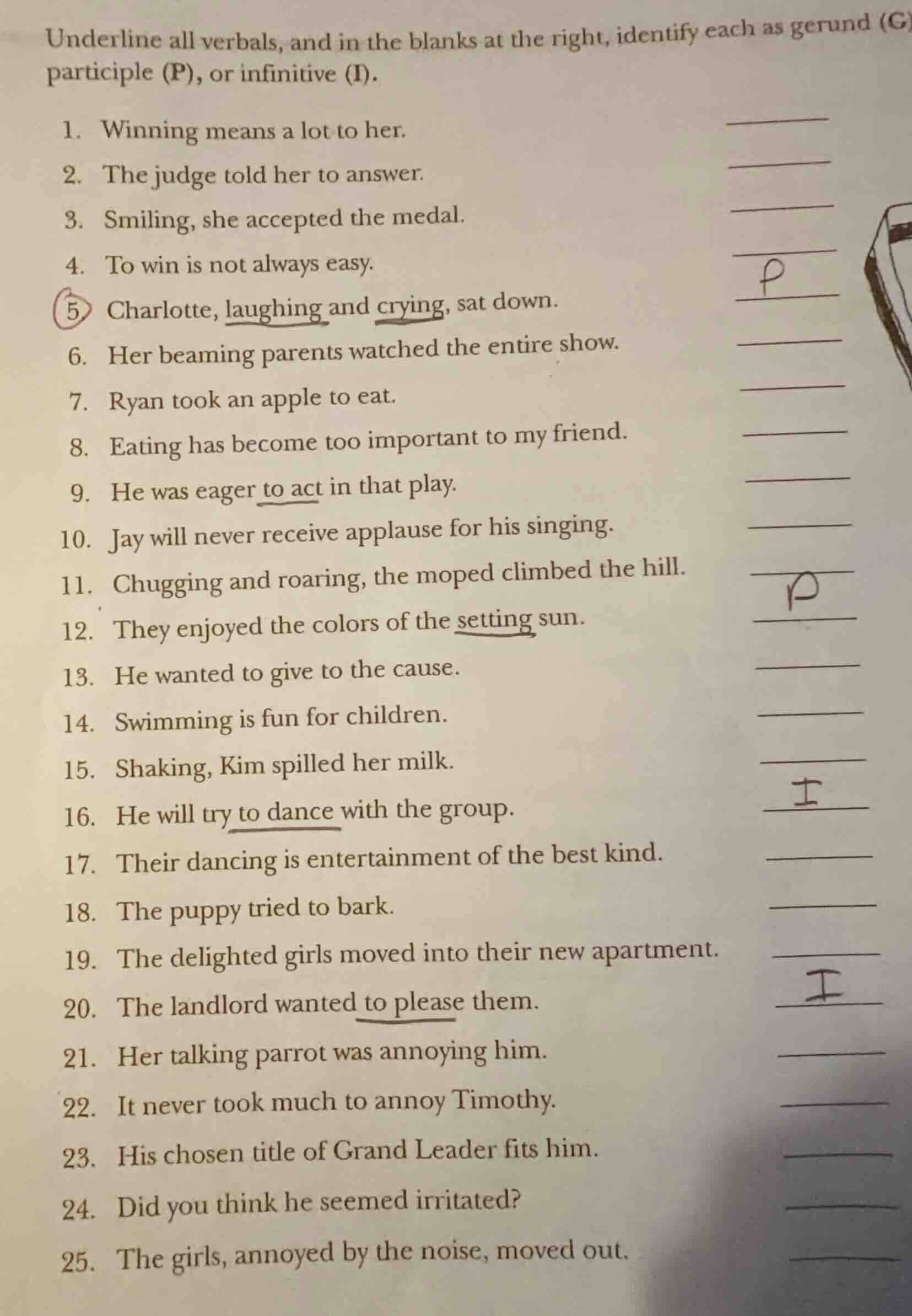
underline all verbals, and in the blanks at the right, identify each as gerund (g) participle (p), or infinitive (i).
- winning means a lot to her.
- the judge told her to answer.
- smiling, she accepted the medal.
- to win is not always easy.
- charlotte, laughing and crying, sat down.
- her beaming parents watched the entire show.
- ryan took an apple to eat.
- eating has become too important to my friend.
- he was eager to act in that play.
- jay will never receive applause for his singing.
- chugging and roaring, the moped climbed the hill.
- they enjoyed the colors of the setting sun.
- he wanted to give to the cause.
- swimming is fun for children.
- shaking, kim spilled her milk.
- he will try to dance with the group.
- their dancing is entertainment of the best kind.
- the puppy tried to bark.
- the delighted girls moved into their new apartment.
- the landlord wanted to please them.
- her talking parrot was annoying him.
- it never took much to annoy timothy.
- his chosen title of grand leader fits him.
- did you think he seemed irritated?
- the girls, annoyed by the noise, moved out.
Response
To solve this, we analyze each sentence to identify the verbal (gerund, participle, or infinitive) and classify it:
1. Winning means a lot to her.
- Verbal: Winning (functions as subject, ends in -ing, gerund).
- Classification: G
2. The judge told her to answer.
- Verbal: to answer (starts with “to,” infinitive).
- Classification: I
3. Smiling, she accepted the medal.
- Verbal: Smiling (describes “she,” ends in -ing, participle).
- Classification: P
4. To win is not always easy.
- Verbal: To win (starts with “to,” infinitive, functions as subject).
- Classification: I
5. Charlotte, laughing and crying, sat down.
- Verbals: laughing, crying (describe “Charlotte,” end in -ing, participles).
- Classification: P (for both)
6. Her beaming parents watched the entire show.
- Verbal: beaming (describes “parents,” ends in -ing, participle).
- Classification: P
7. Ryan took an apple to eat.
- Verbal: to eat (starts with “to,” infinitive, modifies “apple”).
- Classification: I
8. Eating has become too important to my friend.
- Verbal: Eating (functions as subject, ends in -ing, gerund).
- Classification: G
9. He was eager to act in that play.
- Verbal: to act (starts with “to,” infinitive, follows “eager”).
- Classification: I
10. Jay will never receive applause for his singing.
- Verbal: singing (functions as object of preposition, ends in -ing, gerund).
- Classification: G
11. Chugging and roaring, the moped climbed the hill.
- Verbals: Chugging, roaring (describe “moped,” end in -ing, participles).
- Classification: P (for both)
12. They enjoyed the colors of the setting sun.
- Verbal: setting (describes “sun,” ends in -ing, participle).
- Classification: P
13. He wanted to give to the cause.
- Verbal: to give (starts with “to,” infinitive, follows “wanted”).
- Classification: I
14. Swimming is fun for children.
- Verbal: Swimming (functions as subject, ends in -ing, gerund).
- Classification: G
15. Shaking, Kim spilled her milk.
- Verbal: Shaking (describes “Kim,” ends in -ing, participle).
- Classification: P
16. He will try to dance with the group.
- Verbal: to dance (starts with “to,” infinitive, follows “try”).
- Classification: I
17. Their dancing is entertainment of the best kind.
- Verbal: dancing (functions as subject, ends in -ing, gerund).
- Classification: G
18. The puppy tried to bark.
- Verbal: to bark (starts with “to,” infinitive, follows “tried”).
- Classification: I
19. The delighted girls moved into their new apartment.
- Verbal: delighted (describes “girls,” past participle).
- Classification: P
20. The landlord wanted to please them.
- Verbal: to please (starts with “to,” infinitive, follows “wanted”).
- Classification: I
21. Her talking parrot was annoying him.
- Verbal: talking (describes “parrot,” ends in -ing, participle).
- Classification: P
22. It never took much to annoy Timothy.
- Verbal: to annoy (starts with “to,” infinitive, functions as subject).
- Classification: I
23. His chosen title of Grand Leader fits him.
- Verbal: chosen (describes “title,” past participle).
- Classification: P
24. Did you think he seemed irritated?
- Verbal: irritated (describes “he,” past participle).
- Classification: P
25. The girls, annoyed by the noise, moved out.
- Verbal: annoyed (describes “girls,” past participle).
- Classification: P
Final Answers (filled in blanks):
- G
- I
- P
- I
5.…

Snap & solve any problem in the app
Get step-by-step solutions on Sovi AI
Photo-based solutions with guided steps
Explore more problems and detailed explanations
To solve this, we analyze each sentence to identify the verbal (gerund, participle, or infinitive) and classify it:
1. Winning means a lot to her.
- Verbal: Winning (functions as subject, ends in -ing, gerund).
- Classification: G
2. The judge told her to answer.
- Verbal: to answer (starts with “to,” infinitive).
- Classification: I
3. Smiling, she accepted the medal.
- Verbal: Smiling (describes “she,” ends in -ing, participle).
- Classification: P
4. To win is not always easy.
- Verbal: To win (starts with “to,” infinitive, functions as subject).
- Classification: I
5. Charlotte, laughing and crying, sat down.
- Verbals: laughing, crying (describe “Charlotte,” end in -ing, participles).
- Classification: P (for both)
6. Her beaming parents watched the entire show.
- Verbal: beaming (describes “parents,” ends in -ing, participle).
- Classification: P
7. Ryan took an apple to eat.
- Verbal: to eat (starts with “to,” infinitive, modifies “apple”).
- Classification: I
8. Eating has become too important to my friend.
- Verbal: Eating (functions as subject, ends in -ing, gerund).
- Classification: G
9. He was eager to act in that play.
- Verbal: to act (starts with “to,” infinitive, follows “eager”).
- Classification: I
10. Jay will never receive applause for his singing.
- Verbal: singing (functions as object of preposition, ends in -ing, gerund).
- Classification: G
11. Chugging and roaring, the moped climbed the hill.
- Verbals: Chugging, roaring (describe “moped,” end in -ing, participles).
- Classification: P (for both)
12. They enjoyed the colors of the setting sun.
- Verbal: setting (describes “sun,” ends in -ing, participle).
- Classification: P
13. He wanted to give to the cause.
- Verbal: to give (starts with “to,” infinitive, follows “wanted”).
- Classification: I
14. Swimming is fun for children.
- Verbal: Swimming (functions as subject, ends in -ing, gerund).
- Classification: G
15. Shaking, Kim spilled her milk.
- Verbal: Shaking (describes “Kim,” ends in -ing, participle).
- Classification: P
16. He will try to dance with the group.
- Verbal: to dance (starts with “to,” infinitive, follows “try”).
- Classification: I
17. Their dancing is entertainment of the best kind.
- Verbal: dancing (functions as subject, ends in -ing, gerund).
- Classification: G
18. The puppy tried to bark.
- Verbal: to bark (starts with “to,” infinitive, follows “tried”).
- Classification: I
19. The delighted girls moved into their new apartment.
- Verbal: delighted (describes “girls,” past participle).
- Classification: P
20. The landlord wanted to please them.
- Verbal: to please (starts with “to,” infinitive, follows “wanted”).
- Classification: I
21. Her talking parrot was annoying him.
- Verbal: talking (describes “parrot,” ends in -ing, participle).
- Classification: P
22. It never took much to annoy Timothy.
- Verbal: to annoy (starts with “to,” infinitive, functions as subject).
- Classification: I
23. His chosen title of Grand Leader fits him.
- Verbal: chosen (describes “title,” past participle).
- Classification: P
24. Did you think he seemed irritated?
- Verbal: irritated (describes “he,” past participle).
- Classification: P
25. The girls, annoyed by the noise, moved out.
- Verbal: annoyed (describes “girls,” past participle).
- Classification: P
Final Answers (filled in blanks):
- G
- I
- P
- I
- P (for laughing), P (for crying)
- P
- I
- G
- I
- G
- P (for Chugging), P (for roaring)
- P
- I
- G
- P
- I
- G
- I
- P
- I
- P
- I
- P
- P
- P