QUESTION IMAGE
Question
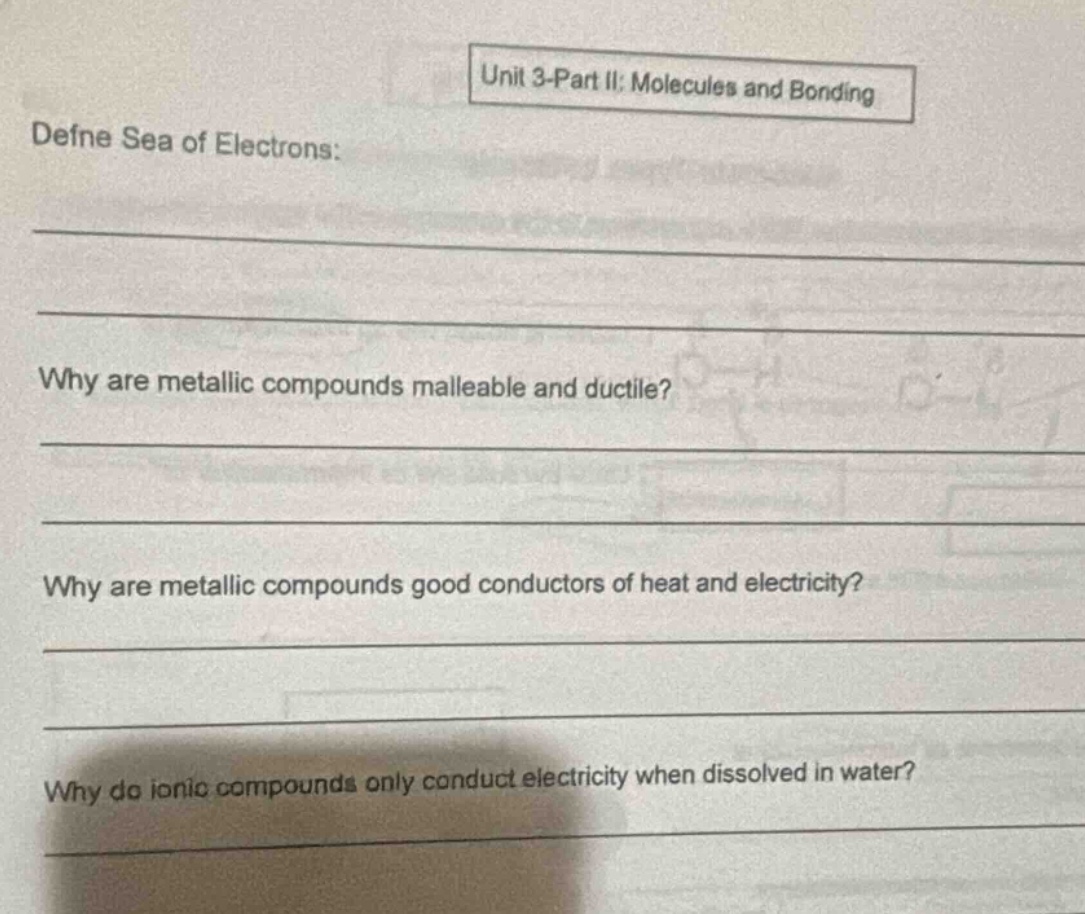
unit 3-part ii: molecules and bonding
define sea of electrons:
why are metallic compounds malleable and ductile?
why are metallic compounds good conductors of heat and electricity?
why do ionic compounds only conduct electricity when dissolved in water?
Brief Explanations
- Sea of Electrons: This is a model describing metallic bonding, where valence electrons of metal atoms are delocalized, moving freely between positively charged metal cations.
- Metallic malleability/ductility: The delocalized electron sea allows metal cation layers to slide past one another without breaking the overall bonding, as the electrons redistribute to maintain attraction.
- Metallic conductivity: Delocalized, freely moving electrons can carry electric charge (for electricity) and kinetic energy (for heat) throughout the metal structure.
- Ionic compound conductivity: Solid ionic compounds have fixed, locked ions that cannot carry charge. Dissolving in water breaks the lattice, freeing ions to move and conduct electric current.

Snap & solve any problem in the app
Get step-by-step solutions on Sovi AI
Photo-based solutions with guided steps
Explore more problems and detailed explanations
- Sea of Electrons: A model for metallic bonding where valence electrons of metal atoms are delocalized, forming a "sea" of freely moving electrons surrounding positively charged metal cations.
- Metallic compounds are malleable and ductile because their delocalized electron sea allows layers of positive metal ions to slide past each other without breaking the overall metallic bonding.
- Metallic compounds are good conductors of heat and electricity because their delocalized, freely moving electrons can carry electrical charge and thermal energy throughout the material.
- Ionic compounds only conduct electricity when dissolved in water because in their solid state, ions are locked in a rigid lattice and cannot move to carry charge; dissolving breaks the lattice, releasing mobile ions that can conduct electric current.