QUESTION IMAGE
Question
unit 4 - applications of derivatives (4.1-4.3) assignment
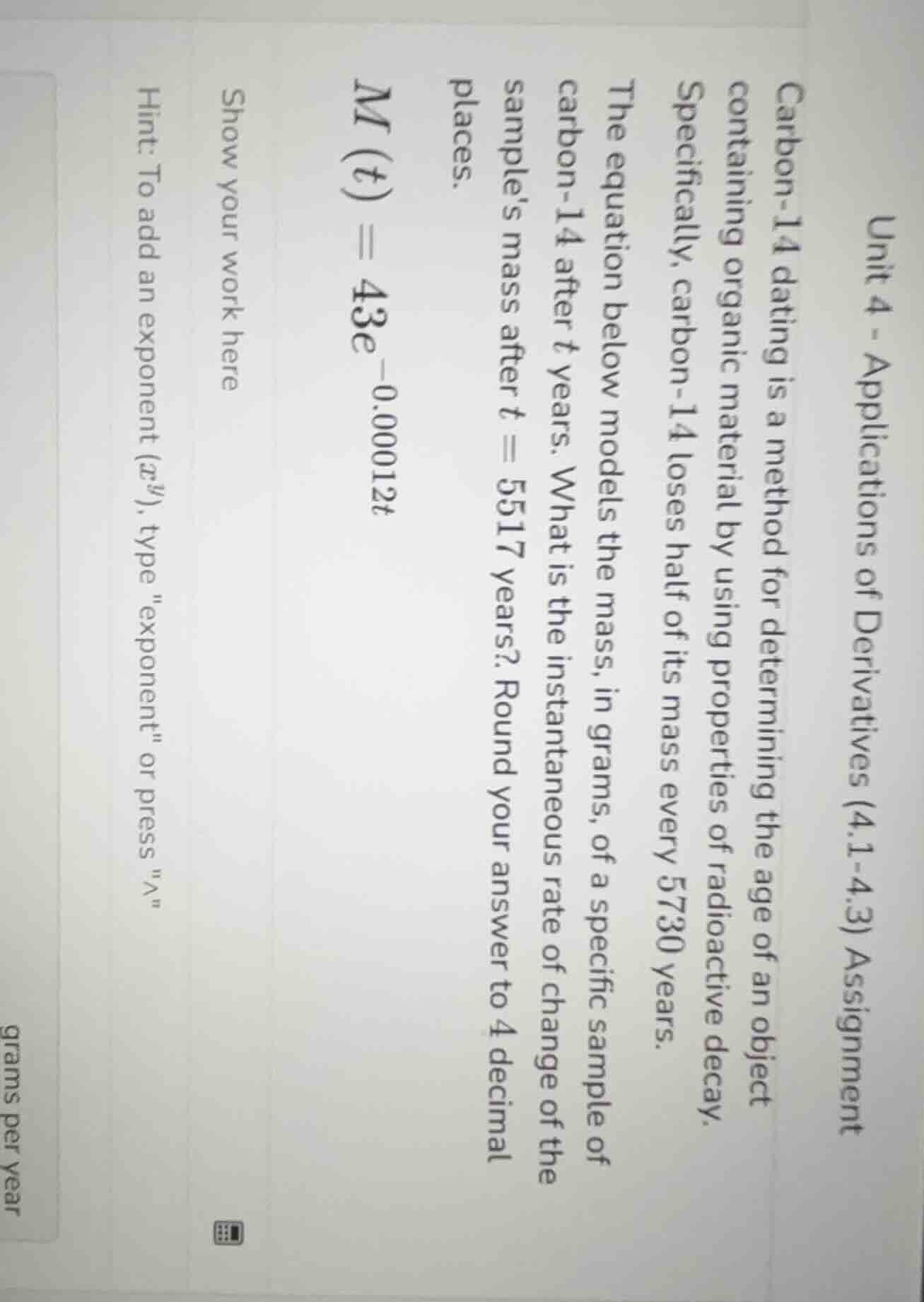
carbon-14 dating is a method for determining the age of an object containing organic material by using properties of radioactive decay. specifically, carbon-14 loses half of its mass every 5730 years.
the equation below models the mass, in grams, of a specific sample of carbon-14 after t years. what is the instantaneous rate of change of the sample’s mass after t = 5517 years? round your answer to 4 decimal places.
m(t) = 43e^{-0.00012t}
show your work here
hint: to add an exponent (x^y), type \exponent\ or press \^\.
Step1: Find derivative of $M(t)$
The function is an exponential decay function. Using the chain rule for derivatives: if $M(t)=Ae^{kt}$, then $M'(t)=Ake^{kt}$.
For $M(t)=43e^{-0.00012t}$, $A=43$, $k=-0.00012$.
$M'(t)=43\times(-0.00012)e^{-0.00012t}=-0.00516e^{-0.00012t}$
Step2: Substitute $t=5517$ into $M'(t)$
First calculate the exponent: $-0.00012\times5517=-0.66204$
Then compute $e^{-0.66204}\approx0.5150$
Now substitute back: $M'(5517)=-0.00516\times0.5150$
Step3: Calculate final value
$M'(5517)\approx-0.00516\times0.5150=-0.0026574$
Round to 4 decimal places: $-0.0027$

Snap & solve any problem in the app
Get step-by-step solutions on Sovi AI
Photo-based solutions with guided steps
Explore more problems and detailed explanations
$-0.0027$ grams per year