QUESTION IMAGE
Question
unit 6: review a
- what thickness limit classifies metal as being sheet?
- what is the standard thickness of 14 gauge steel sheet?
- what is the standard gauge used to specify nonferrous sheet metal thickness?
- what specifications are necessary for ordering a standard size of sheet iron?
- what other item of stock can be measured with a sheet metal gauge tool?
- in what units is plate thickness specified?
- which is more accurate in size, hot - rolled or cold - rolled stock?
- how can hot - rolled stock be distinguished from cold - rolled stock?
- what is a piece of ½\×1\×6\ long stock commonly called?
- how is the size of round steel or cast iron determined?
- how is the size of hexagon steel determined?
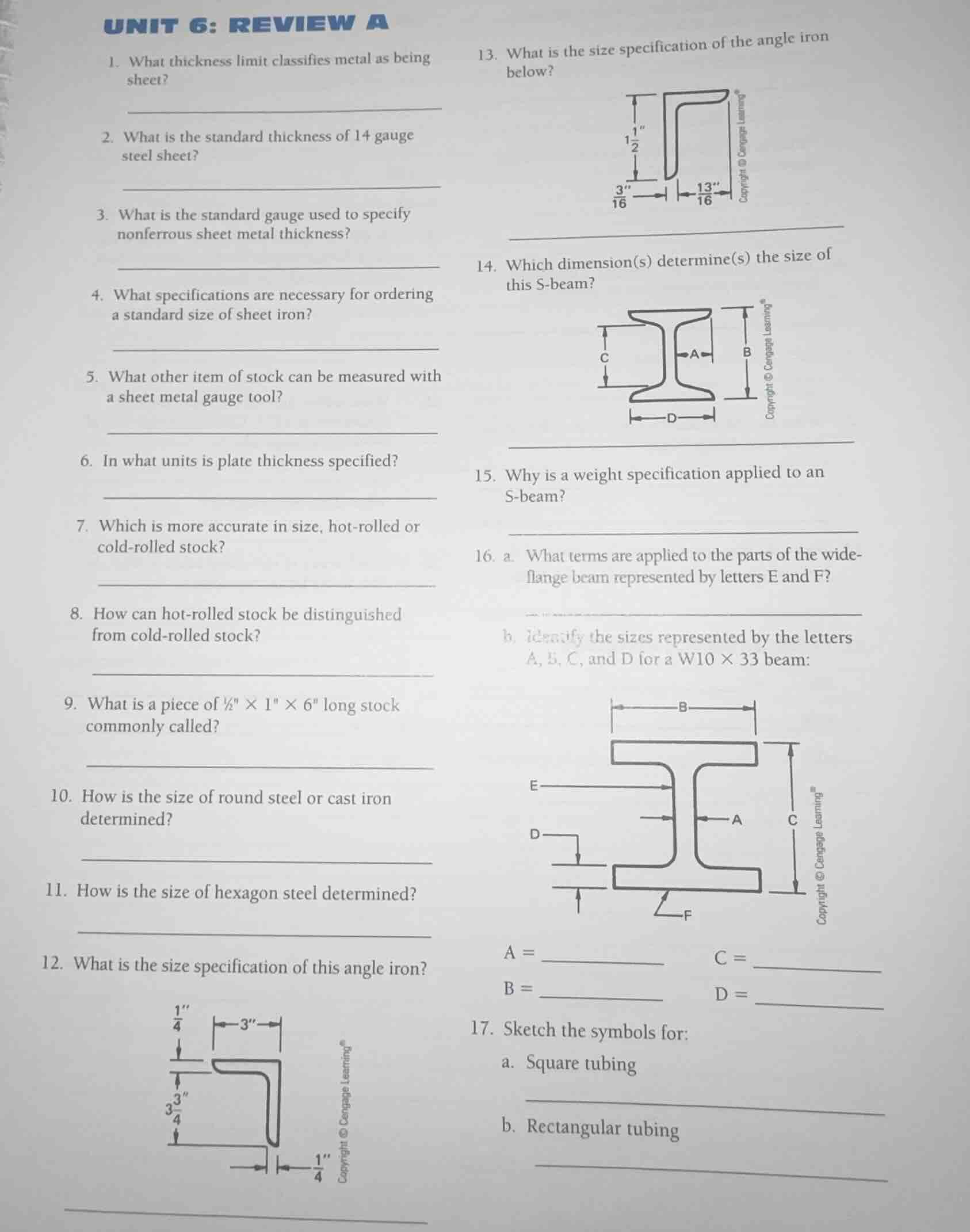
- what is the size specification of this angle iron? (with an image of angle iron with dimensions ¼\, 3\, 3¾\, ¼\)
- what is the size specification of the angle iron below? (with an image of angle iron with dimensions 1½\, 3/16\, 13/16\)
- which dimension(s) determine(s) the size of this s - beam? (with an image of s - beam with labels a, b, c, d)
- why is a weight specification applied to an s - beam?
- a. what terms are applied to the parts of the wide - flange beam represented by letters e and f?
b. identify the sizes represented by the letters a, b, c, and d for a w10×33 beam: (with an image of wide - flange beam with labels a, b, c, d, e, f)
- sketch the symbols for:
a. square tubing
b. rectangular tubing
The problem set provided is related to metalworking, specifically about the specifications, measurements, and identification of different types of metal stock (like sheet metal, angle iron, S - beams, etc.). This falls under the Engineering subfield of Natural Science. Since the questions are more about recalling engineering - related knowledge (such as standard thicknesses, gauge systems, and part identification in structural steel) rather than calculations, we'll use the Answer - Explanation Format.
Question 1
In metalworking, a metal is classified as sheet when its thickness is 0.25 inches (or 6.35 millimeters) or less. This is a standard industry - recognized limit for distinguishing sheet metal from plate metal (which is thicker).
The standard thickness for 14 - gauge steel sheet is a well - known value in the metalworking industry. Through standard gauge - to - thickness conversion tables (which are based on industry standards), 14 - gauge steel sheet has a thickness of $\frac{5}{64}$ inches (or approximately 0.078125 inches, or 1.984375 millimeters).
For nonferrous sheet metal thickness, the standard gauge used is the Brown and Sharpe (B&S) gauge. This gauge system is specifically designed and widely accepted for measuring the thickness of nonferrous metals (like copper, aluminum, etc.) in sheet form.

Snap & solve any problem in the app
Get step-by-step solutions on Sovi AI
Photo-based solutions with guided steps
Explore more problems and detailed explanations
A thickness limit of 0.25 inches (or 6.35 mm) classifies metal as being sheet.