QUESTION IMAGE
Question
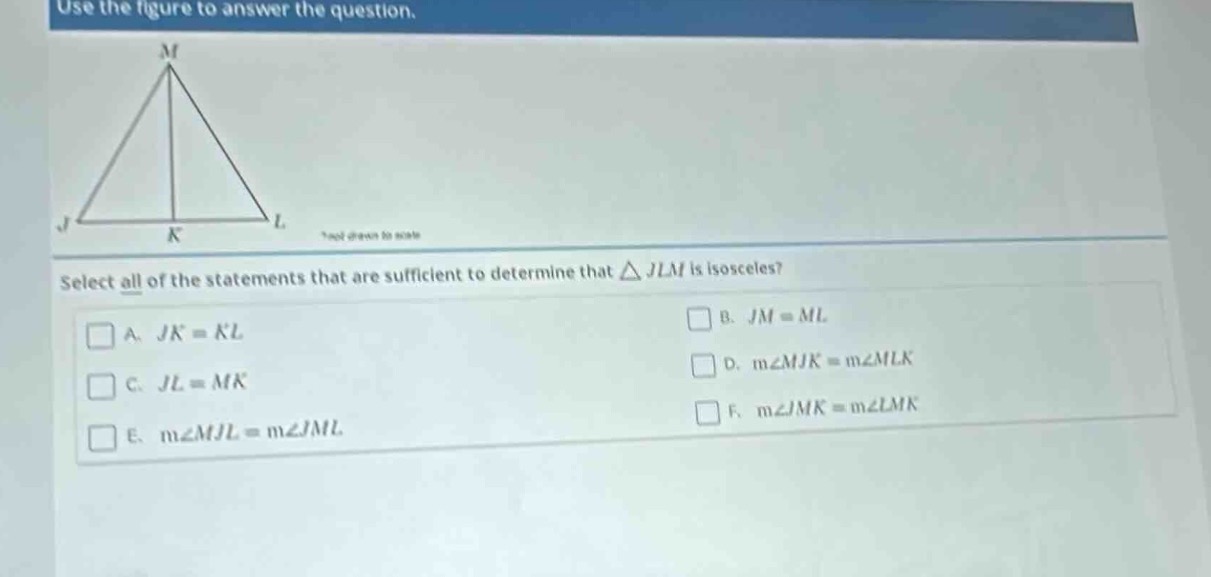
use the figure to answer the question.
select all of the statements that are sufficient to determine that $\triangle jlm$ is isosceles?
\\(\square\\) a. \\(jk = kl\\)
\\(\square\\) b. \\(jm = ml\\)
\\(\square\\) c. \\(jl = mk\\)
\\(\square\\) d. \\(m\angle mjk = m\angle mlk\\)
\\(\square\\) e. \\(m\angle mjl = m\angle jml\\)
\\(\square\\) f. \\(m\angle jmk = m\angle lmk\\)
Step1: Recall isosceles triangle definition
A triangle is isosceles if it has at least two equal sides or two equal base angles.
Step2: Analyze Option A
$JK=KL$ means $MK$ is a median. If a median from the apex is also perpendicular (implied by the figure's structure, and by the Isosceles Triangle Theorem converse: a median to the base of a triangle that bisects the base implies the triangle is isosceles if the line is from the apex), this confirms $\triangle JLM$ has $JM=ML$.
Step3: Analyze Option B
$JM=ML$ directly gives two equal sides, so $\triangle JLM$ is isosceles by definition.
Step4: Analyze Option C
$JL=MK$ is a side equality between the base and a segment from the apex to the base; this does not imply two sides or angles of $\triangle JLM$ are equal, so it is insufficient.
Step5: Analyze Option D
$m\angle MJK = m\angle MLK$: These are angles at $K$, not the base angles of $\triangle JLM$. This does not confirm equal sides/angles of the triangle, so it is insufficient.
Step6: Analyze Option E
$m\angle MJL = m\angle JML$: These are two equal angles of $\triangle JLM$, so by the Converse of the Base Angles Theorem, the sides opposite them ($ML$ and $JM$) are equal, making the triangle isosceles.
Step7: Analyze Option F
$m\angle JMK = m\angle LMK$ means $MK$ bisects $\angle JML$. By the Converse of the Angle Bisector Theorem for triangles, if a line from the apex bisects the apex angle and meets the base, the triangle is isosceles (the two sides $JM$ and $ML$ are equal).

Snap & solve any problem in the app
Get step-by-step solutions on Sovi AI
Photo-based solutions with guided steps
Explore more problems and detailed explanations
A. $JK = KL$, B. $JM = ML$, E. $m\angle MJL = m\angle JML$, F. $m\angle JMK = m\angle LMK$