QUESTION IMAGE
Question
use the information and diagram to answer the following question.
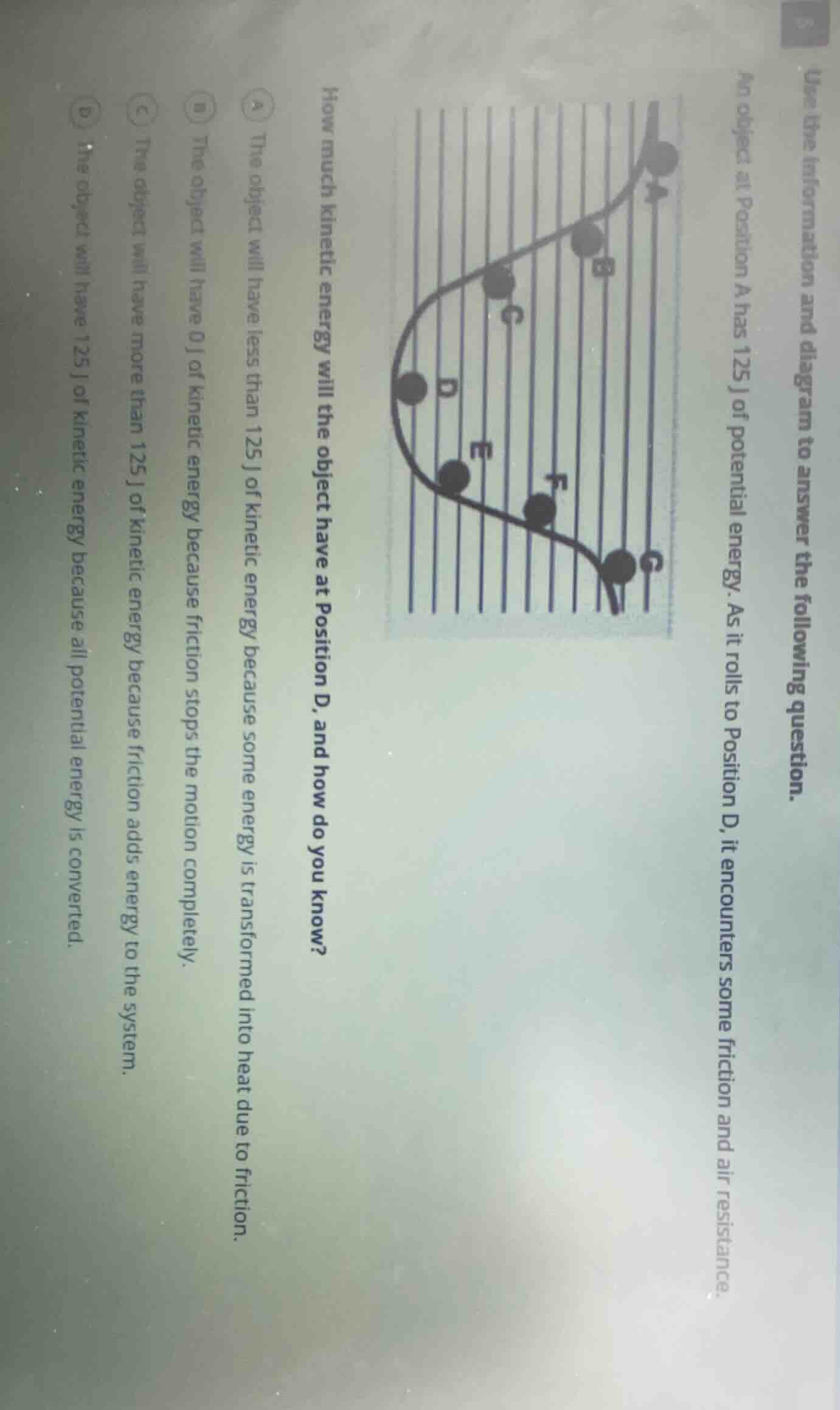
an object at position a has 125 j of potential energy. as it rolls to position d, it encounters some friction and air resistance.
how much kinetic energy will the object have at position d, and how do you know?
a the object will have less than 125 j of kinetic energy because some energy is transformed into heat due to friction.
b the object will have 0 j of kinetic energy because friction stops the motion completely.
c the object will have more than 125 j of kinetic energy because friction adds energy to the system.
d the object will have 125 j of kinetic energy because all potential energy is converted.
- At Position A, the object has 125 J of potential energy. As it moves to Position D, friction and air resistance act on it.
- According to the law of conservation of energy, the total mechanical energy (potential + kinetic) should be conserved in the absence of non - conservative forces (like friction and air resistance). But here, friction and air resistance are present, which are non - conservative forces. These forces convert some of the mechanical energy (potential energy that is being converted to kinetic energy) into heat energy.
- So, the kinetic energy at Position D will be less than the potential energy at Position A (125 J) because some of the energy is lost as heat due to friction and air resistance.
- Option B is wrong because friction does not stop the motion completely (the object is still moving at D, as seen from the diagram). Option C is wrong because friction is a non - conservative force that dissipates energy, not adds to the system's kinetic energy. Option D is wrong because the presence of non - conservative forces (friction and air resistance) means that not all potential energy is converted to kinetic energy; some is lost as heat.

Snap & solve any problem in the app
Get step-by-step solutions on Sovi AI
Photo-based solutions with guided steps
Explore more problems and detailed explanations
A. The object will have less than 125 J of kinetic energy because some energy is transformed into heat due to friction.