QUESTION IMAGE
Question
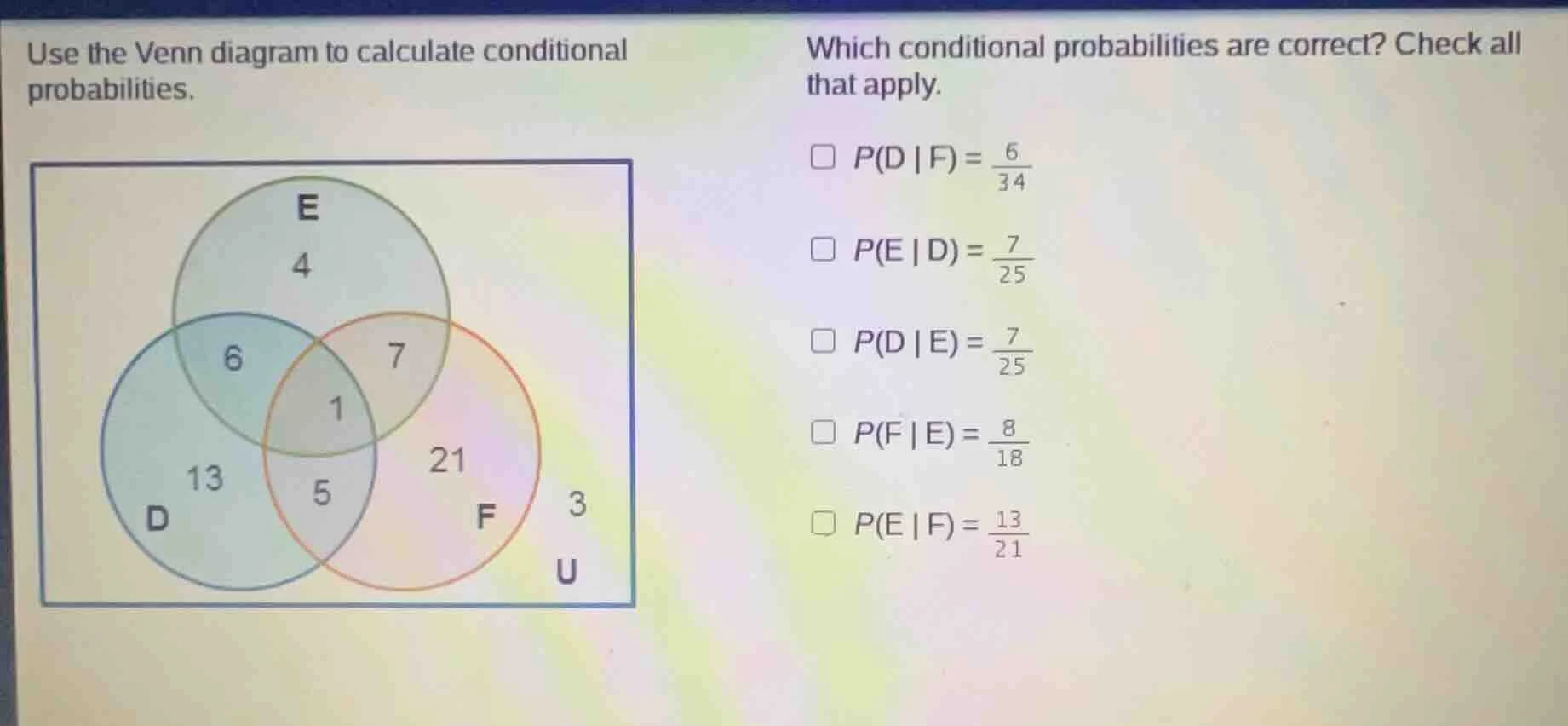
use the venn diagram to calculate conditional probabilities. which conditional probabilities are correct? check all that apply. \\( p(d | f)= \frac{6}{34} \\) \\( p(e | d)= \frac{7}{25} \\) \\( p(d | e)= \frac{7}{25} \\) \\( p(f | e)= \frac{8}{18} \\) \\( p(e | f)= \frac{13}{21} \\)
To solve this, we use the formula for conditional probability \( P(A|B) = \frac{P(A \cap B)}{P(B)} \), which translates to \( \frac{\text{Number of elements in } A \cap B}{\text{Number of elements in } B} \) when dealing with counts in a Venn diagram. First, we calculate the total number of elements in each set (D, E, F) by summing their regions:
- For set D: \( 13 + 6 + 1 + 5 = 25 \)
- For set E: \( 4 + 6 + 1 + 7 = 18 \)
- For set F: \( 21 + 7 + 1 + 5 = 34 \)
- \( D \cap F \): \( 5 + 1 = 6 \)
- \( E \cap D \): \( 6 + 1 = 7 \)
- \( D \cap E \): \( 6 + 1 = 7 \) (same as \( E \cap D \))
- \( F \cap E \): \( 7 + 1 = 8 \)
- \( E \cap F \): \( 7 + 1 = 8 \) (same as \( F \cap E \))
- \( E \cap F \) for \( P(E|F) \): \( 7 + 1 = 8 \), and set F has 34 elements? Wait, no, earlier we calculated set F as 34? Wait, no, let's recalculate set F: 21 (only F) + 7 (E and F only) + 1 (all three) + 5 (D and F only) = 21 + 7 + 1 + 5 = 34. Correct. Set E: 4 (only E) + 6 (D and E only) + 1 (all three) + 7 (E and F only) = 4 + 6 + 1 + 7 = 18. Correct. Set D: 13 (only D) + 6 (D and E only) + 1 (all three) + 5 (D and F only) = 13 + 6 + 1 + 5 = 25. Correct.
Now let's check each option:
Option 1: \( P(D|F) = \frac{6}{34} \)
- \( D \cap F \) has 5 + 1 = 6 elements.
- Set F has 34 elements.
- So \( P(D|F) = \frac{6}{34} \). Correct.
Option 2: \( P(E|D) = \frac{7}{25} \)
- \( E \cap D \) has 6 + 1 = 7 elements.
- Set D has 25 elements.
- So \( P(E|D) = \frac{7}{25} \). Correct.
Option 3: \( P(D|E) = \frac{7}{25} \)
- \( D \cap E \) has 6 + 1 = 7 elements.
- Set E has 18 elements, not 25. So \( P(D|E) = \frac{7}{18} \), not \( \frac{7}{25} \). Incorrect.
Option 4: \( P(F|E) = \frac{8}{18} \)
- \( F \cap E \) has 7 + 1 = 8 elements.
- Set E has 18 elements.
- So \( P(F|E) = \frac{8}{18} \). Correct.
Option 5: \( P(E|F) = \frac{13}{21} \)
- \( E \cap F \) has 7 + 1 = 8 elements.
- Set F has 34 elements. So \( P(E|F) = \frac{8}{34} \), not \( \frac{13}{21} \). Incorrect. Wait, wait, maybe I made a mistake. Wait, set F: 21 (only F) + 7 (E and F) + 1 (all three) + 5 (D and F) = 34. So \( E \cap F \) is 7 + 1 = 8. So \( P(E|F) = \frac{8}{34} \), not \( \frac{13}{21} \). So this is incorrect.
Wait, let's re-express each:
- \( P(D|F) \): \( D \cap F \) is 5 (D and F only) + 1 (all three) = 6. Set F is 21 + 7 + 1 + 5 = 34. So \( 6/34 \). Correct.
- \( P(E|D) \): \( E \cap D \) is 6 (D and E only) + 1 (all three) = 7. Set D is 13 + 6 + 1 + 5 = 25. So \( 7/25 \). Correct.
- \( P(D|E) \): \( D \cap E \) is 6 + 1 = 7. Set E is 4 + 6 + 1 + 7 = 18. So \( 7/18
eq 7/25 \). Incorrect.
- \( P(F|E) \): \( F \cap E \) is 7 (E and F only) + 1 (all three) = 8. Set E is 18. So \( 8/18 \). Correct.
- \( P(E|F) \): \( E \cap F \) is 7 + 1 = 8. Set F is 34. So \( 8/34
eq 13/21 \). Incorrect.
So the correct options are the first, second, and fourth? Wait, wait, let's check again:
Wait, the fourth option: \( P(F|E) = \frac{8}{18} \). Set E has 18 elements (4 + 6 + 1 + 7). \( F \cap E \) is 7 (E and F only) + 1 (all three) = 8. So \( 8/18 \). Correct.
First option: \( P(D|F) = 6/34 \). \( D \cap F \) is 5 (D and F only) + 1 (all three) = 6. Set F is 34. Correct.
Second option: \( P(E|D) = 7/25 \). \( E \cap D \) is 6 (D and E only) + 1 (all three) = 7. Set D is 25. Correct.
Wait, but the original options:
- \( P(D|F) = 6/34 \): correct.
- \( P(E|D) = 7/25 \): correct.
- \( P(D|E) = 7/25 \): incorrect (should be 7/18).
- \( P(F|E) = 8/18 \): correct.
- \( P(E|F) = 13/21 \): incorrect (should be 8/34).
So the correct ones are the first, second, and fou…

Snap & solve any problem in the app
Get step-by-step solutions on Sovi AI
Photo-based solutions with guided steps
Explore more problems and detailed explanations
The correct conditional probabilities are:
- \( \boldsymbol{P(D | F) = \frac{6}{34}} \) (first option)
- \( \boldsymbol{P(E | D) = \frac{7}{25}} \) (second option)
- \( \boldsymbol{P(F | E) = \frac{8}{18}} \) (fourth option)
(Note: If the options are labeled as checkboxes with the first being \( P(D|F)=\frac{6}{34} \), second \( P(E|D)=\frac{7}{25} \), fourth \( P(F|E)=\frac{8}{18} \), then those are the correct ones.)