QUESTION IMAGE
Question
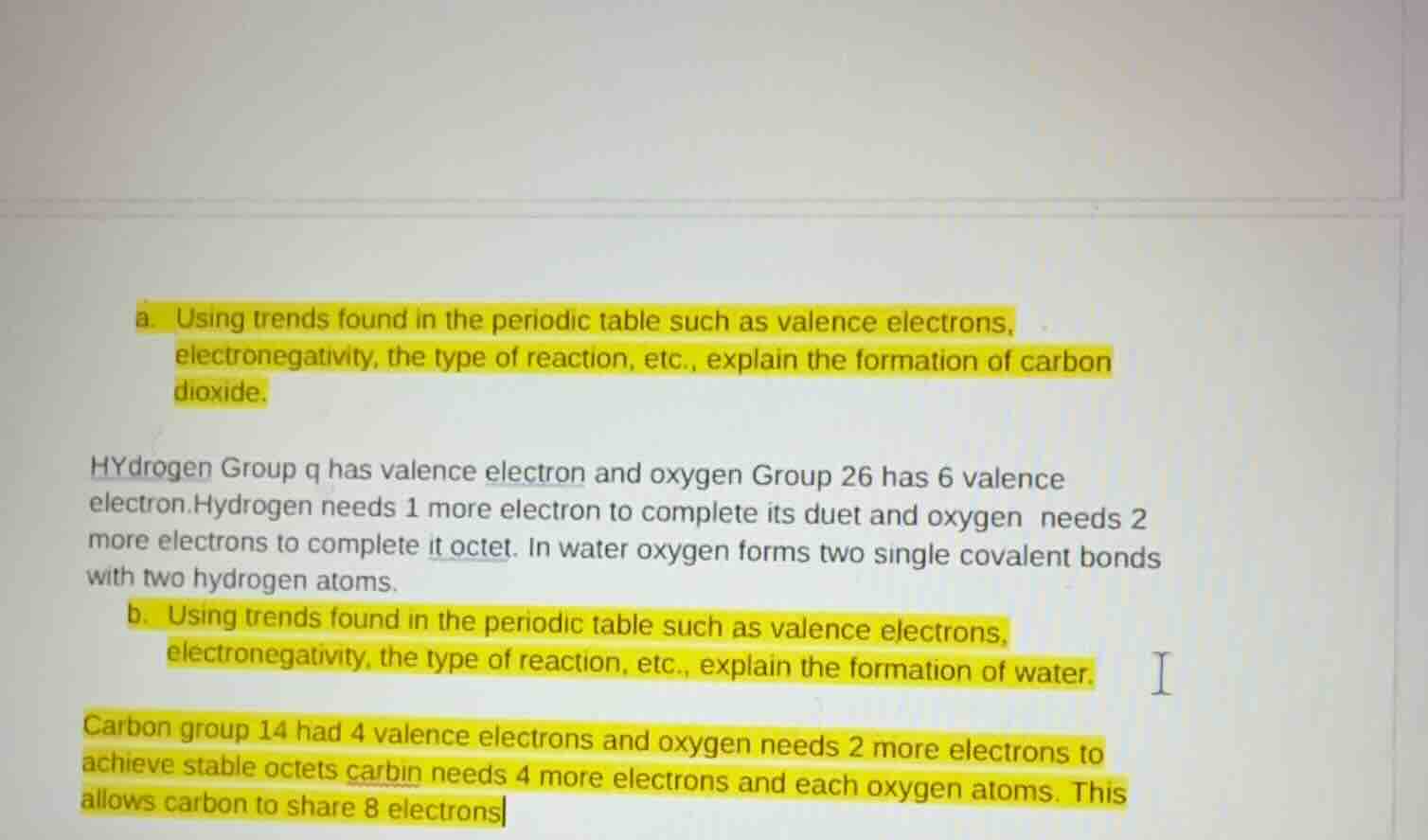
a. using trends found in the periodic table such as valence electrons, electronegativity, the type of reaction, etc., explain the formation of carbon dioxide.
hydrogen group q has valence electron and oxygen group 26 has 6 valence electron.hydrogen needs 1 more electron to complete its duet and oxygen needs 2 more electrons to complete it octet. in water oxygen forms two single covalent bonds with two hydrogen atoms.
b. using trends found in the periodic table such as valence electrons, electronegativity, the type of reaction, etc., explain the formation of water.
carbon group 14 had 4 valence electrons and oxygen needs 2 more electrons to achieve stable octets carbin needs 4 more electrons and each oxygen atoms. this allows carbon to share 8 electrons
For part a (CO₂ formation):
- Valence Electrons: Carbon is in Group 14, so it has 4 valence electrons. Oxygen is in Group 16, with 6 valence electrons. Carbon needs 4 more electrons to fill its octet; each oxygen needs 2 more electrons to fill its octet.
- Bonding: Carbon shares two pairs of electrons with each oxygen atom, forming two double covalent bonds ($\text{O=C=O}$). This allows all atoms to reach a stable electron configuration.
- Electronegativity & Reaction Type: Oxygen is more electronegative than carbon, so the bonds are polar covalent, but the linear molecule is nonpolar overall. The formation is a combustion/redox reaction where carbon (e.g., from graphite or methane) reacts with oxygen gas, with electrons shared rather than transferred.
For part b (H₂O formation):
- Valence Electrons: Hydrogen is in Group 1, with 1 valence electron (needs 1 more to complete its duet of 2 electrons). Oxygen is in Group 16, with 6 valence electrons (needs 2 more to complete its octet).
- Bonding: Oxygen shares one pair of electrons with each of two hydrogen atoms, forming two single covalent bonds. This gives oxygen a full octet and each hydrogen a full duet, creating a bent polar molecule.
- Electronegativity & Reaction Type: Oxygen is much more electronegative than hydrogen, making the bonds polar covalent. The formation is a synthesis/redox reaction where hydrogen gas reacts with oxygen gas, with electrons shared unequally between the atoms.

Snap & solve any problem in the app
Get step-by-step solutions on Sovi AI
Photo-based solutions with guided steps
Explore more problems and detailed explanations
a. Formation of Carbon Dioxide:
Carbon (Group 14, 4 valence electrons) forms two double covalent bonds with two oxygen atoms (Group 16, 6 valence electrons each). Each oxygen shares 2 electrons with carbon, and carbon shares 2 electrons with each oxygen. This allows carbon to fill its octet (8 electrons total) and each oxygen to fill its octet (8 electrons total). The electronegativity difference between C and O creates polar covalent bonds, but the linear molecular geometry makes the overall molecule nonpolar. The reaction is typically a redox/combustion reaction where carbon reacts with oxygen gas to form CO₂.
b. Formation of Water:
Oxygen (Group 16, 6 valence electrons) forms two single covalent bonds with two hydrogen atoms (Group 1, 1 valence electron each). Each hydrogen shares its single electron with oxygen, and oxygen shares one electron with each hydrogen. This gives oxygen a full octet (8 electrons) and each hydrogen a full duet (2 electrons). Oxygen's higher electronegativity makes the bonds polar covalent, and the bent molecular geometry makes the water molecule polar overall. The reaction is a synthesis/redox reaction where hydrogen gas reacts with oxygen gas to form H₂O.