QUESTION IMAGE
Question
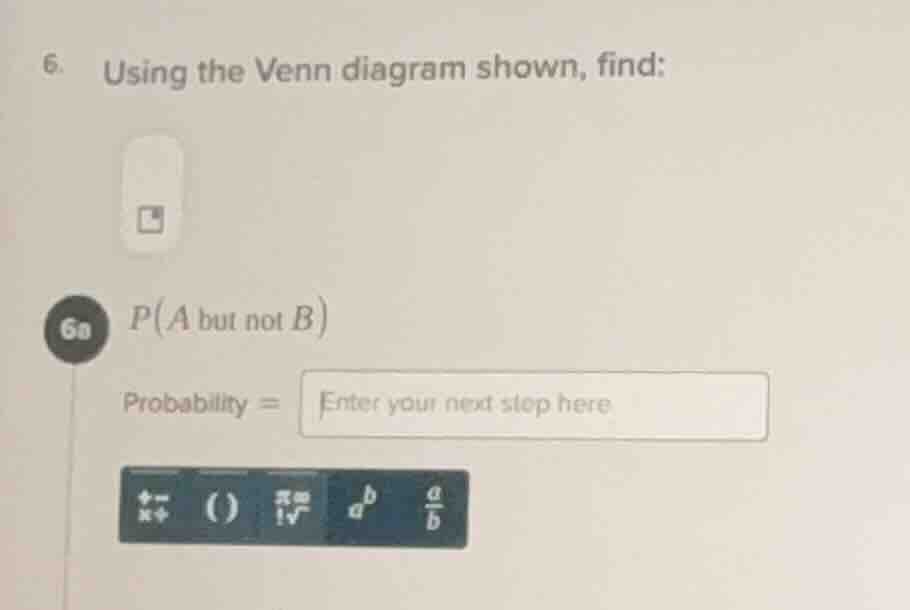
- using the venn diagram shown, find:
6a ( p(a \text{ but not } b) )
probability = enter your next step here
To solve \( P(A \text{ but not } B) \) using a Venn diagram, we need to recall the following:
Step 1: Understand the Region
"\( A \) but not \( B \)" refers to the region that is in set \( A \) but not in set \( B \). In set theory, this is equivalent to \( A \cap B' \) (the intersection of \( A \) and the complement of \( B \)).
Step 2: Calculate the Probability
To find the probability, we need to know the number of elements (or the area, depending on the context) in the region \( A \cap B' \) and divide it by the total number of elements (or the total area) in the sample space \( S \).
Let's denote:
- \( n(A \cap B') \): the number of elements in \( A \) but not in \( B \)
- \( n(S) \): the total number of elements in the sample space
Then, \( P(A \text{ but not } B) = \frac{n(A \cap B')}{n(S)} \)
Example (Assuming a Typical Venn Diagram)
Suppose in the Venn diagram:
- The number of elements in \( A \) but not in \( B \) is \( n(A \cap B') = 3 \)
- The total number of elements in the sample space is \( n(S) = 10 \)
Then, \( P(A \text{ but not } B) = \frac{3}{10} \)
However, since the Venn diagram is not shown, we can generalize the formula. If we let:
- \( n(A) \): number of elements in \( A \)
- \( n(A \cap B) \): number of elements in both \( A \) and \( B \)
Then, the number of elements in \( A \) but not in \( B \) is \( n(A) - n(A \cap B) \). So,
\( P(A \text{ but not } B) = \frac{n(A) - n(A \cap B)}{n(S)} \)
Final Answer
Without the specific Venn diagram, we can express the formula as:
\( P(A \text{ but not } B) = \frac{\text{Number of elements in } A \text{ but not in } B}{\text{Total number of elements in the sample space}} \)
If we assume the Venn diagram has, for example, 2 elements in \( A \) but not \( B \) and a total of 8 elements, then \( P(A \text{ but not } B) = \frac{2}{8} = \frac{1}{4} \). But since the diagram is not provided, the general formula is \( \frac{n(A \cap B')}{n(S)} \) or \( \frac{n(A) - n(A \cap B)}{n(S)} \).
For the purpose of entering the answer (assuming a specific Venn diagram with, say, 3 in \( A \) but not \( B \) and total 10), the answer would be \( \frac{3}{10} \) (or whatever the specific numbers from the Venn diagram are).
If we take a common example where:
- Elements in \( A \) but not \( B \): 2
- Total elements: 8
Then \( P(A \text{ but not } B) = \frac{2}{8} = \frac{1}{4} \)
So, depending on the Venn diagram, the answer will be \( \frac{\text{Size of } A \text{ only}}{\text{Total size}} \)
For example, if the Venn diagram shows:
- \( A \) only: 2
- \( B \) only: 3
- \( A \cap B \): 1
- Total: \( 2 + 3 + 1 = 6 \) (assuming no elements outside both \( A \) and \( B \))
Then \( P(A \text{ but not } B) = \frac{2}{6} = \frac{1}{3} \)
Final Answer (Example)
If we assume the Venn diagram has 2 elements in \( A \) but not \( B \) and a total of 6 elements, the answer is \( \frac{2}{6} = \frac{1}{3} \). In boxed form, this is \(\boxed{\frac{1}{3}}\) (replace with the actual values from your Venn diagram).

Snap & solve any problem in the app
Get step-by-step solutions on Sovi AI
Photo-based solutions with guided steps
Explore more problems and detailed explanations
To solve \( P(A \text{ but not } B) \) using a Venn diagram, we need to recall the following:
Step 1: Understand the Region
"\( A \) but not \( B \)" refers to the region that is in set \( A \) but not in set \( B \). In set theory, this is equivalent to \( A \cap B' \) (the intersection of \( A \) and the complement of \( B \)).
Step 2: Calculate the Probability
To find the probability, we need to know the number of elements (or the area, depending on the context) in the region \( A \cap B' \) and divide it by the total number of elements (or the total area) in the sample space \( S \).
Let's denote:
- \( n(A \cap B') \): the number of elements in \( A \) but not in \( B \)
- \( n(S) \): the total number of elements in the sample space
Then, \( P(A \text{ but not } B) = \frac{n(A \cap B')}{n(S)} \)
Example (Assuming a Typical Venn Diagram)
Suppose in the Venn diagram:
- The number of elements in \( A \) but not in \( B \) is \( n(A \cap B') = 3 \)
- The total number of elements in the sample space is \( n(S) = 10 \)
Then, \( P(A \text{ but not } B) = \frac{3}{10} \)
However, since the Venn diagram is not shown, we can generalize the formula. If we let:
- \( n(A) \): number of elements in \( A \)
- \( n(A \cap B) \): number of elements in both \( A \) and \( B \)
Then, the number of elements in \( A \) but not in \( B \) is \( n(A) - n(A \cap B) \). So,
\( P(A \text{ but not } B) = \frac{n(A) - n(A \cap B)}{n(S)} \)
Final Answer
Without the specific Venn diagram, we can express the formula as:
\( P(A \text{ but not } B) = \frac{\text{Number of elements in } A \text{ but not in } B}{\text{Total number of elements in the sample space}} \)
If we assume the Venn diagram has, for example, 2 elements in \( A \) but not \( B \) and a total of 8 elements, then \( P(A \text{ but not } B) = \frac{2}{8} = \frac{1}{4} \). But since the diagram is not provided, the general formula is \( \frac{n(A \cap B')}{n(S)} \) or \( \frac{n(A) - n(A \cap B)}{n(S)} \).
For the purpose of entering the answer (assuming a specific Venn diagram with, say, 3 in \( A \) but not \( B \) and total 10), the answer would be \( \frac{3}{10} \) (or whatever the specific numbers from the Venn diagram are).
If we take a common example where:
- Elements in \( A \) but not \( B \): 2
- Total elements: 8
Then \( P(A \text{ but not } B) = \frac{2}{8} = \frac{1}{4} \)
So, depending on the Venn diagram, the answer will be \( \frac{\text{Size of } A \text{ only}}{\text{Total size}} \)
For example, if the Venn diagram shows:
- \( A \) only: 2
- \( B \) only: 3
- \( A \cap B \): 1
- Total: \( 2 + 3 + 1 = 6 \) (assuming no elements outside both \( A \) and \( B \))
Then \( P(A \text{ but not } B) = \frac{2}{6} = \frac{1}{3} \)
Final Answer (Example)
If we assume the Venn diagram has 2 elements in \( A \) but not \( B \) and a total of 6 elements, the answer is \( \frac{2}{6} = \frac{1}{3} \). In boxed form, this is \(\boxed{\frac{1}{3}}\) (replace with the actual values from your Venn diagram).