QUESTION IMAGE
Question
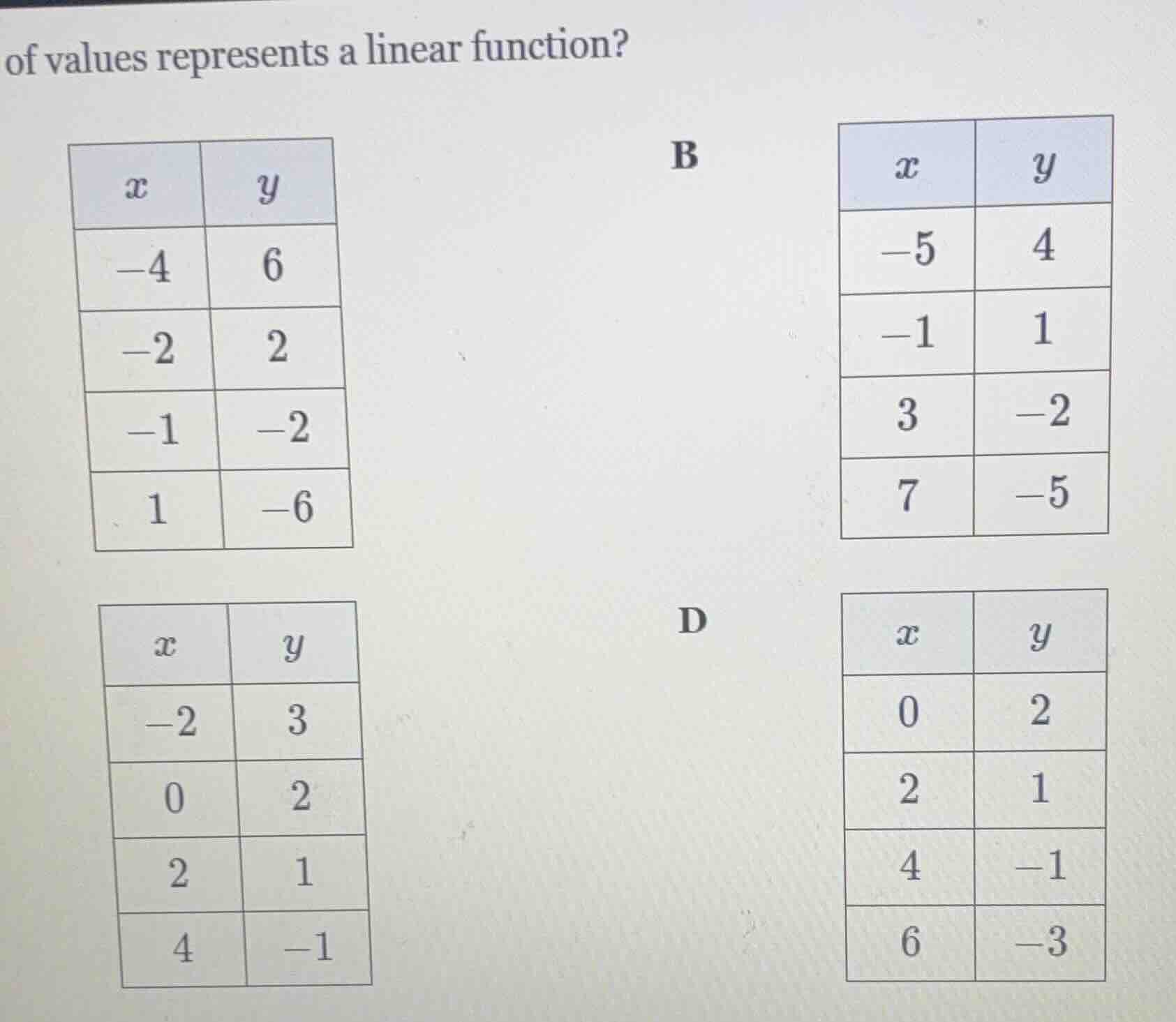
of values represents a linear function?
| x | y |
|---|---|
| -2 | 2 |
| -1 | -2 |
| 1 | -6 |
b
| x | y |
|---|---|
| -1 | 1 |
| 3 | -2 |
| 7 | -5 |
| x | y |
|---|---|
| 0 | 2 |
| 2 | 1 |
| 4 | -1 |
d
| x | y |
|---|---|
| 2 | 1 |
| 4 | -1 |
| 6 | -3 |
Step1: Recall linear function slope formula
For a linear function, the slope \( m=\frac{y_2 - y_1}{x_2 - x_1} \) should be constant between any two points \((x_1,y_1)\) and \((x_2,y_2)\).
Step2: Check Option (let's assume the first table is A, second B, third C, fourth D. Wait, the given tables: Let's label them as A (left top), B (right top), C (left bottom), D (right bottom). Wait, the user's image: first left table (A), right top (B), left bottom (C), right bottom (D). Let's check each:
Check Table A:
Points: \((-4,6)\), \((-2,2)\), \((-1,-2)\), \((1,-6)\)
Slope between \((-4,6)\) and \((-2,2)\): \( m_1=\frac{2 - 6}{-2 - (-4)}=\frac{-4}{2}=-2 \)
Slope between \((-2,2)\) and \((-1,-2)\): \( m_2=\frac{-2 - 2}{-1 - (-2)}=\frac{-4}{1}=-4 \)
\( m_1
eq m_2 \), so not linear.
Check Table B:
Points: \((-5,4)\), \((-1,1)\), \((3,-2)\), \((7,-5)\)
Slope between \((-5,4)\) and \((-1,1)\): \( m_1=\frac{1 - 4}{-1 - (-5)}=\frac{-3}{4}=-0.75 \)
Slope between \((-1,1)\) and \((3,-2)\): \( m_2=\frac{-2 - 1}{3 - (-1)}=\frac{-3}{4}=-0.75 \)
Slope between \((3,-2)\) and \((7,-5)\): \( m_3=\frac{-5 - (-2)}{7 - 3}=\frac{-3}{4}=-0.75 \)
Wait, but wait, let's check Table C and D. Wait, maybe I mislabeled. Wait the left bottom table (C) has points \((-2,3)\), \((0,2)\), \((2,1)\), \((4,-1)\)? No, left bottom: \((-2,3)\), \((0,2)\), \((2,1)\), \((4,-1)\)? Wait no, left bottom table: \( x=-2,y=3 \); \( x=0,y=2 \); \( x=2,y=1 \); \( x=4,y=-1 \). Let's check slope:
Check Table C:
Slope between \((-2,3)\) and \((0,2)\): \( m_1=\frac{2 - 3}{0 - (-2)}=\frac{-1}{2}=-0.5 \)
Slope between \((0,2)\) and \((2,1)\): \( m_2=\frac{1 - 2}{2 - 0}=\frac{-1}{2}=-0.5 \)
Slope between \((2,1)\) and \((4,-1)\): \( m_3=\frac{-1 - 1}{4 - 2}=\frac{-2}{2}=-1 \). Not constant.
Check Table D (right bottom):
Points: \((0,2)\), \((2,1)\), \((4,-1)\), \((6,-3)\)
Slope between \((0,2)\) and \((2,1)\): \( m_1=\frac{1 - 2}{2 - 0}=\frac{-1}{2}=-0.5 \)
Slope between \((2,1)\) and \((4,-1)\): \( m_2=\frac{-1 - 1}{4 - 2}=\frac{-2}{2}=-1 \). Not constant.
Wait, earlier Table B: Wait, let's recheck Table B points: \((-5,4)\), \((-1,1)\), \((3,-2)\), \((7,-5)\)
Slope between \((-5,4)\) and \((-1,1)\): \( \frac{1 - 4}{-1 - (-5)}=\frac{-3}{4}=-0.75 \)
Slope between \((-1,1)\) and \((3,-2)\): \( \frac{-2 - 1}{3 - (-1)}=\frac{-3}{4}=-0.75 \)
Slope between \((3,-2)\) and \((7,-5)\): \( \frac{-5 - (-2)}{7 - 3}=\frac{-3}{4}=-0.75 \). Wait, but maybe I made a mistake with Table C and D. Wait the left bottom table (C) is \((-2,3)\), \((0,2)\), \((2,1)\), \((4,-1)\)? No, looking at the image: left bottom table: \( x=-2,y=3 \); \( x=0,y=2 \); \( x=2,y=1 \); \( x=4,-1 \). Wait, the right bottom table (D) is \( x=0,y=2 \); \( x=2,y=1 \); \( x=4,-1 \); \( x=6,-3 \). Wait, maybe the correct one is Table B? Wait no, let's check Table C (left bottom) again. Wait, no, the user's problem: Let's check the table with \( x=-2,y=3 \); \( x=0,y=2 \); \( x=2,y=1 \); \( x=4,-1 \): no, slope changes. Wait the table with \( x=0,y=2 \); \( x=2,y=1 \); \( x=4,-1 \); \( x=6,-3 \): slope between (0,2) and (2,1) is -0.5, (2,1) and (4,-1) is -1, so no. Wait Table B: points (-5,4), (-1,1), (3,-2), (7,-5). The x - differences: from -5 to -1: +4; -1 to 3: +4; 3 to 7: +4. y - differences: 4 to 1: -3; 1 to -2: -3; -2 to -5: -3. So slope \( m=\frac{-3}{4} \) constant. Wait, but maybe the correct answer is Table B? Wait, no, let's check the other tables. Wait the first table (A): x from -4 to -2: +2, y from 6 to 2: -4 (slope -2); -2 to -1: +1, y from 2 to -2: -4 (slope -4). Not constant. Table C (left botto…

Snap & solve any problem in the app
Get step-by-step solutions on Sovi AI
Photo-based solutions with guided steps
Explore more problems and detailed explanations
The table with \( x \) values \(-5, -1, 3, 7\) and \( y \) values \(4, 1, -2, -5\) (labeled as B) represents a linear function.