QUESTION IMAGE
Question
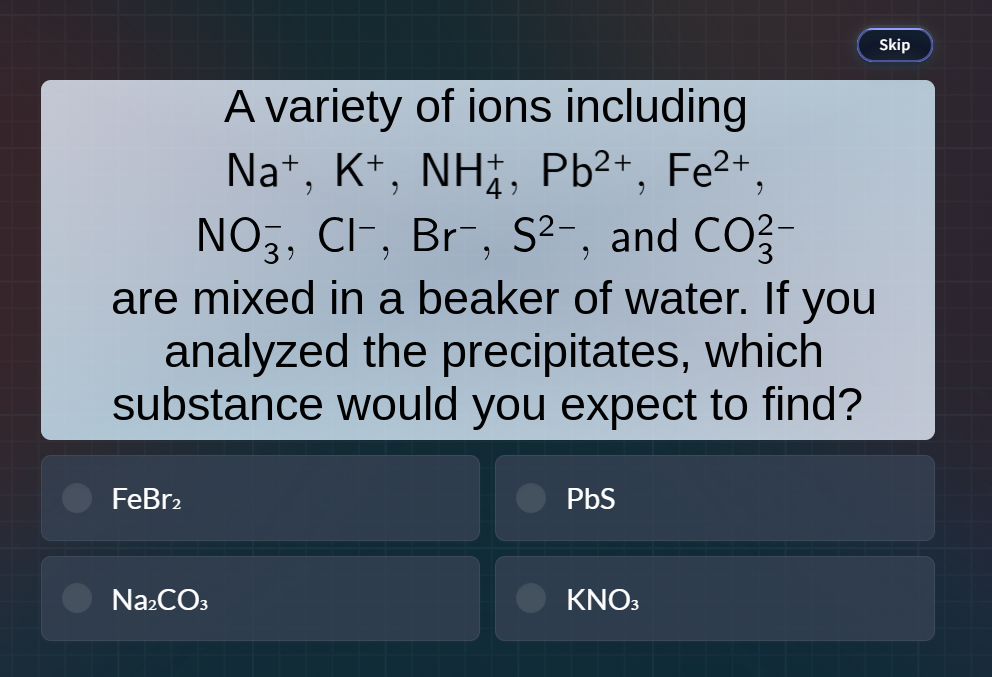
a variety of ions including $ce{na+}$, $ce{k+}$, $ce{nh^+_4}$, $ce{pb^2+}$, $ce{fe^2+}$, $ce{no^-_{3}}$, $ce{cl-}$, $ce{br-}$, $ce{s^2-}$, and $ce{co^{2-}_{3}}$ are mixed in a beaker of water. if you analyzed the precipitates, which substance would you expect to find? $ce{febr2}$ $ce{pbs}$ $ce{na2co3}$ $ce{kno3}$
To determine the precipitate, we use solubility rules. Salts of Group 1 metals (Na⁺, K⁺) and ammonium (NH₄⁺) are soluble. Nitrates (NO₃⁻) are generally soluble. Halides (Cl⁻, Br⁻) are soluble except with Ag⁺, Pb²⁺, Hg₂²⁺, but Fe²⁺ with Br⁻ (FeBr₂) is soluble. Carbonates (CO₃²⁻) with Group 1 (Na⁺) are soluble (Na₂CO₃). Sulfides (S²⁻) with Pb²⁺ form PbS, which is insoluble (a common precipitate for heavy metals and sulfide). KNO₃ is soluble (Group 1 + nitrate). So PbS is the precipitate.

Snap & solve any problem in the app
Get step-by-step solutions on Sovi AI
Photo-based solutions with guided steps
Explore more problems and detailed explanations
B. PbS