QUESTION IMAGE
Question
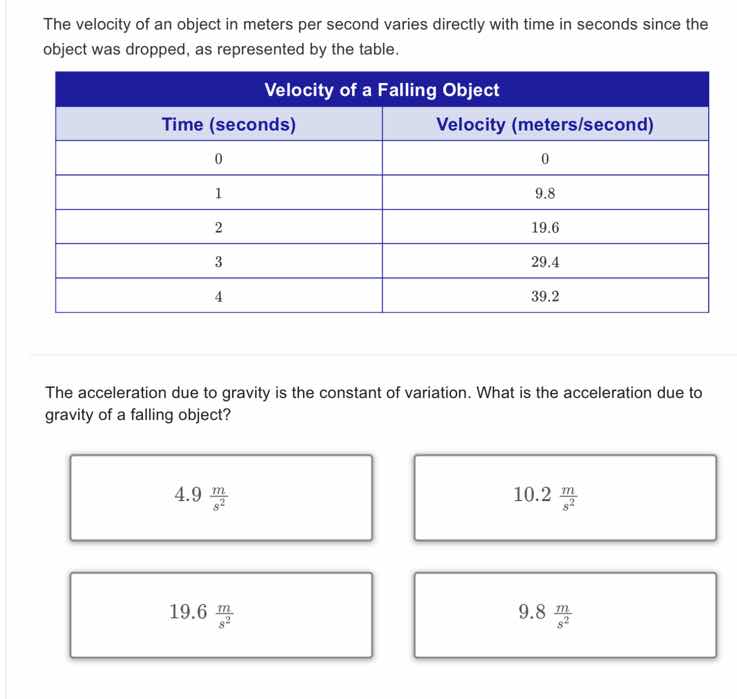
the velocity of an object in meters per second varies directly with time in seconds since the object was dropped, as represented by the table.
velocity of a falling object
| time (seconds) | velocity (meters/second) |
|---|---|
| 1 | 9.8 |
| 2 | 19.6 |
| 3 | 29.4 |
| 4 | 39.2 |
the acceleration due to gravity is the constant of variation. what is the acceleration due to gravity of a falling object?
4.9 $\frac{m}{s^2}$ 10.2 $\frac{m}{s^2}$
19.6 $\frac{m}{s^2}$ 9.8 $\frac{m}{s^2}$
Step1: Recall direct variation formula
For direct variation, the formula is \( v = kt \), where \( v \) is velocity, \( t \) is time, and \( k \) is the constant of variation (acceleration here).
Step2: Calculate \( k \) using a data point
Take the point \( t = 1 \) second and \( v = 9.8 \) m/s. Substitute into \( v = kt \): \( 9.8 = k \times 1 \), so \( k = 9.8 \). We can check with other points (e.g., \( t = 2 \), \( v = 19.6 \): \( 19.6 = k \times 2 \), \( k = \frac{19.6}{2}=9.8 \)), which confirms \( k = 9.8 \) \( \frac{m}{s^2} \).

Snap & solve any problem in the app
Get step-by-step solutions on Sovi AI
Photo-based solutions with guided steps
Explore more problems and detailed explanations
D. \( 9.8 \frac{m}{s^2} \) (assuming the options are labeled with D for the last option as per the layout, with the option text \( 9.8 \frac{m}{s^2} \))