QUESTION IMAGE
Question
view passage 1
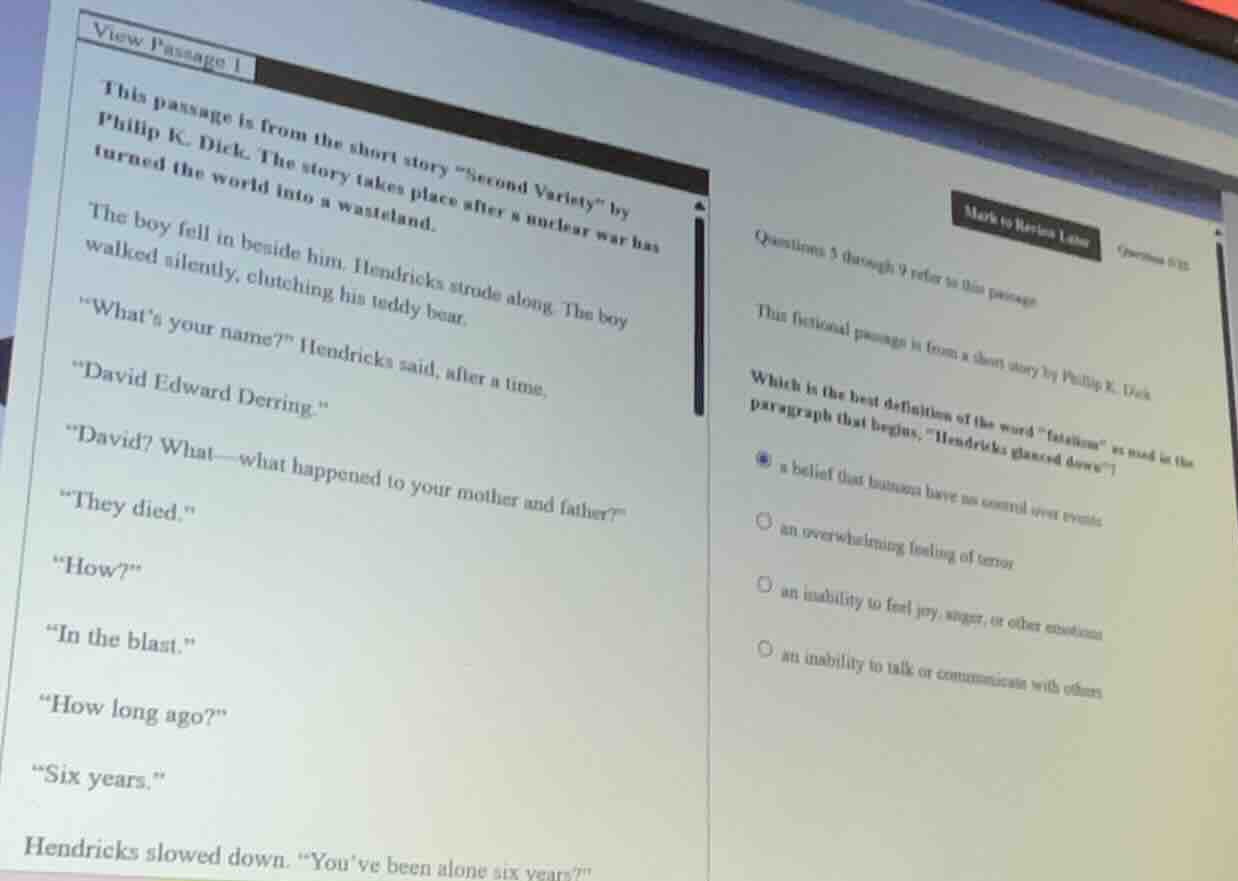
this passage is from the short story \second variety\ by philip k. dick. the story takes place after a nuclear war has turned the world into a wasteland.
the boy fell in beside him. hendricks strode along. the boy walked silently, clutching his teddy bear.
\whats your name?\ hendricks said, after a time.
\david edward derring.\
\david? what—what happened to your mother and father?\
\they died.\
\how?\
\in the blast.\
\how long ago?\
\six years.\
hendricks slowed down. \youve been alone six years?\
mark to review later
question 5 of 32
questions 5 through 9 refer to this passage.
this fictional passage is from a short story by philip k. dick.
which is the best definition of the word \fatalism\ as used in the paragraph that begins, \hendricks glanced down\?
- a belief that humans have no control over events
- an overwhelming feeling of terror
- an inability to feel joy, anger, or other emotions
- an inability to talk or communicate with others
To determine the best definition of "fatalism" in the context, we analyze each option:
- Option 1: "a belief that humans have no control over events" fits the post - nuclear war wasteland setting. In such a devastated world, the idea that events are out of human control (like the nuclear war and its consequences) aligns with fatalism.
- Option 2: "an overwhelming feeling of terror" is more about fear, not fatalism.
- Option 3: "an inability to feel joy, anger, or other emotions" refers to emotional flatness, not fatalism.
- Option 4: "an inability to talk or communicate with others" is about communication, not fatalism.

Snap & solve any problem in the app
Get step-by-step solutions on Sovi AI
Photo-based solutions with guided steps
Explore more problems and detailed explanations
a belief that humans have no control over events