QUESTION IMAGE
Question
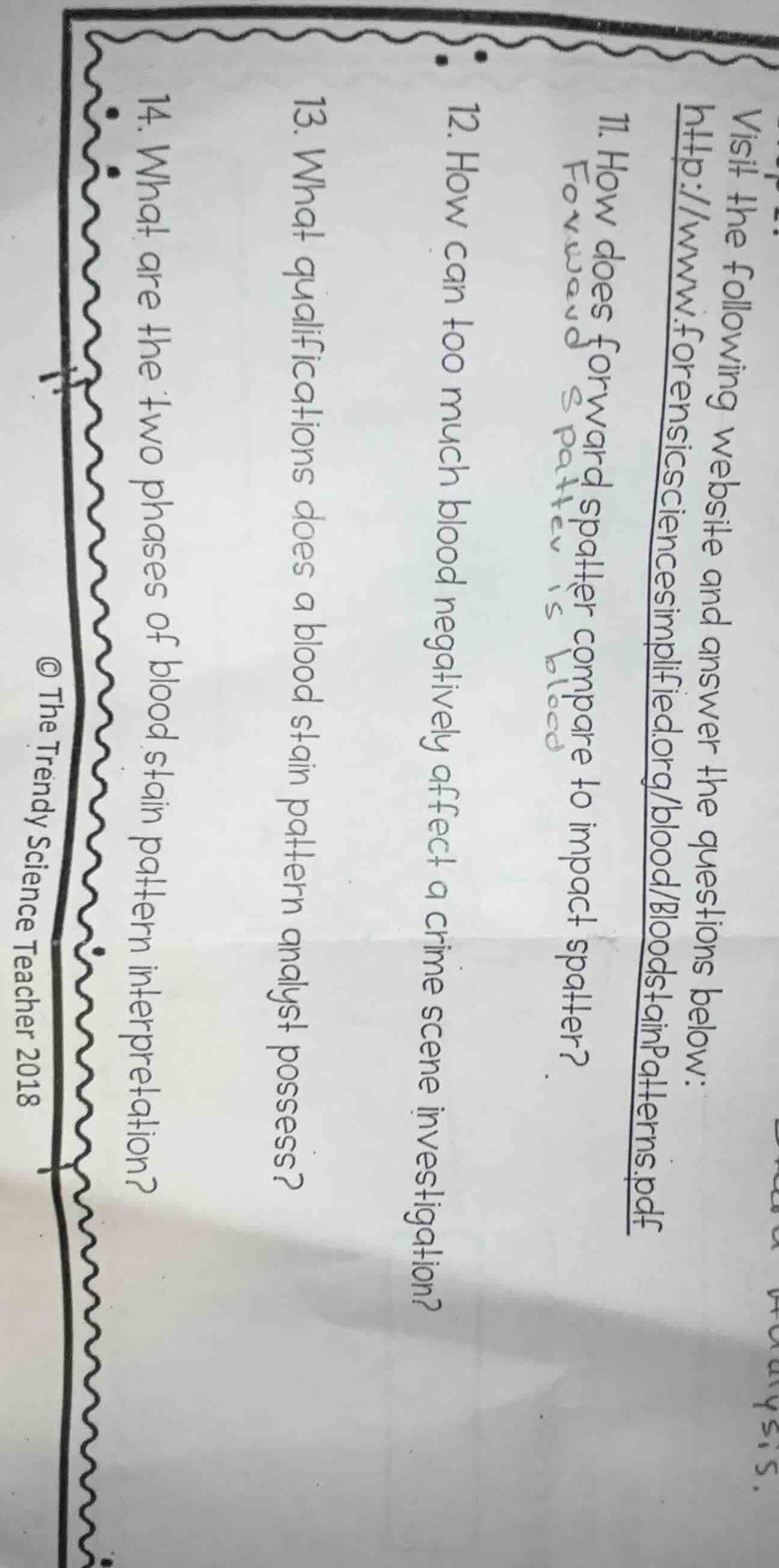
visit the following website and answer the questions below: http://www.forensicsciencesimplified.org/blood/bloodstainpatterns.pdf 11. how does forward spatter compare to impact spatter? 12. how can too much blood negatively affect a crime scene investigation? 13. what qualifications does a blood stain pattern analyst possess? 14. what are the two phases of blood stain pattern interpretation? © the trendy science teacher 2018
To answer these questions, you need to visit the provided website (http://www.forensicsciencesimplified.org/blood/bloodstainpatterns.pdf) and extract the relevant information:
Question 11: How does forward spatter compare to impact spatter?
- Step 1: Open the PDF from the given URL.
- Step 2: Navigate to the section on bloodstain patterns (likely the “Bloodstain Patterns” chapter).
- Step 3: Locate definitions or comparisons of “forward spatter” and “impact spatter.”
- Key Info: Forward spatter is blood projected away from the source (e.g., a weapon) during an impact, while impact spatter (or “back spatter”) is blood projected toward the source. Forward spatter typically produces smaller, more dispersed droplets, while impact spatter may have larger droplets or a different distribution.
Question 12: How can too much blood negatively affect a crime scene investigation?
- Step 1: Find the section on crime scene challenges or bloodstain analysis limitations.
- Step 2: Identify how excess blood interferes with evidence.
- Key Info: Excess blood can obscure other stains (e.g., footprints, tool marks), dilute trace evidence (e.g., DNA, fibers), or make it difficult to distinguish between primary and secondary patterns, leading to misinterpretation of events.
Question 13: What qualifications does a blood stain pattern analyst possess?
- Step 1: Look for “Qualifications” or “Training” sections in the PDF.
- Step 2: Extract requirements (e.g., education, certification, experience).
- Key Info: Typically, a bloodstain pattern analyst has a degree in forensic science, biology, or a related field, plus specialized training in bloodstain pattern analysis (e.g., through organizations like the International Association for Bloodstain Pattern Analysis, IABPA). They also need experience in crime scene processing and understanding of physics (trajectory, velocity) and biology (blood properties).
Question 14: What are the two phases of blood stain pattern interpretation?
- Step 1: Find the “Interpretation” section of the PDF.
- Step 2: Identify the two phases.
- Key Info: The two phases are Reconstruction (analyzing the physical characteristics of stains to determine events) and Interpretation (using the reconstructed data to explain the sequence of events, actions, or positions of individuals at the scene).
For precise answers, directly reference the PDF content. If you need further help, share specific excerpts from the document!

Snap & solve any problem in the app
Get step-by-step solutions on Sovi AI
Photo-based solutions with guided steps
Explore more problems and detailed explanations
To answer these questions, you need to visit the provided website (http://www.forensicsciencesimplified.org/blood/bloodstainpatterns.pdf) and extract the relevant information:
Question 11: How does forward spatter compare to impact spatter?
- Step 1: Open the PDF from the given URL.
- Step 2: Navigate to the section on bloodstain patterns (likely the “Bloodstain Patterns” chapter).
- Step 3: Locate definitions or comparisons of “forward spatter” and “impact spatter.”
- Key Info: Forward spatter is blood projected away from the source (e.g., a weapon) during an impact, while impact spatter (or “back spatter”) is blood projected toward the source. Forward spatter typically produces smaller, more dispersed droplets, while impact spatter may have larger droplets or a different distribution.
Question 12: How can too much blood negatively affect a crime scene investigation?
- Step 1: Find the section on crime scene challenges or bloodstain analysis limitations.
- Step 2: Identify how excess blood interferes with evidence.
- Key Info: Excess blood can obscure other stains (e.g., footprints, tool marks), dilute trace evidence (e.g., DNA, fibers), or make it difficult to distinguish between primary and secondary patterns, leading to misinterpretation of events.
Question 13: What qualifications does a blood stain pattern analyst possess?
- Step 1: Look for “Qualifications” or “Training” sections in the PDF.
- Step 2: Extract requirements (e.g., education, certification, experience).
- Key Info: Typically, a bloodstain pattern analyst has a degree in forensic science, biology, or a related field, plus specialized training in bloodstain pattern analysis (e.g., through organizations like the International Association for Bloodstain Pattern Analysis, IABPA). They also need experience in crime scene processing and understanding of physics (trajectory, velocity) and biology (blood properties).
Question 14: What are the two phases of blood stain pattern interpretation?
- Step 1: Find the “Interpretation” section of the PDF.
- Step 2: Identify the two phases.
- Key Info: The two phases are Reconstruction (analyzing the physical characteristics of stains to determine events) and Interpretation (using the reconstructed data to explain the sequence of events, actions, or positions of individuals at the scene).
For precise answers, directly reference the PDF content. If you need further help, share specific excerpts from the document!