QUESTION IMAGE
Question
vocabulary in context
read the passage.
home, home on the range
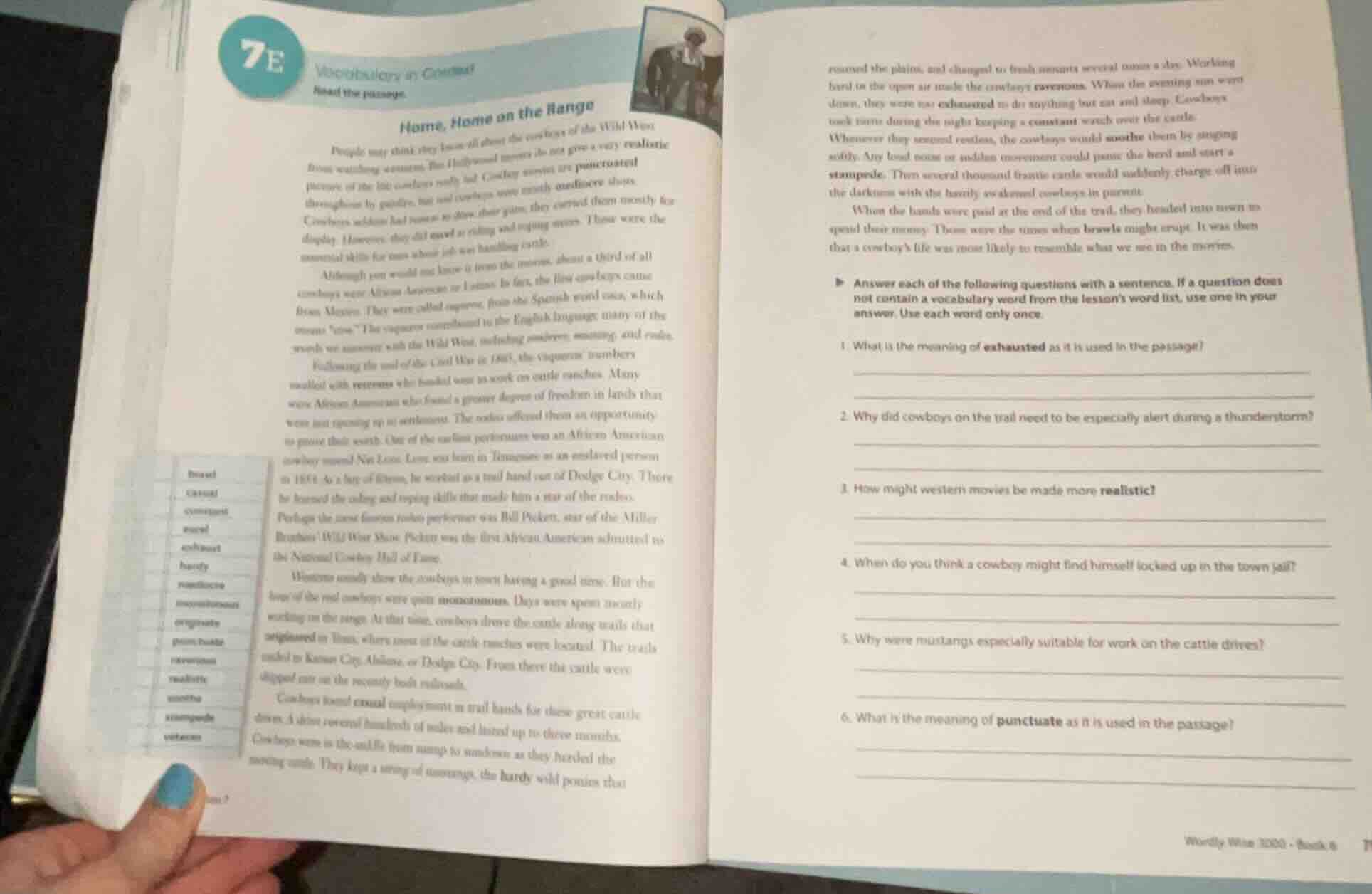
people may think they know all about the cowboys of the wild west from watching scenes in hollywood movies. in fact, movies do not give a very realistic picture of the life cowboys really led. cowboy movies are punctuated throughout by gunfights, but real cowboys were mostly nonviolent. cowboys seldom had reason to draw their guns; they carried them mostly for display. however, they did need roping and riding skills. these were the essential skills for men whose job was handling cattle.
although you would not know it from the movies, about a third of all cowboys were african american or latino. in fact, the first cowboys came from mexico. they were called vaqueros, from the spanish word vaca, which means “cow.” the vaqueros contributed to the english language many of the words we associate with the wild west, including lasso, mustang, and rodeo.
following the end of the civil war in 1865, the vaqueros numbers swelled with veterans who looked west to work on cattle ranches. many were african american who found a greater degree of freedom in lands that were just opening up to settlement. the rodeo offered them an opportunity to prove their worth. one of the earliest performers was an african american cowboy named nat love. love was born in tennessee as an enslaved person in 1854. at a lot of fifteen, he worked as a trail hand out of dodge city. there he honed the roping and riding skills that made him a star of the rodeos. perhaps the most famous rodeo performer was bill pickett, star of the miller brothers’ 101 wild west show. pickett was the first african american admitted to the national cowboy hall of fame.
westerns mostly show the cowboys in town having a good time. but the lives of the real cowboys were quite monotonous. days were spent mostly working on the range. at that time, cowboys drove the cattle along trails that originated in texas, where most of the cattle ranches were located. the trails ended in kansas city, abilene, or dodge city. from there the cattle were shipped east on the recently built railroads.
cowboys found casual employment in trail hands for these great cattle drives. a drive covered hundreds of miles and lasted up to three months. cowboys were in the saddle from sunup to sundown as they herded the moving cattle. they kept a string of mustangs, the hardy wild ponies that roamed the plains, and changed to fresh mounts several times a day. working hard in the open air made the cowboys ravenous. when the evening sun went down, they were too exhausted to do anything but eat and sleep. cowboys took turns during the night keeping a constant watch over the cattle. whenever they seemed restless, the cowboys would soothe them by singing softly. any loud noise or sudden movement could panic the herd and start a stampede. then several thousand frantic cattle would suddenly charge off into the darkness with the barely awakened cowboys in pursuit.
when the herds were paid at the end of the trail, they headed into town to spend their money. these were the times when brawls might erupt. it was then that a cowboy’s life was most likely to resemble what we see in the movies.
- answer each of the following questions with a sentence. if a question does not contain a vocabulary word from the lesson’s word list, use one in your answer. use each word only once.
- what is the meaning of exhausted as it is used in the passage?
_____________________________________________________
_____________________________________________________
- why did cowboys on the trail need to be especially alert during a thunderstorm?
_____________________________________________________
_____________________________________________________
- how might western movies be made more realistic?
_____________________________________________________
_____________________________________________________
- when do you think a cowboy might find himself locked up in the town jail?
_____________________________________________________
_____________________________________________________
- why were mustangs especially suitable for work on the cattle drives?
_____________________________________________________
_____________________________________________________
- what is the meaning of punctuate as it is used in the passage?
_____________________________________________________
_____________________________________________________
word list:
brawl
casual
constant
essential
exhaust
hardy
monotonous
nonviolent
originate
panic
basic
ravenous
realistic
soothe
stampede
vaquero
- Defines "exhausted" using context from the passage and a lesson word.
- Links thunderstorm noise/movement to cattle panic, using a lesson word.
- Suggests adding mundane cowboy work details, using a lesson word.
- Connects post-pay town brawls to jail, using a lesson word.
- Notes mustangs' hardiness for drives, using a lesson word.
- Defines "punctuate" using passage context and a lesson word.

Snap & solve any problem in the app
Get step-by-step solutions on Sovi AI
Photo-based solutions with guided steps
Explore more problems and detailed explanations
- In the passage, exhausted means extremely tired, so worn out that cowboys could only eat and sleep after a long day of work.
- Cowboys needed to be alert during thunderstorms because the loud noise could panic the herd and start a stampede.
- Western movies could be more realistic by showing the monotonous, daily work of cowboys instead of just gunfights.
- A cowboy might end up in jail when he heads to town after being paid, as that is when brawls often erupt.
- Mustangs were especially suitable because they are hardy wild ponies that can handle the long, tough cattle drives.
- In the passage, punctuate means to break up or interrupt, as gunfights only occasionally broke up the mostly ordinary days of real cowboys.