QUESTION IMAGE
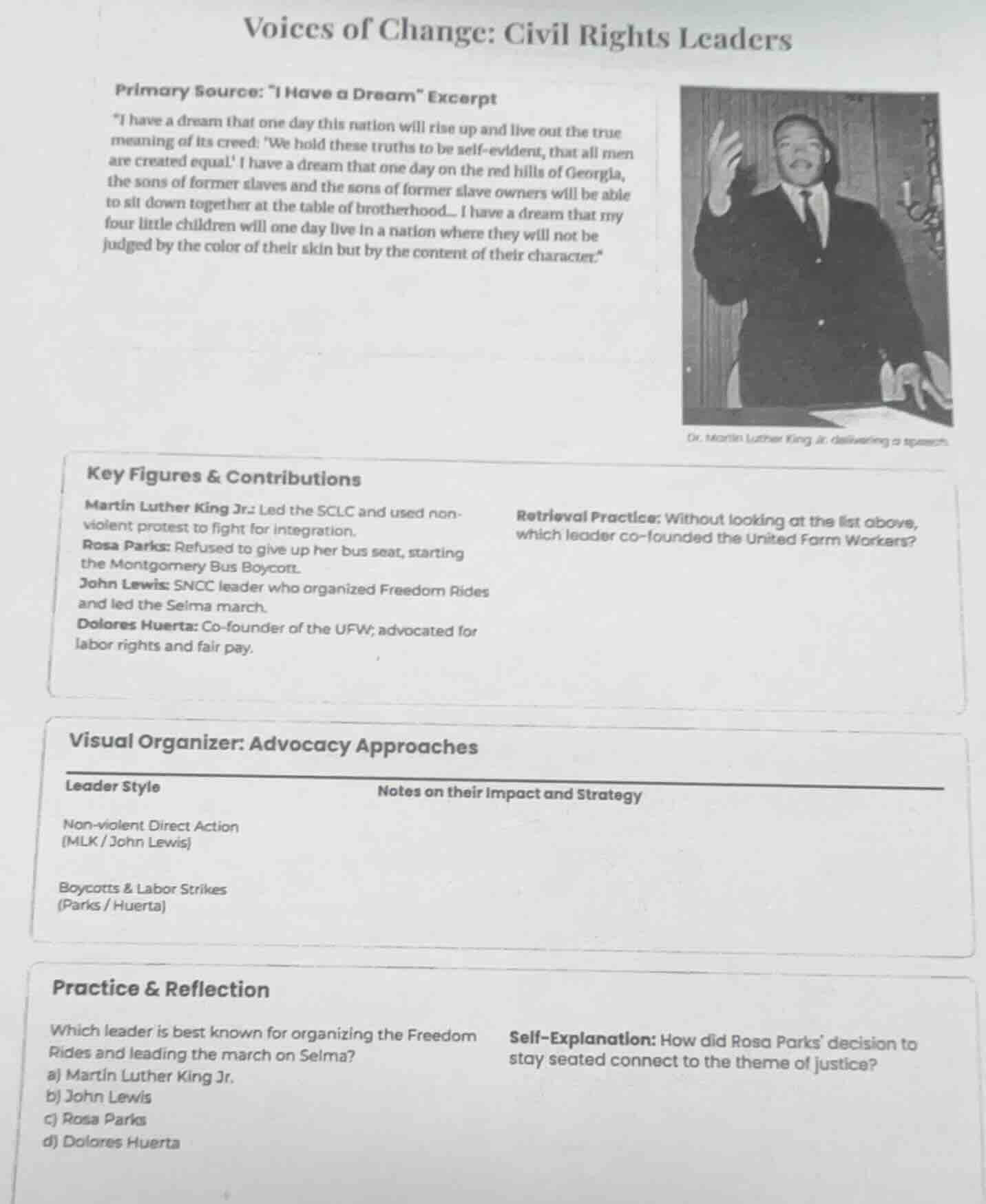
Question
voices of change: civil rights leaders
primary source: \i have a dream\ excerpt
\i have a dream that one day this nation will rise up and live out the true
meaning of its creed: we hold these truths to be self-evident, that all men
are created equal. i have a dream that one day on the red hills of georgia,
the sons of former slaves and the sons of former slave owners will be able
to sit down together at the table of brotherhood... i have a dream that my
four little children will one day live in a nation where they will not be
judged by the color of their skin but by the content of their character.\
dr. martin luther king jr. delivering a speech
key figures & contributions
martin luther king jr.: led the sclc and used non-violent protest to fight for integration.
rosa parks: refused to give up her bus seat, starting the montgomery bus boycott.
john lewis: sncc leader who organized freedom rides and led the selma march.
dolores huerta: co-founder of the ufw; advocated for labor rights and fair pay.
retrieval practice: without looking at the list above,
which leader co-founded the united farm workers?
visual organizer: advocacy approaches
leader style notes on their impact and strategy
non-violent direct action (mlk / john lewis)
boycotts & labor strikes (parks / huerta)
practice & reflection
which leader is best known for organizing the freedom rides and leading the march on selma?
a) martin luther king jr.
b) john lewis
c) rosa parks
d) dolores huerta
self-explanation: how did rosa parks decision to stay seated connect to the theme of justice?
Retrieval Practice Question
The "Key Figures & Contributions" section explicitly states Dolores Huerta co-founded the UFW (United Farm Workers).
Practice & Reflection Multiple Choice Question
The "Key Figures & Contributions" section notes John Lewis organized Freedom Rides and led the Selma march.
Self-Explanation Question
Rosa Parks' act challenged the unjust, racially segregated bus laws of the time, which enforced systemic racial inequality. By refusing to give up her seat, she took a stand against arbitrary, discriminatory treatment, framing the fight for justice as demanding equal treatment under the law regardless of race.

Snap & solve any problem in the app
Get step-by-step solutions on Sovi AI
Photo-based solutions with guided steps
Explore more problems and detailed explanations
- Retrieval Practice Answer: Dolores Huerta
- Practice & Reflection Multiple Choice: b) John Lewis
- Self-Explanation Answer: Rosa Parks' decision to stay seated challenged the unjust racial segregation laws of Montgomery's public transit system. This act directly opposed systemic racial inequality, as the laws enforced unfair, discriminatory treatment based on skin color. By refusing to comply, she advocated for the core theme of justice: equal rights and treatment for all people, regardless of race, and sparked the Montgomery Bus Boycott, a pivotal moment in the fight for civil rights justice.