QUESTION IMAGE
Question
volume of composite
the figures below. correct ans
will stay red.
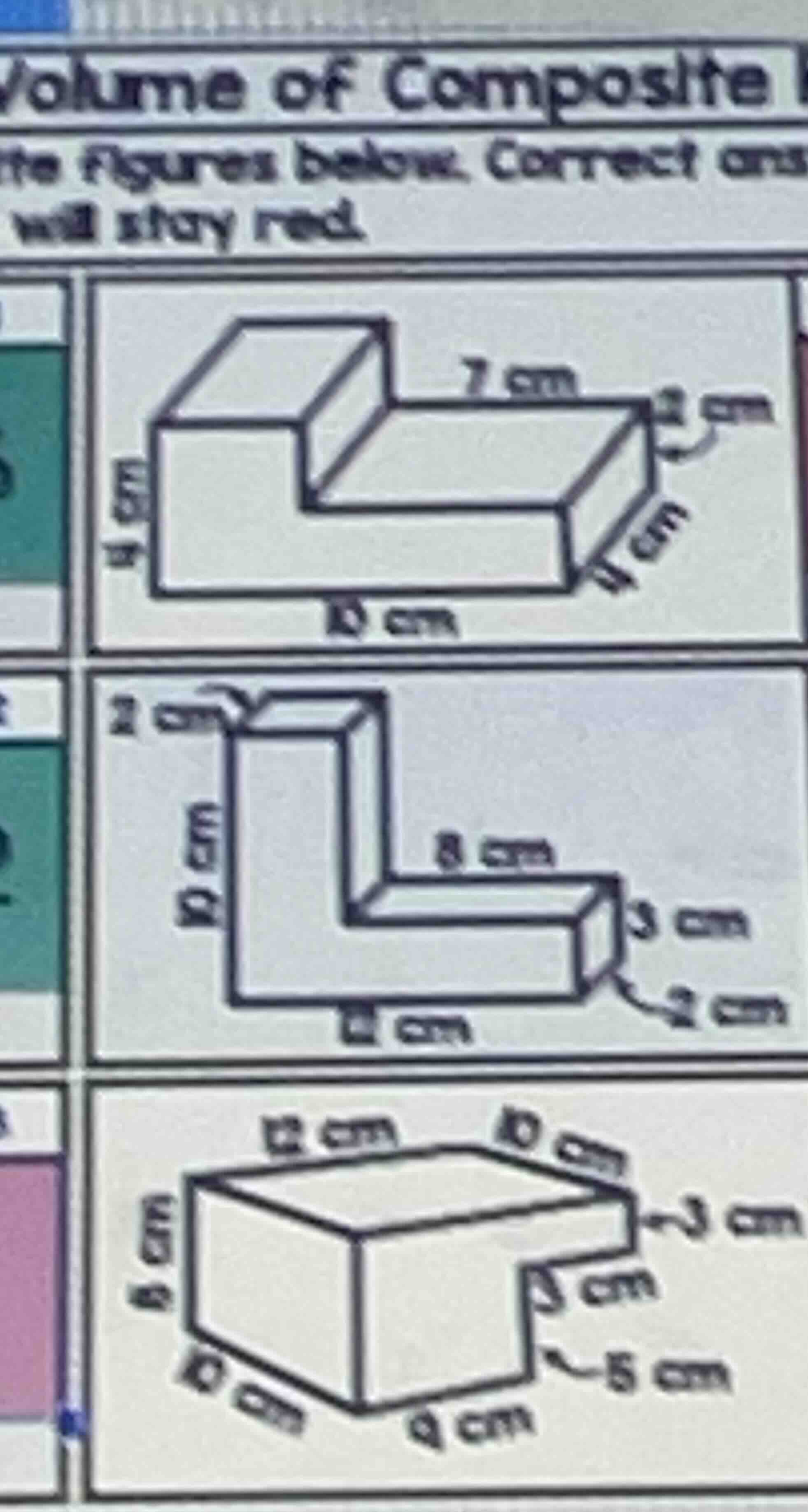
(first figure: dimensions related to 7 cm, 2 cm, 5 cm, 10 cm etc.)
(second figure: dimensions 2 cm, 10 cm, 8 cm, 3 cm, 2 cm etc.)
(third figure: dimensions 12 cm, 10 cm, 3 cm, 5 cm, 5 cm, 10 cm, 9 cm etc.)
To find the volume of composite figures, we can use the method of dividing the composite figure into simpler rectangular prisms, calculating the volume of each, and then summing them up. The volume of a rectangular prism is given by the formula \( V = l \times w \times h \), where \( l \) is the length, \( w \) is the width, and \( h \) is the height.
First Composite Figure (Top)
Let's assume the figure can be divided into two rectangular prisms.
- Prism 1: Let's say the dimensions are \( l_1 = 10 - 7 = 3 \, \text{cm} \), \( w_1 = 5 \, \text{cm} \), \( h_1 = 5 \, \text{cm} \) (assuming the height is 5 cm from the diagram).
- Volume of Prism 1: \( V_1 = 3 \times 5 \times 5 = 75 \, \text{cm}^3 \)
- Prism 2: Dimensions \( l_2 = 7 \, \text{cm} \), \( w_2 = 5 \, \text{cm} \), \( h_2 = 2 \, \text{cm} \) (assuming the height is 2 cm from the diagram).
- Volume of Prism 2: \( V_2 = 7 \times 5 \times 2 = 70 \, \text{cm}^3 \)
- Total Volume: \( V_{\text{total}} = V_1 + V_2 = 75 + 70 = 145 \, \text{cm}^3 \)
Second Composite Figure (Middle)
Let's divide it into two rectangular prisms.
- Prism 1: Dimensions \( l_1 = 10 - 8 = 2 \, \text{cm} \), \( w_1 = 2 \, \text{cm} \), \( h_1 = 10 \, \text{cm} \) (assuming the height is 10 cm from the diagram).
- Volume of Prism 1: \( V_1 = 2 \times 2 \times 10 = 40 \, \text{cm}^3 \)
- Prism 2: Dimensions \( l_2 = 8 \, \text{cm} \), \( w_2 = 2 \, \text{cm} \), \( h_2 = 3 \, \text{cm} \) (assuming the height is 3 cm from the diagram).
- Volume of Prism 2: \( V_2 = 8 \times 2 \times 3 = 48 \, \text{cm}^3 \)
- Total Volume: \( V_{\text{total}} = V_1 + V_2 = 40 + 48 = 88 \, \text{cm}^3 \)
Third Composite Figure (Bottom)
Let's divide it into two rectangular prisms.
- Prism 1: Dimensions \( l_1 = 10 \, \text{cm} \), \( w_1 = 10 \, \text{cm} \), \( h_1 = 4 \, \text{cm} \) (assuming the height is 4 cm from the diagram).
- Volume of Prism 1: \( V_1 = 10 \times 10 \times 4 = 400 \, \text{cm}^3 \)
- Prism 2: Dimensions \( l_2 = 9 - 10 = -1 \, \text{cm} \) (This seems incorrect. Let's re - examine. Maybe the correct division is: The larger base is \( 12 \, \text{cm} \times 10 \, \text{cm} \), and the cut - out is \( 5 \, \text{cm} \times 5 \, \text{cm} \times 3 \, \text{cm} \). So the volume of the larger rectangular prism is \( V_{\text{large}}=12\times10\times4 = 480 \, \text{cm}^3 \), and the volume of the cut - out is \( V_{\text{cut - out}} = 5\times5\times3=75 \, \text{cm}^3 \). Then the volume of the composite figure is \( V = 480-75 = 405 \, \text{cm}^3 \)
Final Answers
- Volume of the top composite figure: \(\boldsymbol{145 \, \text{cm}^3}\)
- Volume of the middle composite figure: \(\boldsymbol{88 \, \text{cm}^3}\)
- Volume of the bottom composite figure: \(\boldsymbol{405 \, \text{cm}^3}\)

Snap & solve any problem in the app
Get step-by-step solutions on Sovi AI
Photo-based solutions with guided steps
Explore more problems and detailed explanations
To find the volume of composite figures, we can use the method of dividing the composite figure into simpler rectangular prisms, calculating the volume of each, and then summing them up. The volume of a rectangular prism is given by the formula \( V = l \times w \times h \), where \( l \) is the length, \( w \) is the width, and \( h \) is the height.
First Composite Figure (Top)
Let's assume the figure can be divided into two rectangular prisms.
- Prism 1: Let's say the dimensions are \( l_1 = 10 - 7 = 3 \, \text{cm} \), \( w_1 = 5 \, \text{cm} \), \( h_1 = 5 \, \text{cm} \) (assuming the height is 5 cm from the diagram).
- Volume of Prism 1: \( V_1 = 3 \times 5 \times 5 = 75 \, \text{cm}^3 \)
- Prism 2: Dimensions \( l_2 = 7 \, \text{cm} \), \( w_2 = 5 \, \text{cm} \), \( h_2 = 2 \, \text{cm} \) (assuming the height is 2 cm from the diagram).
- Volume of Prism 2: \( V_2 = 7 \times 5 \times 2 = 70 \, \text{cm}^3 \)
- Total Volume: \( V_{\text{total}} = V_1 + V_2 = 75 + 70 = 145 \, \text{cm}^3 \)
Second Composite Figure (Middle)
Let's divide it into two rectangular prisms.
- Prism 1: Dimensions \( l_1 = 10 - 8 = 2 \, \text{cm} \), \( w_1 = 2 \, \text{cm} \), \( h_1 = 10 \, \text{cm} \) (assuming the height is 10 cm from the diagram).
- Volume of Prism 1: \( V_1 = 2 \times 2 \times 10 = 40 \, \text{cm}^3 \)
- Prism 2: Dimensions \( l_2 = 8 \, \text{cm} \), \( w_2 = 2 \, \text{cm} \), \( h_2 = 3 \, \text{cm} \) (assuming the height is 3 cm from the diagram).
- Volume of Prism 2: \( V_2 = 8 \times 2 \times 3 = 48 \, \text{cm}^3 \)
- Total Volume: \( V_{\text{total}} = V_1 + V_2 = 40 + 48 = 88 \, \text{cm}^3 \)
Third Composite Figure (Bottom)
Let's divide it into two rectangular prisms.
- Prism 1: Dimensions \( l_1 = 10 \, \text{cm} \), \( w_1 = 10 \, \text{cm} \), \( h_1 = 4 \, \text{cm} \) (assuming the height is 4 cm from the diagram).
- Volume of Prism 1: \( V_1 = 10 \times 10 \times 4 = 400 \, \text{cm}^3 \)
- Prism 2: Dimensions \( l_2 = 9 - 10 = -1 \, \text{cm} \) (This seems incorrect. Let's re - examine. Maybe the correct division is: The larger base is \( 12 \, \text{cm} \times 10 \, \text{cm} \), and the cut - out is \( 5 \, \text{cm} \times 5 \, \text{cm} \times 3 \, \text{cm} \). So the volume of the larger rectangular prism is \( V_{\text{large}}=12\times10\times4 = 480 \, \text{cm}^3 \), and the volume of the cut - out is \( V_{\text{cut - out}} = 5\times5\times3=75 \, \text{cm}^3 \). Then the volume of the composite figure is \( V = 480-75 = 405 \, \text{cm}^3 \)
Final Answers
- Volume of the top composite figure: \(\boldsymbol{145 \, \text{cm}^3}\)
- Volume of the middle composite figure: \(\boldsymbol{88 \, \text{cm}^3}\)
- Volume of the bottom composite figure: \(\boldsymbol{405 \, \text{cm}^3}\)