QUESTION IMAGE
Question
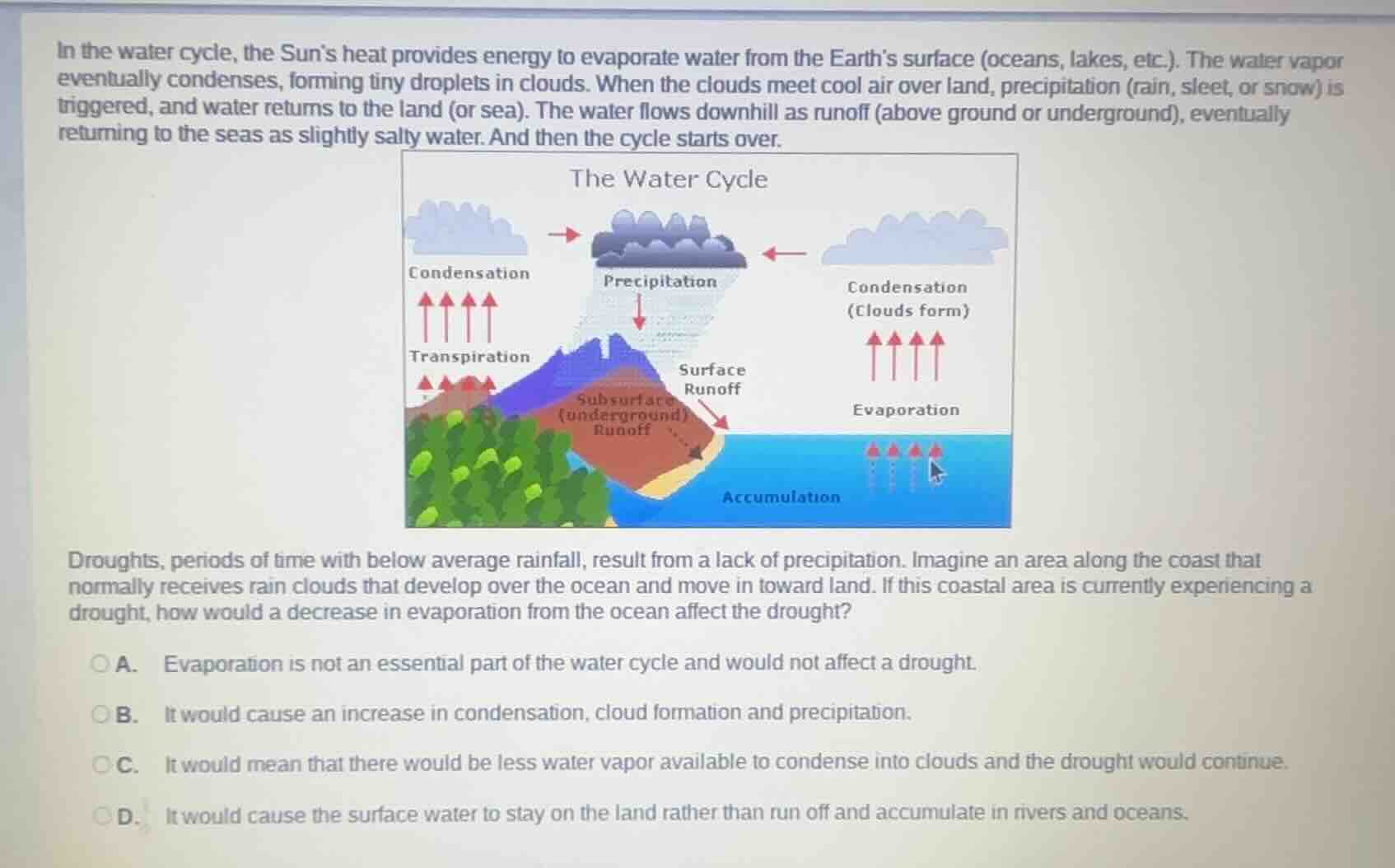
in the water cycle, the sun’s heat provides energy to evaporate water from the earth’s surface (oceans, lakes, etc.). the water vapor eventually condenses, forming tiny droplets in clouds. when the clouds meet cool air over land, precipitation (rain, sleet, or snow) is triggered, and water returns to the land (or sea). the water flows downhill as runoff (above ground or underground), eventually returning to the seas as slightly salty water. and then the cycle starts over.
droughts, periods of time with below average rainfall, result from a lack of precipitation. imagine an area along the coast that normally receives rain clouds that develop over the ocean and move in toward land. if this coastal area is currently experiencing a drought, how would a decrease in evaporation from the ocean affect the drought?
a. evaporation is not an essential part of the water cycle and would not affect a drought.
b. it would cause an increase in condensation, cloud formation and precipitation.
c. it would mean that there would be less water vapor available to condense into clouds and the drought would continue.
d. it would cause the surface water to stay on the land rather than run off and accumulate in rivers and oceans.
To solve this, we analyze the water cycle and the impact of reduced ocean evaporation:
- Option A: Evaporation is essential (drives condensation/clouds/precipitation), so A is wrong.
- Option B: Less evaporation means less water vapor, so condensation/clouds/precipitation would decrease, not increase. B is wrong.
- Option C: Evaporation provides water vapor for condensation. A decrease in ocean evaporation reduces available water vapor, limiting cloud formation and precipitation. This would prolong the drought (since drought is caused by lack of precipitation). C matches.
- Option D: Evaporation affects vapor/clouds, not surface runoff retention. D is irrelevant.

Snap & solve any problem in the app
Get step-by-step solutions on Sovi AI
Photo-based solutions with guided steps
Explore more problems and detailed explanations
C. It would mean that there would be less water vapor available to condense into clouds and the drought would continue.