QUESTION IMAGE
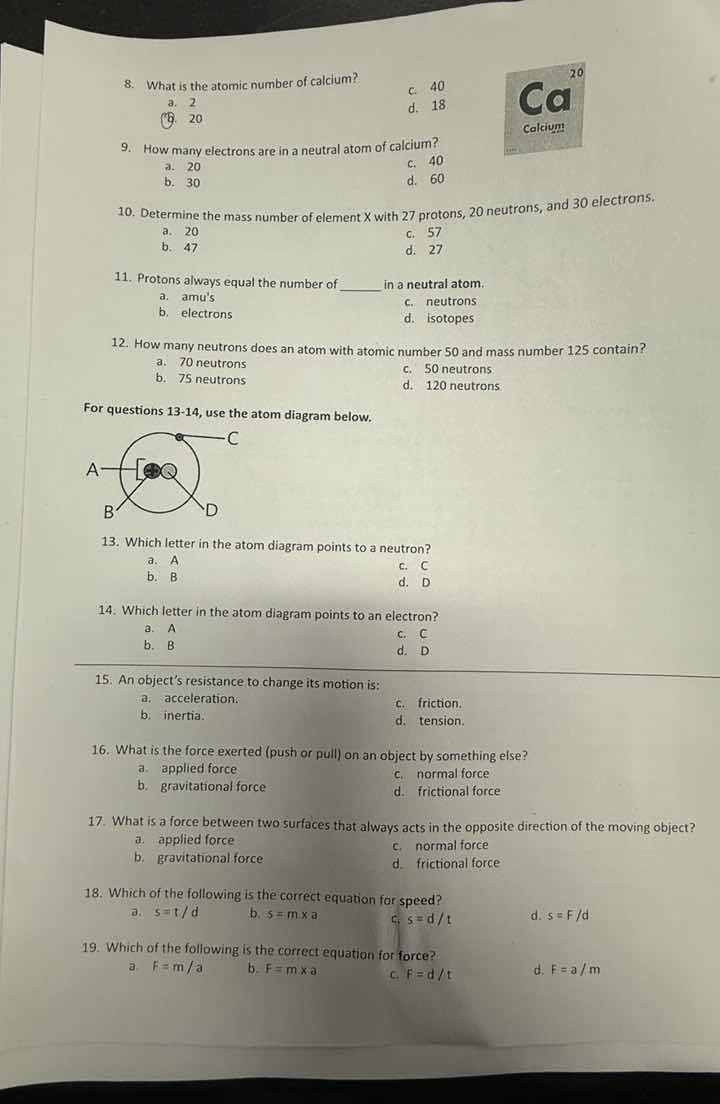
Question
- what is the atomic number of calcium?
a. 2
b. 20
c. 40
d. 18
- how many electrons are in a neutral atom of calcium?
a. 20
b. 30
c. 40
d. 60
- determine the mass number of element x with 27 protons, 20 neutrons, and 30 electrons.
a. 20
b. 47
c. 57
d. 27
- protons always equal the number of ______ in a neutral atom.
a. amu’s
b. electrons
c. neutrons
d. isotopes
- how many neutrons does an atom with atomic number 50 and mass number 125 contain?
a. 70 neutrons
b. 75 neutrons
c. 50 neutrons
d. 120 neutrons
for questions 13 - 14, use the atom diagram below.
atom diagram with labels a, b, c, d
- which letter in the atom diagram points to a neutron?
a. a
b. b
c. c
d. d
- which letter in the atom diagram points to an electron?
a. a
b. b
c. c
d. d
- an object’s resistance to change its motion is:
a. acceleration.
b. inertia.
c. friction.
d. tension.
- what is the force exerted (push or pull) on an object by something else?
a. applied force
b. gravitational force
c. normal force
d. frictional force
- what is a force between two surfaces that always acts in the opposite direction of the moving object?
a. applied force
b. gravitational force
c. normal force
d. frictional force
- which of the following is the correct equation for speed?
a. ( s = t / d )
b. ( s = m \times a )
c. ( s = d / t )
d. ( s = f / d )
- which of the following is the correct equation for force?
a. ( f = m / a )
b. ( f = m \times a )
c. ( f = d / t )
d. ( f = a / m )
Question 8
The atomic number of an element is equal to the number of protons in its nucleus. From the periodic table, calcium (Ca) has an atomic number of 20. The options a (2) is for helium, c (40) is the mass number of calcium, and d (18) is for argon. So the correct option is b.
In a neutral atom, the number of electrons is equal to the number of protons (atomic number). Calcium has an atomic number of 20, so the number of electrons in a neutral calcium atom is 20. Option b (30) is incorrect, c (40) is the mass number, and d (60) is not related.
Step1: Recall the formula for mass number
Mass number ($A$) is the sum of the number of protons ($p$) and neutrons ($n$), i.e., $A = p + n$.
Step2: Substitute the given values
Given $p = 27$ and $n = 20$, so $A = 27 + 20 = 47$.

Snap & solve any problem in the app
Get step-by-step solutions on Sovi AI
Photo-based solutions with guided steps
Explore more problems and detailed explanations
b. 20