QUESTION IMAGE
Question
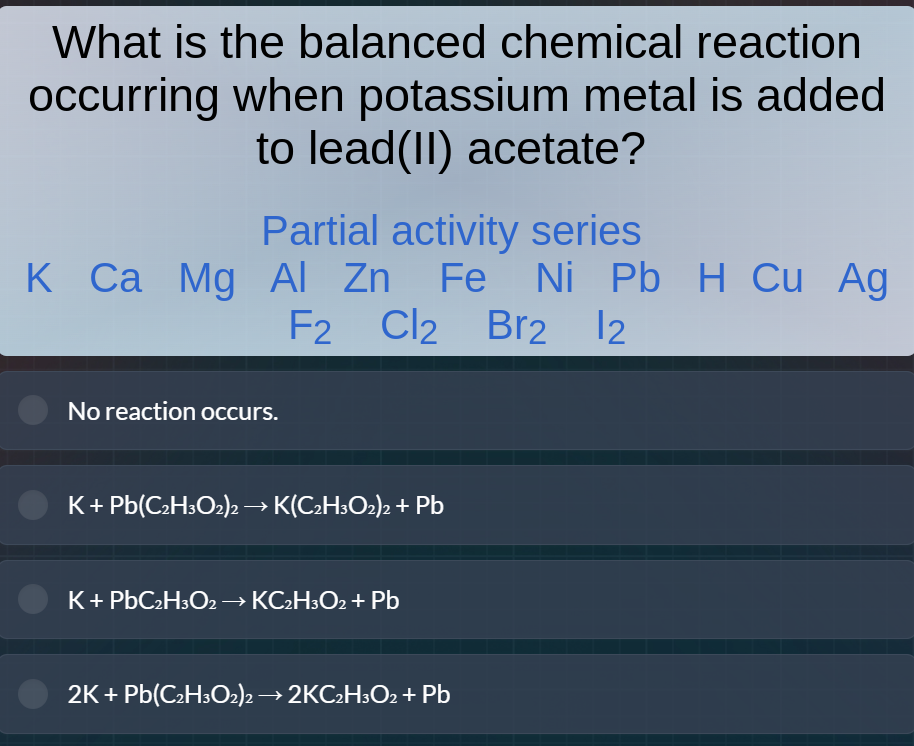
what is the balanced chemical reaction occurring when potassium metal is added to lead(ii) acetate? partial activity series k ca mg al zn fe ni pb h cu ag f₂ cl₂ br₂ i₂ no reaction occurs. k + pb(c₂h₃o₂)₂ → k(c₂h₃o₂)₂ + pb k + pbc₂h₃o₂ → kc₂h₃o₂ + pb 2k + pb(c₂h₃o₂)₂ → 2kc₂h₃o₂ + pb
Step1: Determine Reactivity
From the activity series, K is more reactive than Pb, so a single - displacement reaction will occur. The general form of a single - displacement reaction for a metal displacing another metal in a compound is \( \text{Metal}_1+\text{Metal}_2\text{Compound}
ightarrow\text{Metal}_1\text{Compound}+\text{Metal}_2 \). Here, the reactants are K (metal) and \( \text{Pb}(\text{C}_2\text{H}_3\text{O}_2)_2 \) (lead(II) acetate, a compound of Pb).
Step2: Write Unbalanced Equation
The unbalanced equation from the reaction is \( \text{K}+\text{Pb}(\text{C}_2\text{H}_3\text{O}_2)_2
ightarrow\text{KC}_2\text{H}_3\text{O}_2+\text{Pb} \) (or \( \text{K}(\text{C}_2\text{H}_3\text{O}_2)+\text{Pb} \), but the acetate ion is \( \text{C}_2\text{H}_3\text{O}_2^- \), so the formula for potassium acetate is \( \text{KC}_2\text{H}_3\text{O}_2 \) or \( \text{K}(\text{C}_2\text{H}_3\text{O}_2) \), they are equivalent).
Step3: Balance the Equation
- Balance acetate ions: On the left - hand side, there are 2 acetate ions (\( \text{C}_2\text{H}_3\text{O}_2^- \)) in \( \text{Pb}(\text{C}_2\text{H}_3\text{O}_2)_2 \). On the right - hand side, in \( \text{KC}_2\text{H}_3\text{O}_2 \), there is 1 acetate ion per formula unit. So we need 2 moles of \( \text{KC}_2\text{H}_3\text{O}_2 \) to balance the acetate ions. So we put a coefficient of 2 in front of \( \text{KC}_2\text{H}_3\text{O}_2 \), getting \( \text{K}+\text{Pb}(\text{C}_2\text{H}_3\text{O}_2)_2
ightarrow2\text{KC}_2\text{H}_3\text{O}_2+\text{Pb} \).
- Balance potassium atoms: Now, on the right - hand side, we have 2 K atoms (from \( 2\text{KC}_2\text{H}_3\text{O}_2 \)). So we need to put a coefficient of 2 in front of K on the left - hand side. The balanced equation is \( 2\text{K}+\text{Pb}(\text{C}_2\text{H}_3\text{O}_2)_2
ightarrow2\text{KC}_2\text{H}_3\text{O}_2+\text{Pb} \) (or \( 2\text{K}+\text{Pb}(\text{C}_2\text{H}_3\text{O}_2)_2
ightarrow2\text{K}(\text{C}_2\text{H}_3\text{O}_2)+\text{Pb} \)). Also, we can check the other options:
- The option "No reaction occurs" is wrong because K is more reactive than Pb.
- The option \( \text{K}+\text{Pb}(\text{C}_2\text{H}_3\text{O}_2)_2
ightarrow\text{K}(\text{C}_2\text{H}_3\text{O}_2)+\text{Pb} \) is unbalanced (acetate ions and K atoms are not balanced).
- The option \( \text{K}+\text{PbC}_2\text{H}_3\text{O}_2
ightarrow\text{KC}_2\text{H}_3\text{O}_2+\text{Pb} \) has the wrong formula for lead(II) acetate (the correct formula is \( \text{Pb}(\text{C}_2\text{H}_3\text{O}_2)_2 \), not \( \text{PbC}_2\text{H}_3\text{O}_2 \)).

Snap & solve any problem in the app
Get step-by-step solutions on Sovi AI
Photo-based solutions with guided steps
Explore more problems and detailed explanations
\( 2\text{K}+\text{Pb}(\text{C}_2\text{H}_3\text{O}_2)_2
ightarrow2\text{KC}_2\text{H}_3\text{O}_2+\text{Pb} \) (the last option: \( 2\text{K}+\text{Pb}(\text{C}_2\text{H}_3\text{O}_2)_2
ightarrow2\text{KC}_2\text{H}_3\text{O}_2+\text{Pb} \))