QUESTION IMAGE
Question
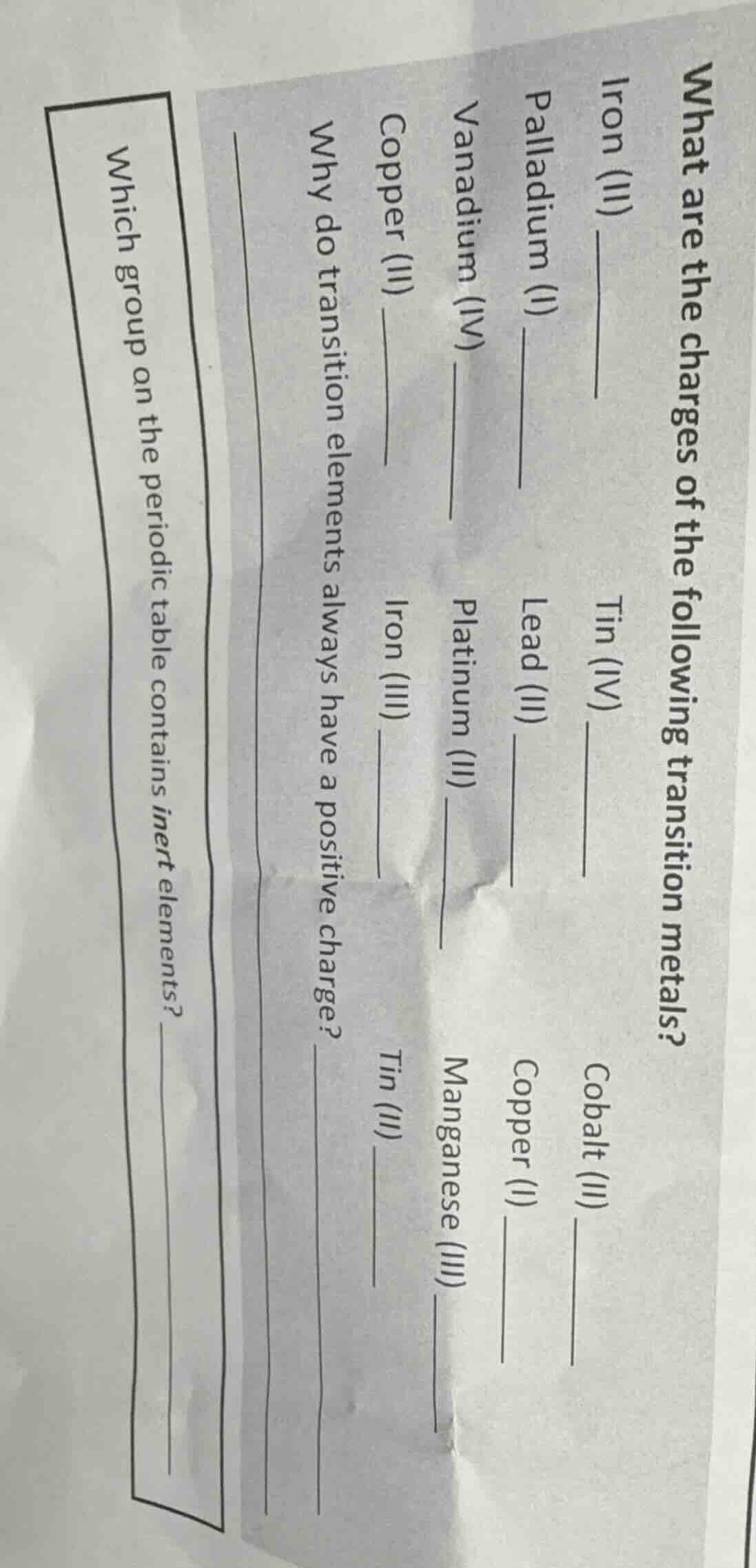
what are the charges of the following transition metals?iron (ii) ______tin (iv) ____cobalt (ii) ____palladium (i) ____lead (ii) ____copper (i) ____vanadium (iv) ____platinum (ii) ____manganese (iii) ____copper (ii) ____iron (iii) ____tin (ii) ____why do transition elements always have a positive charge?________________________________________________________________________________________________________________________________________which group on the periodic table contains inert elements? ______
- For metal ion charges, the Roman numeral in the name directly corresponds to the positive charge of the ion.
- Transition elements have low ionization energies and tend to lose valence electrons (from s and d orbitals) to form stable cations, resulting in positive charges.
- Inert (noble gas) elements are located in Group 18 (8A) of the periodic table, as they have full valence electron shells and are unreactive.

Snap & solve any problem in the app
Get step-by-step solutions on Sovi AI
Photo-based solutions with guided steps
Explore more problems and detailed explanations
Ion Charges:
Iron (II): $+2$
Tin (IV): $+4$
Cobalt (II): $+2$
Palladium (I): $+1$
Lead (II): $+2$
Copper (I): $+1$
Vanadium (IV): $+4$
Platinum (II): $+2$
Manganese (III): $+3$
Copper (II): $+2$
Iron (III): $+3$
Tin (II): $+2$
Transition Element Charge Question:
Transition elements tend to lose valence electrons (from their outermost s and inner d orbitals) to achieve stable electron configurations, resulting in positively charged ions.
Inert Elements Group Question:
Group 18 (or Group 8A)