QUESTION IMAGE
Question
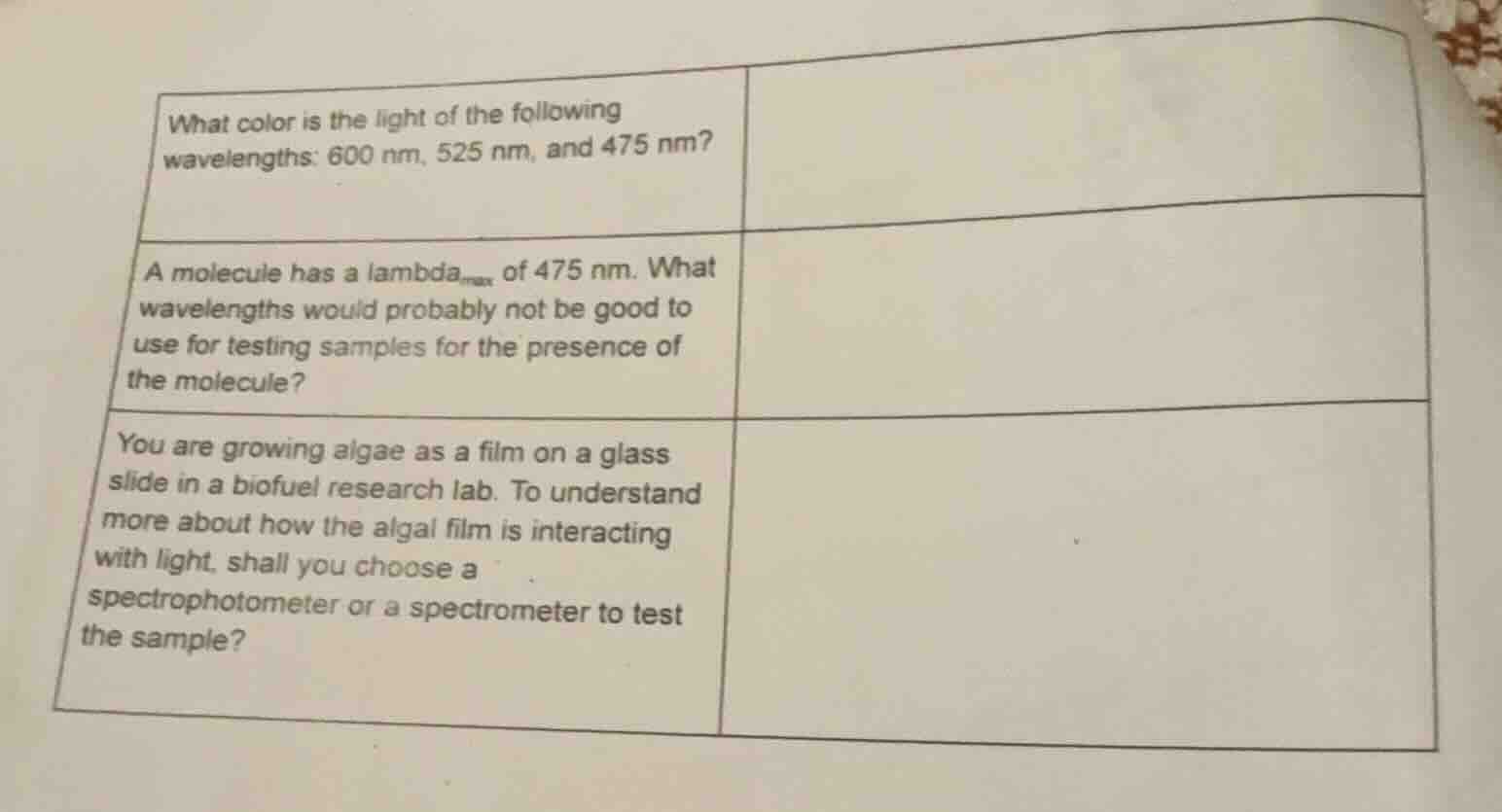
what color is the light of the following wavelengths: 600 nm, 525 nm, and 475 nm?
a molecule has a lambda_max of 475 nm. what wavelengths would probably not be good to use for testing samples for the presence of the molecule?
you are growing algae as a film on a glass slide in a biofuel research lab. to understand more about how the algal film is interacting with light, shall you choose a spectrophotometer or a spectrometer to test the sample?
First Sub - Question: What color is the light of the following wavelengths: 600 nm, 525 nm, and 475 nm?
- For a wavelength of 600 nm: In the visible light spectrum, wavelengths around 600 nm fall in the orange - red region, specifically orange (the visible spectrum ranges from approximately 400 nm to 700 nm; 600 nm is in the orange range, with red being around 620 - 700 nm and orange around 590 - 620 nm, so 600 nm is orange).
- For a wavelength of 525 nm: Wavelengths around 525 nm are in the green region (green is approximately 495 - 570 nm, so 525 nm is green).
- For a wavelength of 475 nm: Wavelengths around 475 nm are in the blue region (blue is approximately 450 - 495 nm, so 475 nm is blue).
A molecule absorbs light most strongly at its $\lambda_{max}$ (475 nm in this case). For detecting the presence of the molecule, we rely on the absorption of light. Wavelengths that are close to the $\lambda_{max}$ will have significant absorption, while wavelengths far from $\lambda_{max}$ (where the molecule has very little absorption) are not good for testing. Since the molecule absorbs strongly at 475 nm, wavelengths that are not close to 475 nm (e.g., wavelengths in the regions where the molecule has minimal absorption, like wavelengths far in the red (e.g., 650 nm) or far in the green - yellow (e.g., 580 nm) that are not near 475 nm) would not be good. Specifically, wavelengths that are not in the vicinity of 475 nm (where the molar absorptivity $\epsilon$ is low) are not suitable. For example, wavelengths like 600 nm (which we determined is orange) or 525 nm (green) are relatively far from 475 nm (blue) and would have less absorption by the molecule, so they would not be good for testing as the change in absorbance (which we measure to detect the molecule) would be small.
- A spectrophotometer measures the amount of light absorbed (or transmitted) by a sample at specific wavelengths (or over a range of wavelengths). It is used to measure the absorbance (or transmittance) which gives information about how the sample interacts with light (e.g., which wavelengths are absorbed, the extent of absorption).
- A spectrometer is more focused on analyzing the spectrum of light (e.g., the emission spectrum or the detailed spectral composition), but for studying how the algal film interacts with light (absorption, transmittance), a spectrophotometer is more appropriate as it can measure the absorbance at different wavelengths, which helps in understanding the light - matter interaction of the algal film (e.g., which wavelengths the algae absorb, how much, etc.).

Snap & solve any problem in the app
Get step-by-step solutions on Sovi AI
Photo-based solutions with guided steps
Explore more problems and detailed explanations
600 nm: Orange; 525 nm: Green; 475 nm: Blue