QUESTION IMAGE
Question
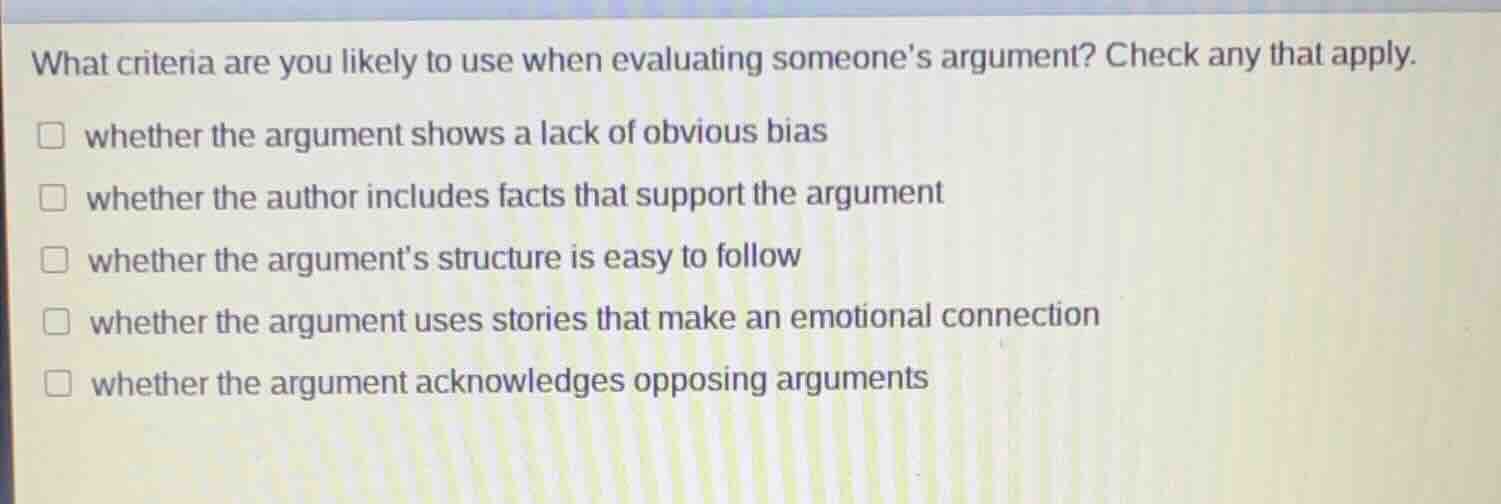
what criteria are you likely to use when evaluating someones argument? check any that apply. whether the argument shows a lack of obvious bias whether the author includes facts that support the argument whether the arguments structure is easy to follow whether the argument uses stories that make an emotional connection whether the argument acknowledges opposing arguments
When evaluating an argument, multiple valid criteria exist:
- Lack of obvious bias: A biased argument may be one - sided or misleading, so checking for this helps assess objectivity.
- Factual support: Facts provide evidence to back up the claim, making the argument more credible.
- Structural clarity: An easy - to - follow structure ensures that the logic of the argument is understandable, which is important for its validity.
- Acknowledging opposing arguments: This shows that the arguer has considered different perspectives, strengthening the argument's credibility.
- Emotional connection (via stories): While emotional appeals can be part of persuasive arguments, but for a strong, well - rounded argument, the other criteria (bias, facts, structure, opposing arguments) are also key. However, all the options except maybe the emotional connection (depending on the context of a "good" argument) can be valid. But typically, in academic or critical evaluation of arguments, the first, second, third, and fifth are very important. The fourth (emotional connection via stories) can be a persuasive tool but not a core criterion for the strength of the argument's logic. But since the question is about "likely to use" and all these can be used in different evaluation contexts, all the options are valid criteria in appropriate situations. But if we consider the core criteria for a strong, logical argument, the most important ones are:
- Whether the argument shows a lack of obvious bias: To ensure objectivity.
- Whether the author includes facts that support the argument: To ensure the argument has evidence.
- Whether the argument’s structure is easy to follow: To ensure the logic is clear.
- Whether the argument acknowledges opposing arguments: To show thoroughness.
- Whether the argument uses stories that make an emotional connection: To assess persuasive techniques (though less about logical strength but still a part of evaluation in some cases like persuasive writing).

Snap & solve any problem in the app
Get step-by-step solutions on Sovi AI
Photo-based solutions with guided steps
Explore more problems and detailed explanations
All the options are valid criteria in appropriate evaluation contexts. But if we consider the core criteria for a strong, logical argument, the most important ones to check are:
- $\square$ whether the argument shows a lack of obvious bias
- $\square$ whether the author includes facts that support the argument
- $\square$ whether the argument’s structure is easy to follow
- $\square$ whether the argument acknowledges opposing arguments
(The option "whether the argument uses stories that make an emotional connection" can also be a valid criterion in persuasive argument evaluation, so it can be checked too depending on the context of evaluation.)