QUESTION IMAGE
Question
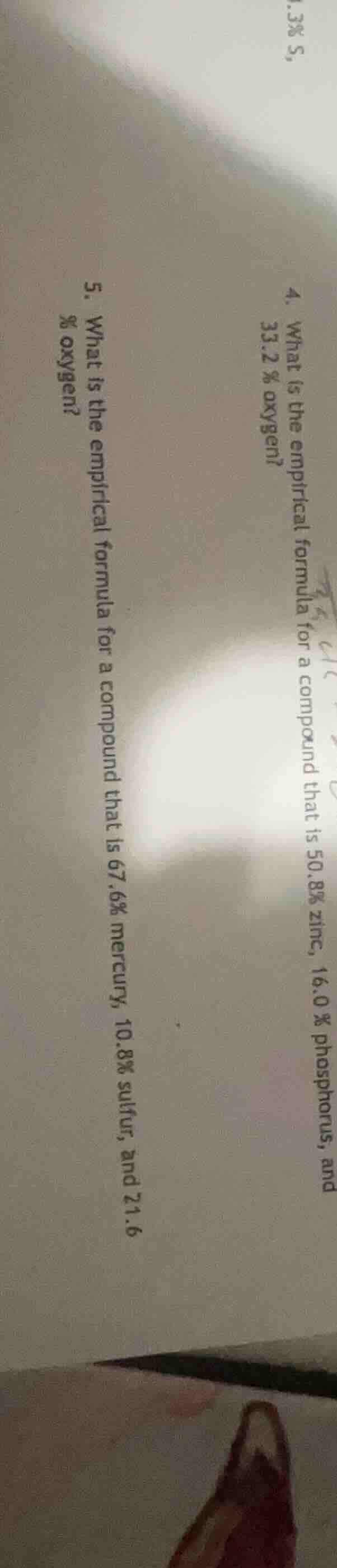
- what is the empirical formula for a compound that is 50.8% zinc, 16.0% phosphorus, and 33.2% oxygen?
- what is the empirical formula for a compound that is 67.6% mercury, 10.8% sulfur, and 21.6% oxygen?
For Question 4:
Step1: Assume 100g sample
Masses: $m_{\text{Zn}}=50.8\ \text{g}$, $m_{\text{P}}=16.0\ \text{g}$, $m_{\text{O}}=33.2\ \text{g}$
Step2: Calculate moles (n=m/M)
Molar masses: $M_{\text{Zn}}=65.38\ \text{g/mol}$, $M_{\text{P}}=30.97\ \text{g/mol}$, $M_{\text{O}}=16.00\ \text{g/mol}$
$n_{\text{Zn}}=\frac{50.8}{65.38} \approx 0.777\ \text{mol}$
$n_{\text{P}}=\frac{16.0}{30.97} \approx 0.517\ \text{mol}$
$n_{\text{O}}=\frac{33.2}{16.00} = 2.075\ \text{mol}$
Step3: Divide by smallest mole value
Smallest $n=0.517\ \text{mol}$
$\text{Zn: } \frac{0.777}{0.517} \approx 1.5$
$\text{P: } \frac{0.517}{0.517} = 1$
$\text{O: } \frac{2.075}{0.517} \approx 4$
Step4: Multiply to get whole numbers
Multiply all by 2: $\text{Zn}=3$, $\text{P}=2$, $\text{O}=8$
---
For Question 5:
Step1: Assume 100g sample
Masses: $m_{\text{Hg}}=67.6\ \text{g}$, $m_{\text{S}}=10.8\ \text{g}$, $m_{\text{O}}=21.6\ \text{g}$
Step2: Calculate moles (n=m/M)
Molar masses: $M_{\text{Hg}}=200.59\ \text{g/mol}$, $M_{\text{S}}=32.07\ \text{g/mol}$, $M_{\text{O}}=16.00\ \text{g/mol}$
$n_{\text{Hg}}=\frac{67.6}{200.59} \approx 0.337\ \text{mol}$
$n_{\text{S}}=\frac{10.8}{32.07} \approx 0.337\ \text{mol}$
$n_{\text{O}}=\frac{21.6}{16.00} = 1.35\ \text{mol}$
Step3: Divide by smallest mole value
Smallest $n=0.337\ \text{mol}$
$\text{Hg: } \frac{0.337}{0.337} = 1$
$\text{S: } \frac{0.337}{0.337} = 1$
$\text{O: } \frac{1.35}{0.337} \approx 4$

Snap & solve any problem in the app
Get step-by-step solutions on Sovi AI
Photo-based solutions with guided steps
Explore more problems and detailed explanations
- $\text{Zn}_3\text{P}_2\text{O}_8$ (or $\text{Zn}_3(\text{PO}_4)_2$)
- $\text{HgSO}_4$