QUESTION IMAGE
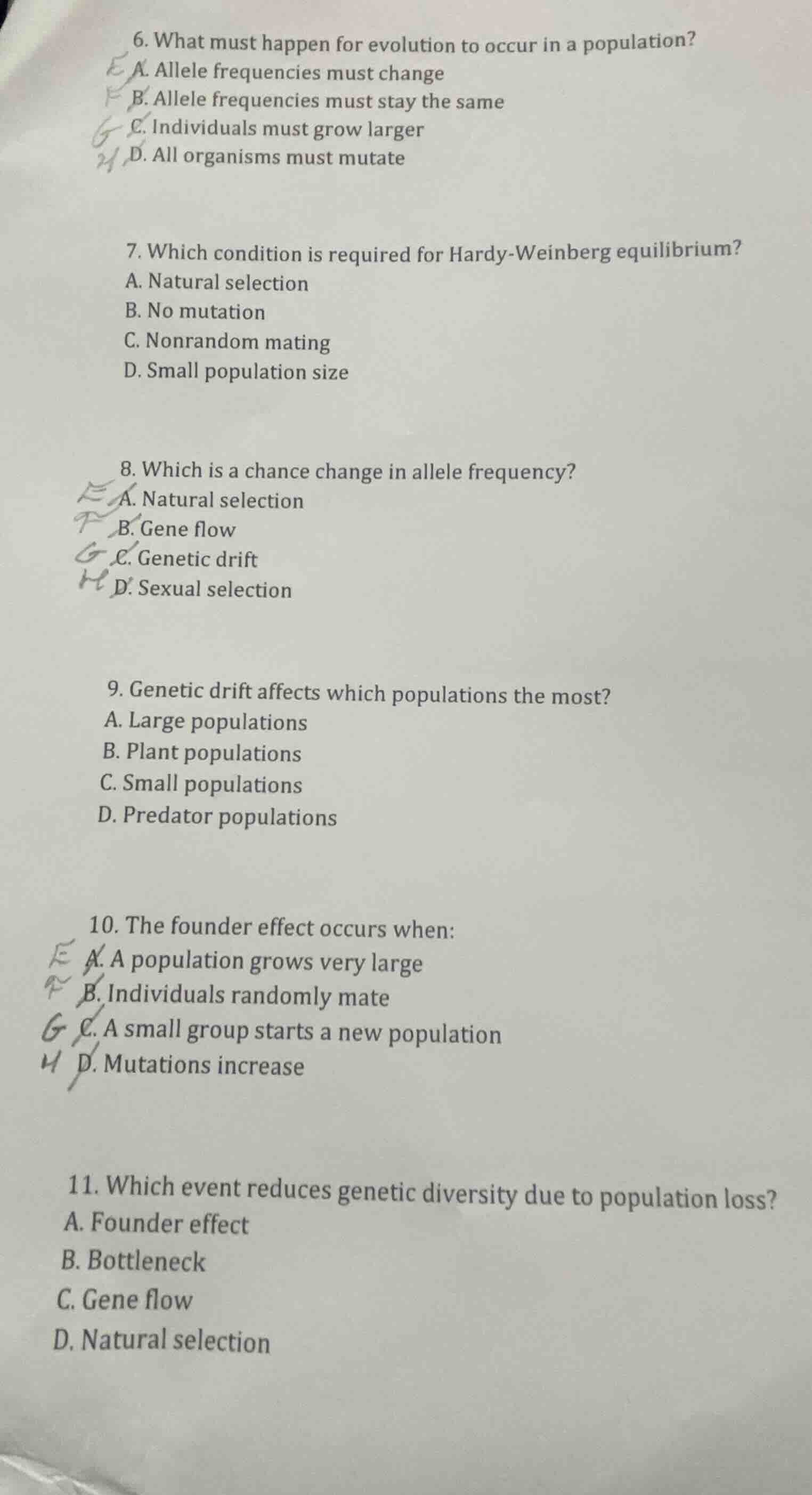
Question
- what must happen for evolution to occur in a population?
a. allele frequencies must change
b. allele frequencies must stay the same
c. individuals must grow larger
d. all organisms must mutate
- which condition is required for hardy-weinberg equilibrium?
a. natural selection
b. no mutation
c. nonrandom mating
d. small population size
- which is a chance change in allele frequency?
a. natural selection
b. gene flow
c. genetic drift
d. sexual selection
- genetic drift affects which populations the most?
a. large populations
b. plant populations
c. small populations
d. predator populations
- the founder effect occurs when:
a. a population grows very large
b. individuals randomly mate
c. a small group starts a new population
d. mutations increase
- which event reduces genetic diversity due to population loss?
a. founder effect
b. bottleneck
c. gene flow
d. natural selection
Brief Explanations
- Evolution is defined as changes in a population's allele frequencies over generations; stable frequencies mean no evolution, individual size changes don't drive population evolution, and universal mutation isn't required.
- Hardy-Weinberg equilibrium requires no evolutionary forces acting; no mutation is one of its core conditions, while natural selection, nonrandom mating, and small population size disrupt equilibrium.
- Genetic drift is specifically the random, chance change in allele frequencies in a population, unlike natural/sexual selection (non-random, trait-based) and gene flow (movement of alleles between populations).
- Genetic drift has a much more pronounced effect on small populations, as chance events can more easily alter allele frequencies compared to large populations where random changes are diluted.
- The founder effect is a type of genetic drift that occurs when a small subset of a larger population establishes a new, isolated population, carrying only a fraction of the original genetic diversity.
- The bottleneck effect happens when a population is drastically reduced in size (population loss), leading to a sharp drop in genetic diversity as only a small set of alleles remains in the surviving population.

Snap & solve any problem in the app
Get step-by-step solutions on Sovi AI
Photo-based solutions with guided steps
Explore more problems and detailed explanations
- A. Allele frequencies must change
- B. No mutation
- C. Genetic drift
- C. Small populations
- C. A small group starts a new population
- B. Bottleneck