QUESTION IMAGE
Question
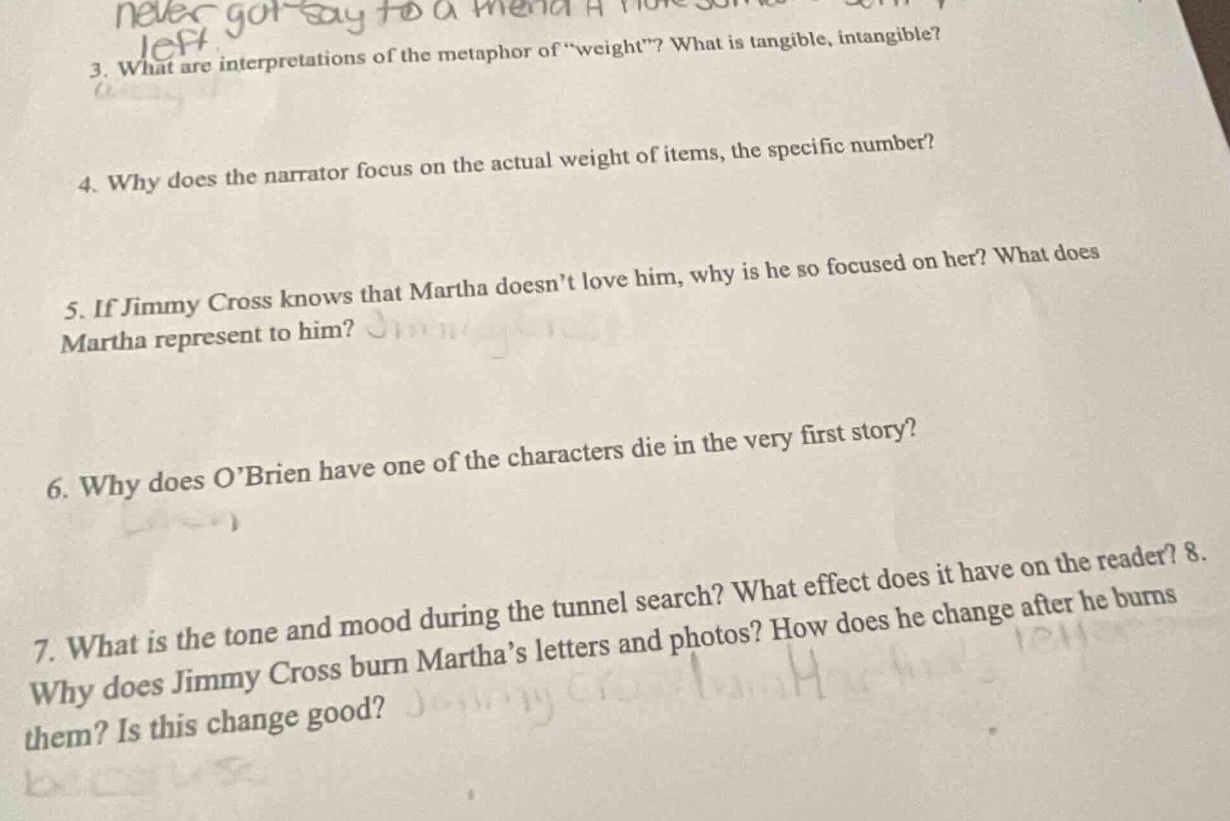
- what are interpretations of the metaphor of \weight\? what is tangible, intangible?
- why does the narrator focus on the actual weight of items, the specific number?
- if jimmy cross knows that martha doesnt love him, why is he so focused on her? what does martha represent to him?
- why does obrien have one of the characters die in the very first story?
- what is the tone and mood during the tunnel search? what effect does it have on the reader? 8. why does jimmy cross burn marthas letters and photos? how does he change after he burns them? is this change good?
To answer these questions, we analyze each one:
Question 3
The metaphor of “weight” can be interpreted as tangible (physical burden of gear, supplies) and intangible (emotional weight of guilt, longing, war’s psychological toll). Tangible weight is literal (e.g., soldiers’ equipment), intangible is abstract (e.g., guilt over Lavender’s death, longing for Martha).
The narrator focuses on actual weight to emphasize the physical reality of war (soldiers’ daily struggle with burden), contrast with intangible emotional weight, and highlight the dehumanizing, mechanistic nature of war (reducing life to numbers/weight). It also mirrors the psychological “weight” of guilt/responsibility (e.g., Cross’s guilt over Lavender, tied to his preoccupation with Martha).
Jimmy Cross focuses on Martha because she represents escape from war (a symbol of peace, innocence, normalcy), a distraction from guilt (over Lavender’s death), and a reminder of humanity/love in dehumanizing circumstances. Even unrequited, she is his connection to a life beyond war, a fantasy of what he could have.

Snap & solve any problem in the app
Get step-by-step solutions on Sovi AI
Photo-based solutions with guided steps
Explore more problems and detailed explanations
- Tangible: Physical burden (gear, supplies, literal weight of objects).
- Intangible: Emotional/psychological weight (guilt, longing, trauma, responsibility).