QUESTION IMAGE
Question
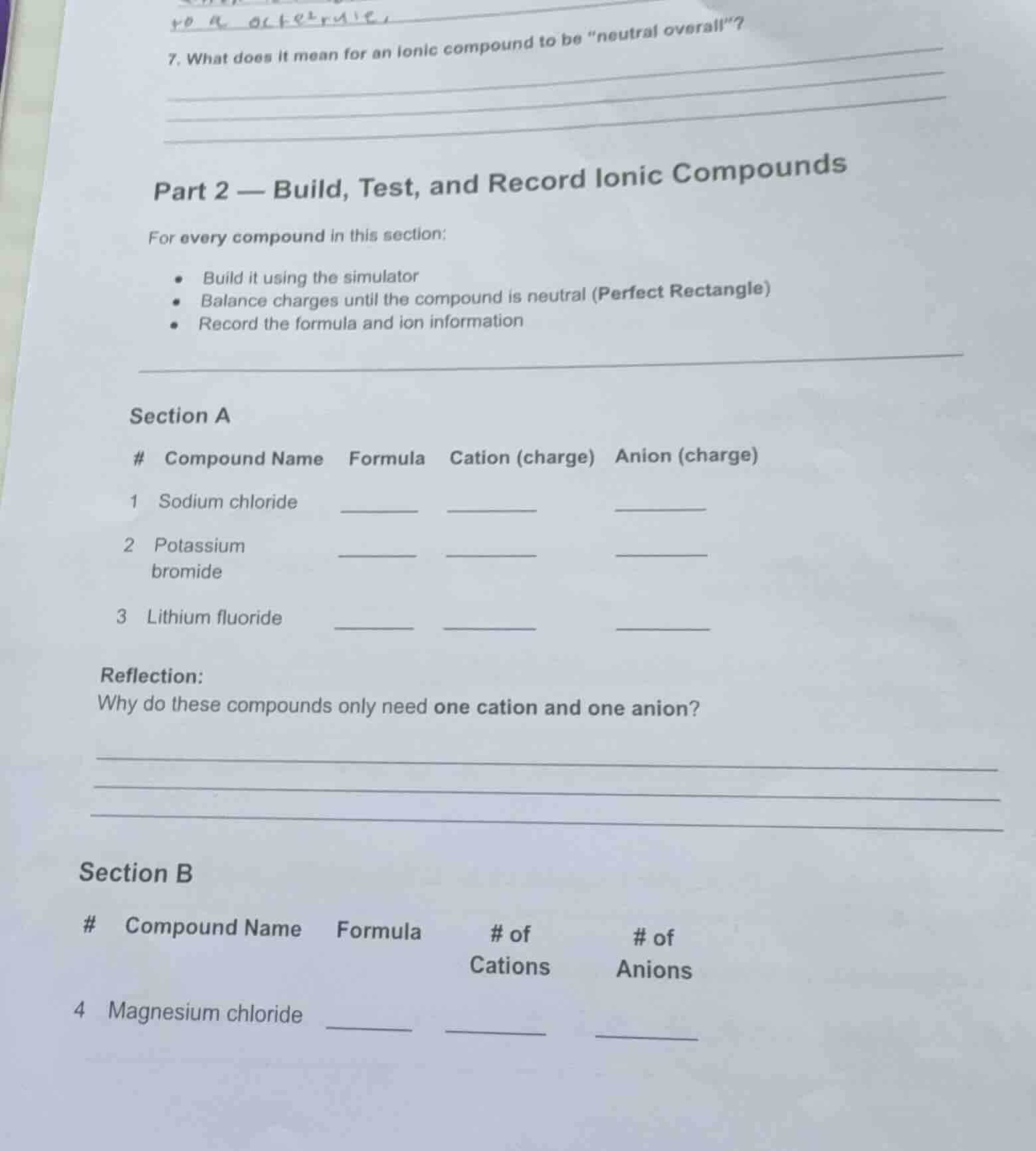
- what does it mean for an ionic compound to be
eutral overall\?
part 2 — build, test, and record ionic compounds
for every compound in this section:
- build it using the simulator
- balance charges until the compound is neutral (perfect rectangle)
- record the formula and ion information
section a
compound name formula cation (charge) anion (charge)
1 sodium chloride
2 potassium bromide
3 lithium fluoride
reflection:
why do these compounds only need one cation and one anion?
section b
compound name formula # of cations # of anions
4 magnesium chloride
Step1: Answer Q7 on neutral ionic compounds
An ionic compound is neutral overall when the total positive charge from all cations exactly cancels out the total negative charge from all anions, resulting in a net charge of 0.
Step2: Fill Section A table
1. Sodium chloride:
Sodium (Group 1) forms $\text{Na}^+$; chlorine (Group 17) forms $\text{Cl}^-$. Charges balance 1:1.
Formula: $\text{NaCl}$; Cation: $\text{Na}^+$ (+1); Anion: $\text{Cl}^-$ (-1)
2. Potassium bromide:
Potassium (Group 1) forms $\text{K}^+$; bromine (Group 17) forms $\text{Br}^-$. Charges balance 1:1.
Formula: $\text{KBr}$; Cation: $\text{K}^+$ (+1); Anion: $\text{Br}^-$ (-1)
3. Lithium fluoride:
Lithium (Group 1) forms $\text{Li}^+$; fluorine (Group 17) forms $\text{F}^-$. Charges balance 1:1.
Formula: $\text{LiF}$; Cation: $\text{Li}^+$ (+1); Anion: $\text{F}^-$ (-1)
Step3: Answer Reflection question
All cations have +1 charge, anions have -1 charge. One +1 and one -1 sum to 0 (neutral), so only one of each is needed.
Step4: Fill Section B (Magnesium chloride)
Magnesium (Group 2) forms $\text{Mg}^{2+}$; chlorine forms $\text{Cl}^-$. 1 $\text{Mg}^{2+}$ needs 2 $\text{Cl}^-$ to balance charge.
Formula: $\text{MgCl}_2$; # of Cations: 1; # of Anions: 2

Snap & solve any problem in the app
Get step-by-step solutions on Sovi AI
Photo-based solutions with guided steps
Explore more problems and detailed explanations
Question 7:
An ionic compound is "neutral overall" when the total positive charge from its cations is equal to the total negative charge from its anions, resulting in a net charge of 0.
Section A:
| # | Compound Name | Formula | Cation (charge) | Anion (charge) |
|---|---|---|---|---|
| 2 | Potassium bromide | $\text{KBr}$ | $\text{K}^+$ (+1) | $\text{Br}^-$ (-1) |
| 3 | Lithium fluoride | $\text{LiF}$ | $\text{Li}^+$ (+1) | $\text{F}^-$ (-1) |
Reflection:
The cations here all have a +1 charge, and the anions all have a -1 charge. A single +1 charge and single -1 charge add up to a net charge of 0 (neutral), so only one of each ion is required to make the compound neutral.
Section B:
| # | Compound Name | Formula | # of Cations | # of Anions |
|---|