QUESTION IMAGE
Question
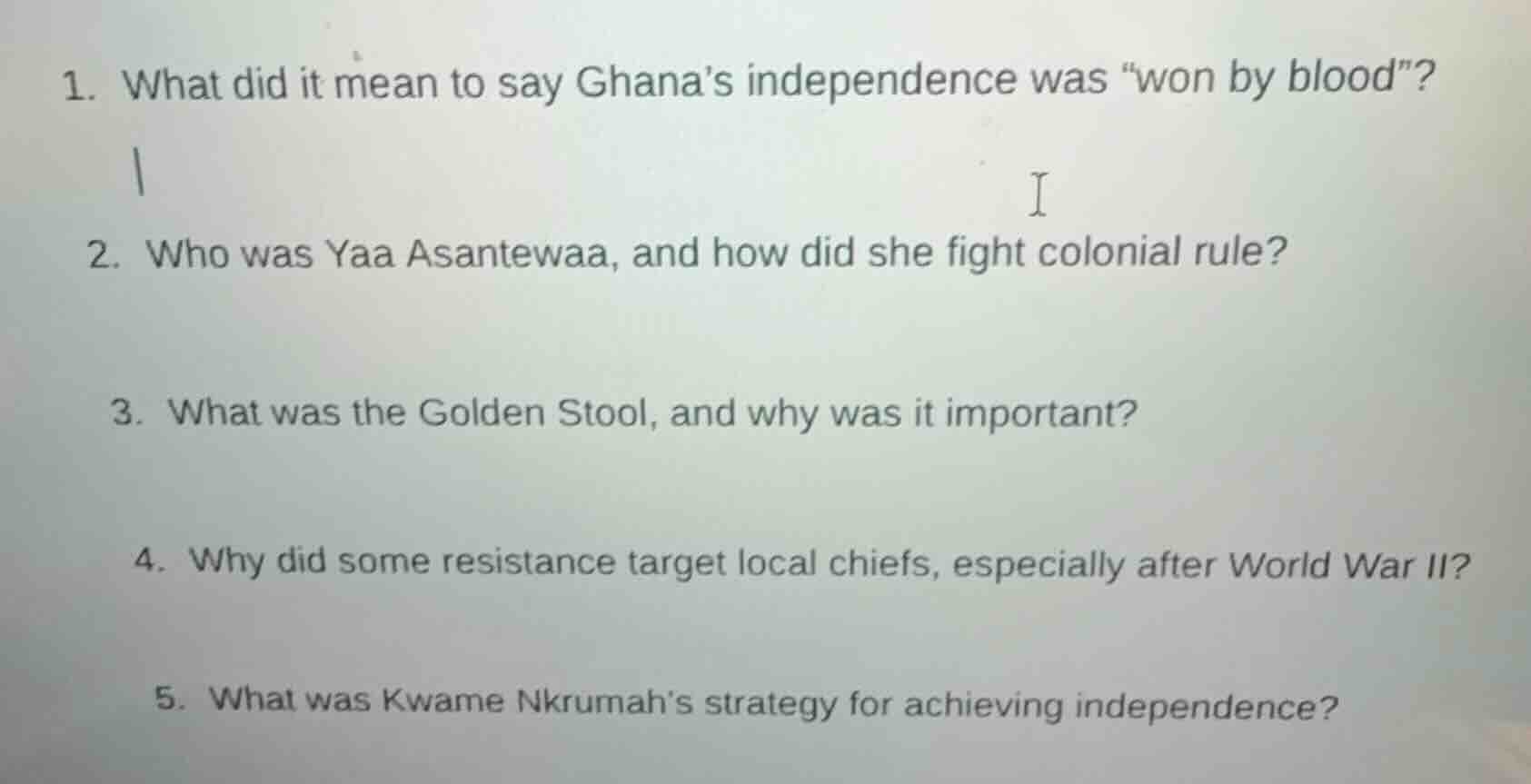
- what did it mean to say ghanas independence was \won by blood\?
- who was yaa asantewaa, and how did she fight colonial rule?
- what was the golden stool, and why was it important?
- why did some resistance target local chiefs, especially after world war ii?
- what was kwame nkrumahs strategy for achieving independence?
Brief Explanations
- This phrase refers to the violent armed resistance by groups like the Ashanti against British colonial forces in conflicts such as the Anglo-Ashanti Wars; these bloody battles laid groundwork for later independence efforts by asserting anti-colonial resolve.
- Yaa Asantewaa was an Ashanti queen mother. She led the 1900 War of the Golden Stool, organizing Ashanti forces to resist British attempts to seize the sacred Golden Stool, a symbol of Ashanti sovereignty, to push back against colonial control.
- The Golden Stool was a sacred, ornate stool of the Ashanti Empire. It was the spiritual and political symbol of Ashanti nationhood, representing the soul, unity, and legitimacy of the Ashanti people and their leadership.
- After WWII, some local chiefs collaborated with colonial powers, enforcing colonial policies, taking land from local people, and benefiting from the colonial system. Resistance groups targeted them as agents of colonial oppression to undermine colonial authority.
- Kwame Nkrumah used a strategy of mass mobilization (uniting workers, farmers, and urban populations), non-violent direct action, building a popular political party (the Convention People's Party), and advocating for immediate self-government rather than gradual reform to secure Ghana's independence in 1957.

Snap & solve any problem in the app
Get step-by-step solutions on Sovi AI
Photo-based solutions with guided steps
Explore more problems and detailed explanations
- It refers to the violent armed resistance (like the Anglo-Ashanti Wars) against British colonial rule, where bloodshed in anti-colonial battles laid groundwork for independence by asserting local sovereignty.
- Yaa Asantewaa was an Ashanti queen mother; she led the 1900 War of the Golden Stool, organizing Ashanti forces to resist British attempts to seize the sacred Golden Stool and fight colonial control.
- The Golden Stool was the sacred symbol of the Ashanti Empire; it represented the Ashanti people's soul, unity, and political legitimacy, making it central to their national identity.
- Many local chiefs collaborated with colonial powers post-WWII, enforcing colonial policies, taking local land, and benefiting from the system, so resistance targeted them as agents of colonial oppression.
- Kwame Nkrumah's strategy included mass mobilization of workers/farmers, non-violent direct action, building a popular political party (Convention People's Party), and demanding immediate self-government instead of gradual reform.