QUESTION IMAGE
Question
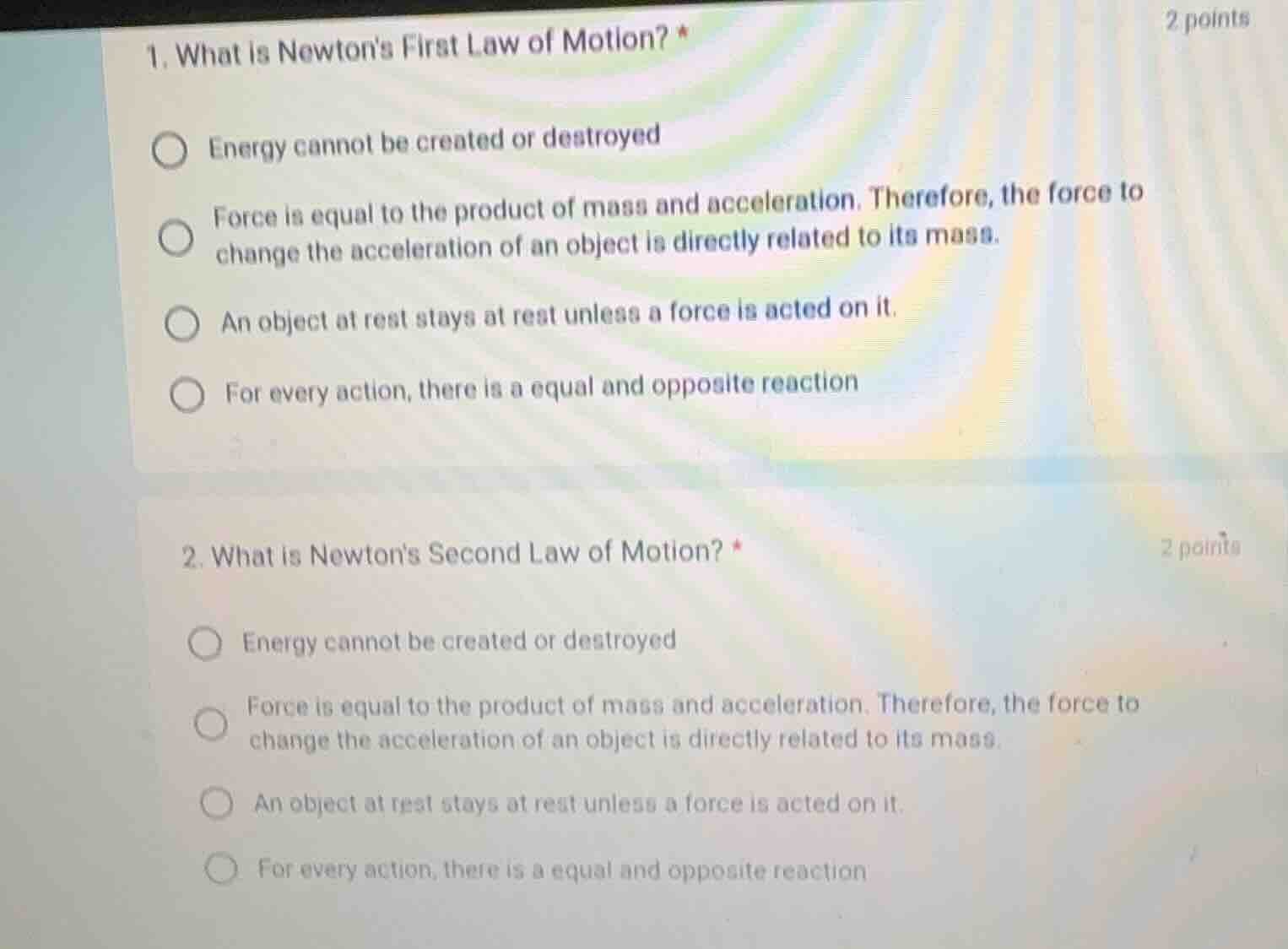
- what is newtons first law of motion? *
energy cannot be created or destroyed
force is equal to the product of mass and acceleration. therefore, the force to change the acceleration of an object is directly related to its mass.
an object at rest stays at rest unless a force is acted on it.
for every action, there is a equal and opposite reaction
- what is newtons second law of motion? *
energy cannot be created or destroyed
force is equal to the product of mass and acceleration. therefore, the force to change the acceleration of an object is directly related to its mass.
an object at rest stays at rest unless a force is acted on it.
for every action, there is a equal and opposite reaction
Question 1:
- "Energy cannot be created or destroyed" is the law of conservation of energy, not Newton's First Law.
- "Force is equal to the product of mass and acceleration..." is Newton's Second Law.
- "An object at rest stays at rest unless a force is acted on it" matches the definition of Newton's First Law (also stating that an object in motion stays in motion with constant velocity unless a net force acts on it, the option here gives the rest part).
- "For every action, there is a equal and opposite reaction" is Newton's Third Law.
- "Energy cannot be created or destroyed" is the law of conservation of energy, not Newton's Second Law.
- "Force is equal to the product of mass and acceleration. Therefore, the force to change the acceleration of an object is directly related to its mass" is the definition of Newton's Second Law ($F = ma$).
- "An object at rest stays at rest unless a force is acted on it" is Newton's First Law.
- "For every action, there is a equal and opposite reaction" is Newton's Third Law.

Snap & solve any problem in the app
Get step-by-step solutions on Sovi AI
Photo-based solutions with guided steps
Explore more problems and detailed explanations
C. An object at rest stays at rest unless a force is acted on it.