QUESTION IMAGE
Question
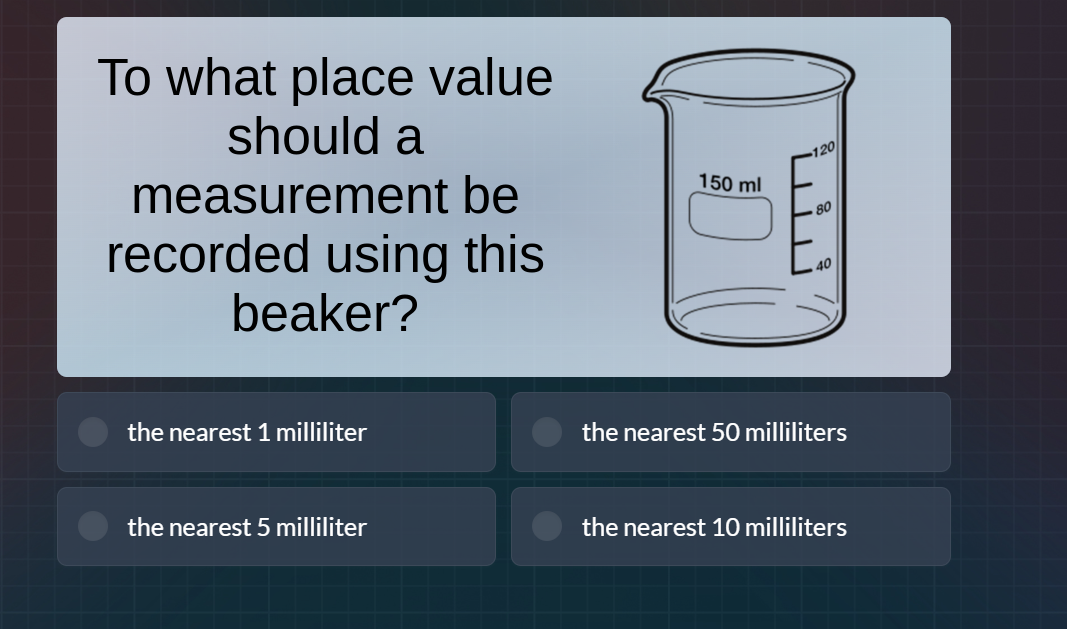
to what place value should a measurement be recorded using this beaker? beaker image with 150 ml and markings at 40, 80, 120 options: the nearest 1 milliliter, the nearest 50 milliliters, the nearest 5 milliliter, the nearest 10 milliliters
To determine the place value for recording measurements with the beaker, we analyze the markings. The beaker has markings at 40, 80, 120 mL. The interval between consecutive markings (e.g., 40 to 80, 80 to 120) is \( 80 - 40 = 40 \) mL, and there are no intermediate markings between them. Wait, no, looking again, the distance between 40 and 80 is 40 mL, but actually, the difference between 40 and 80 is 40, but the number of intervals? Wait, no, the beaker's scale: from 40 to 80 is 40 mL, and if we see the space between 40 and 80, how many divisions? Wait, the image shows 40, 80, 120. So the increment between each major mark is \( 80 - 40 = 40 \)? No, wait, 40 to 80 is 40, 80 to 120 is 40? No, that can't be. Wait, maybe the marks are 40, 80, 120, so the difference between 40 and 80 is 40, but maybe there are no minor marks. So when a measuring device has markings with an interval of \( \Delta x \), the measurement should be recorded to the precision of the interval (or half the interval, but if there are no minor marks, the precision is the interval between the major marks). Wait, no, the beaker here has marks at 40, 80, 120. So the distance between 40 and 80 is 40 mL, but that seems too big. Wait, maybe I misread. Wait, the beaker is 150 mL, with marks at 40, 80, 120. So from 40 to 80 is 40 mL, so the interval between each mark is 40 mL? No, that can't be. Wait, maybe the marks are 40, 80, 120, so the step between them is \( 80 - 40 = 40 \)? No, that's not right. Wait, maybe the beaker has markings at 40, 80, 120, so the difference between 40 and 80 is 40 mL, but that would mean the precision is to the nearest 40 mL? But that's not an option. Wait, no, maybe I made a mistake. Wait, the options are nearest 1, 5, 10, 50 mL. Wait, let's re-examine. The beaker's scale: from 40 to 80 is 40 mL, but maybe there are no smaller divisions. Wait, but the options include 10 mL. Wait, maybe the marks are 40, 80, 120, so the interval between 40 and 80 is 40 mL, but that's divided into how many parts? Wait, no, maybe the beaker has a scale where each major mark is 40 mL apart, but that's not typical. Wait, maybe the correct approach is: when a measuring instrument has markings with an interval of \( \Delta \), the measurement is recorded to the precision of \( \Delta \) (if no minor marks) or half of \( \Delta \) (if there are minor marks). But if there are no minor marks, the precision is the interval between the major marks. Wait, but the options include 10 mL. Wait, maybe the beaker has marks at 40, 80, 120, so the difference between 40 and 80 is 40 mL, but that's not matching. Wait, maybe I misread the marks. Wait, the beaker is 150 mL, with marks at 40, 80, 120. So 40 to 80 is 40, 80 to 120 is 40. But that's 40 mL intervals. But the options are 1, 5, 10, 50. Wait, 50 mL: 40 to 90 would be 50, but no. Wait, maybe the beaker's scale is such that the distance between 40 and 80 is 40 mL, but that's not helpful. Wait, maybe the correct answer is the nearest 10 mL? No, wait, let's think about typical beaker precision. Beakers are not as precise as graduated cylinders, but their markings are usually to the nearest 10 mL or so. Wait, but the options: nearest 10 mL. Wait, but let's check the intervals. If the marks are at 40, 80, 120, the difference between 40 and 80 is 40 mL, but that's a large interval. Wait, maybe the beaker has markings at 40, 80, 120, so the step is 40 mL, but that's not an option. Wait, no, maybe I made a mistake. Wait, the options include "the nearest 10 milliliters". Wait, maybe the beaker has minor marks between 40 and 80, but…

Snap & solve any problem in the app
Get step-by-step solutions on Sovi AI
Photo-based solutions with guided steps
Explore more problems and detailed explanations
D. the nearest 10 milliliters