QUESTION IMAGE
Question
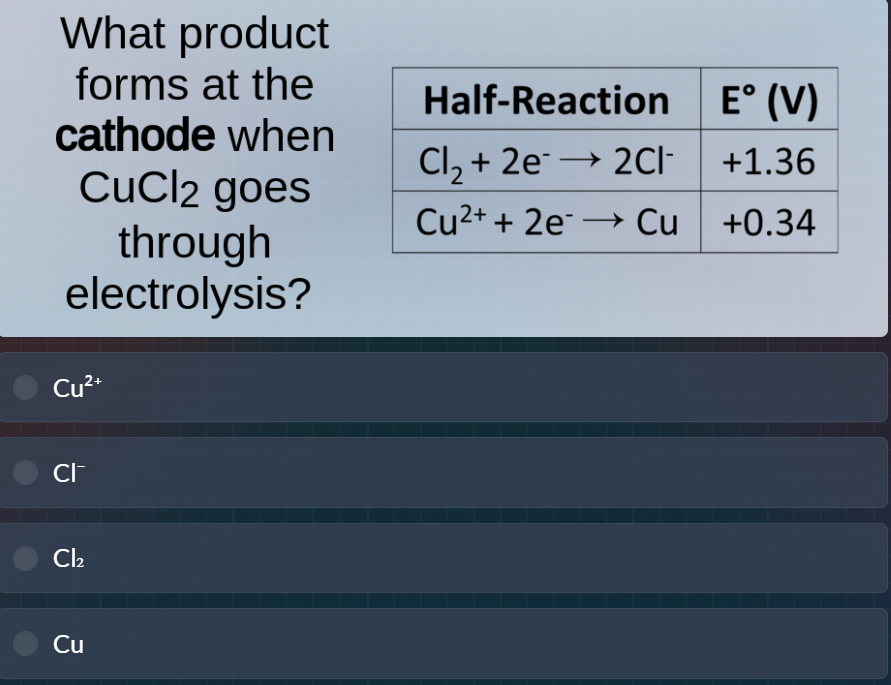
what product forms at the cathode when cucl₂ goes through electrolysis?
half-reaction | e° (v)
cl₂ + 2e⁻ → 2cl⁻ | +1.36
cu²⁺ + 2e⁻ → cu | +0.34
options: cu²⁺, cl⁻, cl₂, cu
In electrolysis, reduction occurs at the cathode. The half - reaction with the more positive (or less negative) standard reduction potential ($E^{\circ}$) is more likely to occur. The two half - reactions are:
- $\ce{Cl_{2} + 2e^{-}->2Cl^{-}}$ with $E^{\circ}= + 1.36\ V$ (this is a reduction reaction, but we can also think about its reverse for oxidation. However, at the cathode, we want reduction).
- $\ce{Cu^{2+}+2e^{-}->Cu}$ with $E^{\circ}= + 0.34\ V$.
Wait, actually, for the electrolysis of $\ce{CuCl_{2}}$, the ions present are $\ce{Cu^{2+}}$ and $\ce{Cl^{-}}$. At the cathode, reduction takes place. The possible reduction reactions are the reduction of $\ce{Cu^{2+}}$ to $\ce{Cu}$ (using the half - reaction $\ce{Cu^{2+}+2e^{-}->Cu}$) and the reduction of $\ce{Cl_{2}}$ to $\ce{Cl^{-}}$ (but $\ce{Cl^{-}}$ is already in the solution, and to get $\ce{Cl_{2}}$, we need oxidation of $\ce{Cl^{-}}$ at the anode). Wait, no, let's correct this. The standard reduction potential for $\ce{Cu^{2+} + 2e^{-}->Cu}$ is $+ 0.34\ V$ and for $\ce{Cl_{2}+2e^{-}->2Cl^{-}}$ is $+ 1.36\ V$. But in the electrolysis of $\ce{CuCl_{2}}$, the species that can be reduced at the cathode are $\ce{Cu^{2+}}$ (from the salt) and $\ce{H^{+}}$ (from water, if we consider aqueous solution). The standard reduction potential of $\ce{Cu^{2+} + 2e^{-}->Cu}$ is more positive than the reduction of $\ce{H^{+}}$ to $\ce{H_{2}}$ (which has $E^{\circ}=0\ V$ for $\ce{2H^{+}+2e^{-}->H_{2}}$). So $\ce{Cu^{2+}}$ will be reduced at the cathode to $\ce{Cu}$. The $\ce{Cl^{-}}$ ions will be oxidized at the anode to $\ce{Cl_{2}}$ (since the oxidation of $\ce{Cl^{-}}$ to $\ce{Cl_{2}}$ (reverse of $\ce{Cl_{2}+2e^{-}->2Cl^{-}}$) has a lower (less positive) oxidation potential compared to the oxidation of $\ce{OH^{-}}$ to $\ce{O_{2}}$ in some cases, but in this case, for $\ce{CuCl_{2}}$ electrolysis, $\ce{Cl^{-}}$ is oxidized to $\ce{Cl_{2}}$ at the anode). So at the cathode, the reduction of $\ce{Cu^{2+}}$ to $\ce{Cu}$ occurs.

Snap & solve any problem in the app
Get step-by-step solutions on Sovi AI
Photo-based solutions with guided steps
Explore more problems and detailed explanations
D. Cu (assuming the options are labeled as A. $\ce{Cu^{2+}}$, B. $\ce{Cl^{-}}$, C. $\ce{Cl_{2}}$, D. $\ce{Cu}$)