QUESTION IMAGE
Question
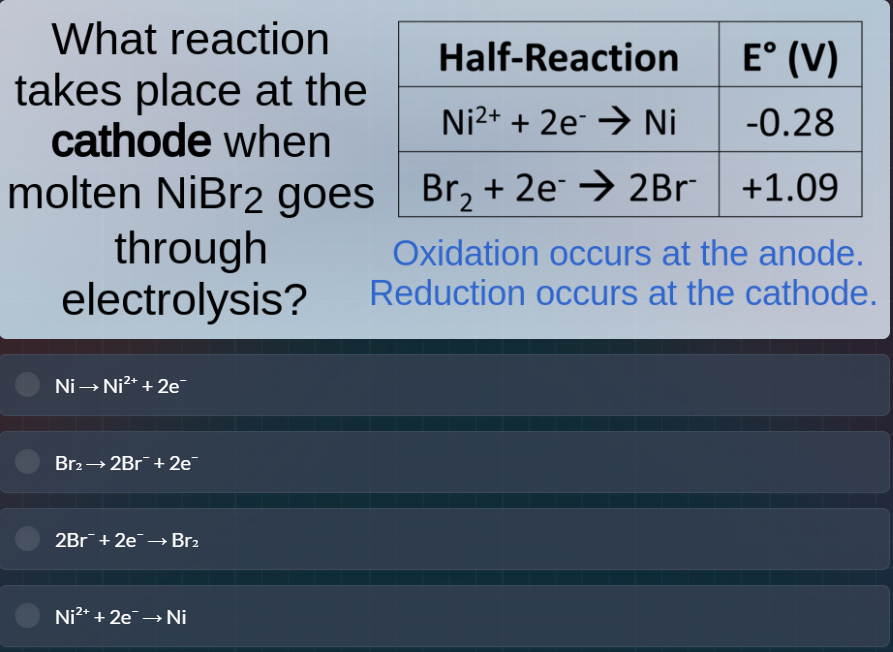
what reaction takes place at the cathode when molten nibr₂ goes through electrolysis?
half-reaction | e° (v)
ni²⁺ + 2e⁻ → ni | -0.28
br₂ + 2e⁻ → 2br⁻ | +1.09
oxidation occurs at the anode. reduction occurs at the cathode.
options:
ni → ni²⁺ + 2e⁻
br₂ → 2br⁻ + 2e⁻
2br⁻ + 2e⁻ → br₂
ni²⁺ + 2e⁻ → ni
Brief Explanations
- Recall the definition of cathode reaction in electrolysis: Reduction (gain of electrons) occurs at the cathode.
- Analyze the half - reactions:
- The given half - reactions are \( \ce{Ni^{2+} + 2e^- \to Ni} \) (reduction, since electrons are gained) with \( E^o=- 0.28\space V \) and \( \ce{Br_2 + 2e^- \to 2Br^-} \) (reduction, electrons gained) with \( E^o = + 1.09\space V \). But in the electrolysis of molten \( \ce{NiBr_2} \), the ions present are \( \ce{Ni^{2+}} \) and \( \ce{Br^-} \).
- For the cathode (reduction), we need to look at the reduction of the cation (or the species that can gain electrons). The \( \ce{Ni^{2+}} \) ion will gain electrons to form \( \ce{Ni} \). The reaction \( \ce{Ni^{2+}+2e^-\to Ni} \) is a reduction reaction (electrons are added to \( \ce{Ni^{2+}} \) to form \( \ce{Ni} \)).
- Let's analyze the other options:
- \( \ce{Ni\to Ni^{2+}+2e^-} \) is an oxidation (loss of electrons), so it can't be at the cathode.
- \( \ce{Br_2\to 2Br^- + 2e^-} \) is an oxidation (loss of electrons), not a cathode reaction.
- \( \ce{2Br^-+2e^-\to Br_2} \) is a reduction, but in molten \( \ce{NiBr_2} \), the bromide ions would be oxidized at the anode (since oxidation of \( \ce{Br^-} \) to \( \ce{Br_2} \) is more favorable in terms of electrode potential compared to the oxidation of \( \ce{Ni} \) to \( \ce{Ni^{2+}} \)), and the reduction of \( \ce{Ni^{2+}} \) is the cathode reaction.

Snap & solve any problem in the app
Get step-by-step solutions on Sovi AI
Photo-based solutions with guided steps
Explore more problems and detailed explanations
D. \( \ce{Ni^{2+} + 2e^- \to Ni} \)