QUESTION IMAGE
Question
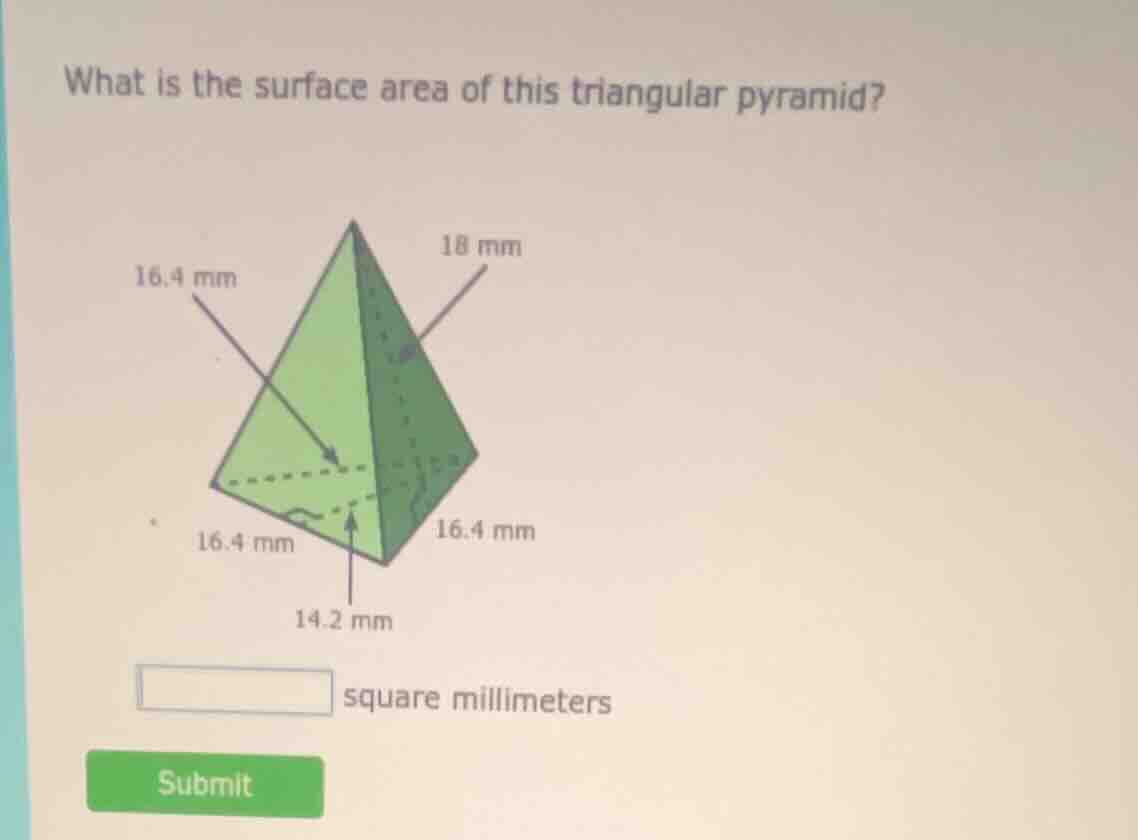
what is the surface area of this triangular pyramid? 16.4 mm 18 mm 16.4 mm 14.2 mm 16.4 mm square millimeters submit
Step1: Analyze the triangular pyramid
A triangular pyramid (tetrahedron) with a triangular base and three triangular faces. Here, the base is an equilateral triangle with side length \( 16.4 \) mm, and the height of the base triangle (altitude) is \( 14.2 \) mm. The three lateral faces are congruent triangles with base \( 16.4 \) mm and slant height \( 18 \) mm? Wait, no, the given slant height? Wait, the base area: area of the triangular base is \( \frac{1}{2} \times \text{base} \times \text{height of base} \). Then the lateral surface area: three times the area of one lateral triangle. Wait, looking at the diagram, the base triangle has sides \( 16.4 \) mm, \( 16.4 \) mm, \( 16.4 \) mm? Wait, no, the base is a triangle with base \( 16.4 \) mm and height \( 14.2 \) mm? Wait, no, the base is an equilateral triangle? Wait, the three edges at the base are \( 16.4 \) mm each? Wait, maybe the base is an equilateral triangle with side \( 16.4 \) mm, and the height of the base triangle (altitude) is \( 14.2 \) mm? Wait, no, let's re-express:
Wait, the surface area of a triangular pyramid (tetrahedron) is the sum of the area of the base and the area of the three lateral faces.
First, the base: it's a triangle with base \( b = 16.4 \) mm and height \( h_{base} = 14.2 \) mm. So area of base \( A_{base} = \frac{1}{2} \times 16.4 \times 14.2 \).
Then, the lateral faces: each lateral face is a triangle with base \( 16.4 \) mm and slant height (height of the lateral triangle) \( 18 \) mm? Wait, the diagram shows a slant height of \( 18 \) mm? Wait, no, the given lengths: the three lateral edges? Wait, no, the lateral faces: each has a base of \( 16.4 \) mm and a height (slant height) of \( 18 \) mm? Wait, maybe I misread. Wait, the triangular pyramid: the base is a triangle, and the three lateral faces are triangles. Let's check the given values:
Wait, the base triangle: base \( 16.4 \) mm, height \( 14.2 \) mm. So area of base: \( \frac{1}{2} \times 16.4 \times 14.2 \).
Then, the three lateral faces: each has a base of \( 16.4 \) mm and a height (slant height) of \( 18 \) mm? Wait, no, the diagram has a slant height of \( 18 \) mm? Wait, maybe the lateral faces have base \( 16.4 \) mm and height \( 18 \) mm? Wait, let's calculate:
First, base area: \( \frac{1}{2} \times 16.4 \times 14.2 \). Let's compute that: \( 0.5 \times 16.4 = 8.2 \); \( 8.2 \times 14.2 = 116.44 \) square mm.
Then, each lateral face: area is \( \frac{1}{2} \times 16.4 \times 18 \). There are three lateral faces, so lateral surface area \( A_{lateral} = 3 \times \frac{1}{2} \times 16.4 \times 18 \).
Wait, but wait, the diagram shows three edges of \( 16.4 \) mm at the base, and a slant height of \( 18 \) mm? Wait, maybe the base is an equilateral triangle? Wait, no, the height of the base is \( 14.2 \) mm, so it's an isoceles triangle? Wait, no, maybe the base is a triangle with sides \( 16.4 \) mm, \( 16.4 \) mm, and \( 16.4 \) mm? Wait, no, the height of the base is \( 14.2 \) mm, so if it's equilateral, the height would be \( \frac{\sqrt{3}}{2} \times 16.4 \approx 14.2 \) mm (since \( \frac{\sqrt{3}}{2} \times 16.4 \approx 0.866 \times 16.4 \approx 14.2 \)). Oh! So the base is an equilateral triangle with side length \( 16.4 \) mm, and its height is \( \frac{\sqrt{3}}{2} \times 16.4 \approx 14.2 \) mm, which matches the given \( 14.2 \) mm. So the base is equilateral with side \( 16.4 \) mm, height \( 14.2 \) mm.
Then, the lateral faces: each is a triangle with base \( 16.4 \) mm and slant height \( 18 \) mm? Wait, the diagram shows a slant height of \( 18 \) m…

Snap & solve any problem in the app
Get step-by-step solutions on Sovi AI
Photo-based solutions with guided steps
Explore more problems and detailed explanations
\( 559.24 \)