QUESTION IMAGE
Question
what i can do
task 7
you can do it!
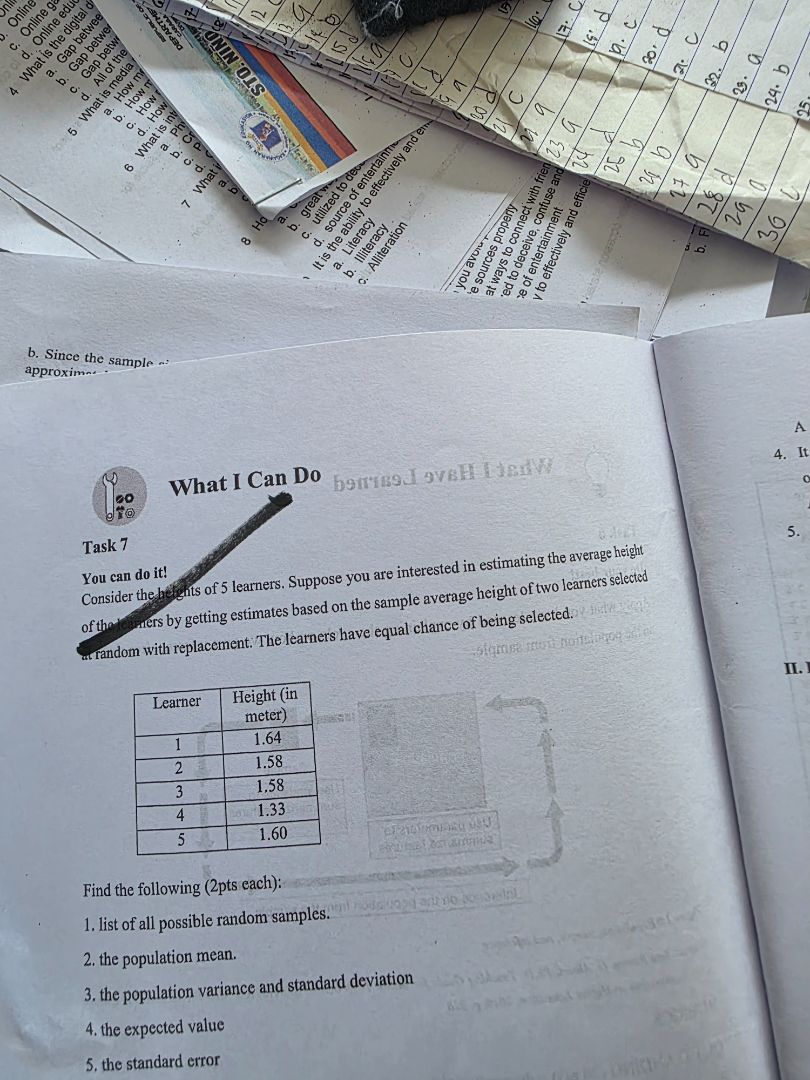
consider the heights of 5 learners. suppose you are interested in estimating the average height of the learners by getting estimates based on the sample average height of two learners selected at random with replacement. the learners have equal chance of being selected.
| learner | height (in meter) |
|---|---|
| 2 | 1.58 |
| 3 | 1.58 |
| 4 | 1.33 |
| 5 | 1.60 |
find the following (2pts each):
- list of all possible random samples.
- the population mean.
- the population variance and standard deviation
- the expected value
- the standard error
1. List of all possible random samples (with replacement)
Since we are selecting 2 learners with replacement from 5 learners, the number of possible samples is \(5\times5 = 25\). The samples are:
- (1,1), (1,2), (1,3), (1,4), (1,5)
- (2,1), (2,2), (2,3), (2,4), (2,5)
- (3,1), (3,2), (3,3), (3,4), (3,5)
- (4,1), (4,2), (4,3), (4,4), (4,5)
- (5,1), (5,2), (5,3), (5,4), (5,5)
Where the first number in the pair represents the first selected learner and the second number represents the second selected learner.
2. Population mean (\(\mu\))
The population consists of the heights of the 5 learners: \(x_1 = 1.64\), \(x_2 = 1.58\), \(x_3 = 1.58\), \(x_4 = 1.33\), \(x_5 = 1.60\)
The formula for the population mean is \(\mu=\frac{\sum_{i = 1}^{N}x_i}{N}\), where \(N = 5\)
\(\sum_{i=1}^{5}x_i=1.64 + 1.58+1.58 + 1.33+1.60=7.73\)
\(\mu=\frac{7.73}{5}=1.546\)
3. Population variance (\(\sigma^2\)) and standard deviation (\(\sigma\))
The formula for population variance is \(\sigma^2=\frac{\sum_{i = 1}^{N}(x_i-\mu)^2}{N}\)
First, calculate \((x_i-\mu)^2\) for each \(x_i\):
- For \(x_1 = 1.64\): \((1.64 - 1.546)^2=(0.094)^2 = 0.008836\)
- For \(x_2 = 1.58\): \((1.58 - 1.546)^2=(0.034)^2=0.001156\)
- For \(x_3 = 1.58\): \((1.58 - 1.546)^2=(0.034)^2 = 0.001156\)
- For \(x_4 = 1.33\): \((1.33 - 1.546)^2=(- 0.216)^2=0.046656\)
- For \(x_5 = 1.60\): \((1.60 - 1.546)^2=(0.054)^2 = 0.002916\)
\(\sum_{i = 1}^{5}(x_i-\mu)^2=0.008836+0.001156 + 0.001156+0.046656+0.002916=0.06072\)
Population variance \(\sigma^2=\frac{0.06072}{5}=0.012144\)
Population standard deviation \(\sigma=\sqrt{\sigma^2}=\sqrt{0.012144}\approx0.1102\)
4. Expected value of the sample mean (when sampling with replacement)
The expected value of the sample mean \(\bar{X}\) is equal to the population mean. So \(E(\bar{X})=\mu = 1.546\)
5. Standard error (SE)
The formula for the standard error when sampling with replacement is \(SE=\frac{\sigma}{\sqrt{n}}\), where \(n = 2\) (sample size) and \(\sigma\approx0.1102\)
\(SE=\frac{0.1102}{\sqrt{2}}\approx\frac{0.1102}{1.4142}\approx0.078\)

Snap & solve any problem in the app
Get step-by-step solutions on Sovi AI
Photo-based solutions with guided steps
Explore more problems and detailed explanations
s:
- List of all possible random samples:
(1,1), (1,2), (1,3), (1,4), (1,5), (2,1), (2,2), (2,3), (2,4), (2,5), (3,1), (3,2), (3,3), (3,4), (3,5), (4,1), (4,2), (4,3), (4,4), (4,5), (5,1), (5,2), (5,3), (5,4), (5,5)
- Population mean: \(1.546\)
- Population variance: \(0.012144\), Population standard deviation: \(\approx0.1102\)
- Expected value: \(1.546\)
- Standard error: \(\approx0.078\)