QUESTION IMAGE
Question
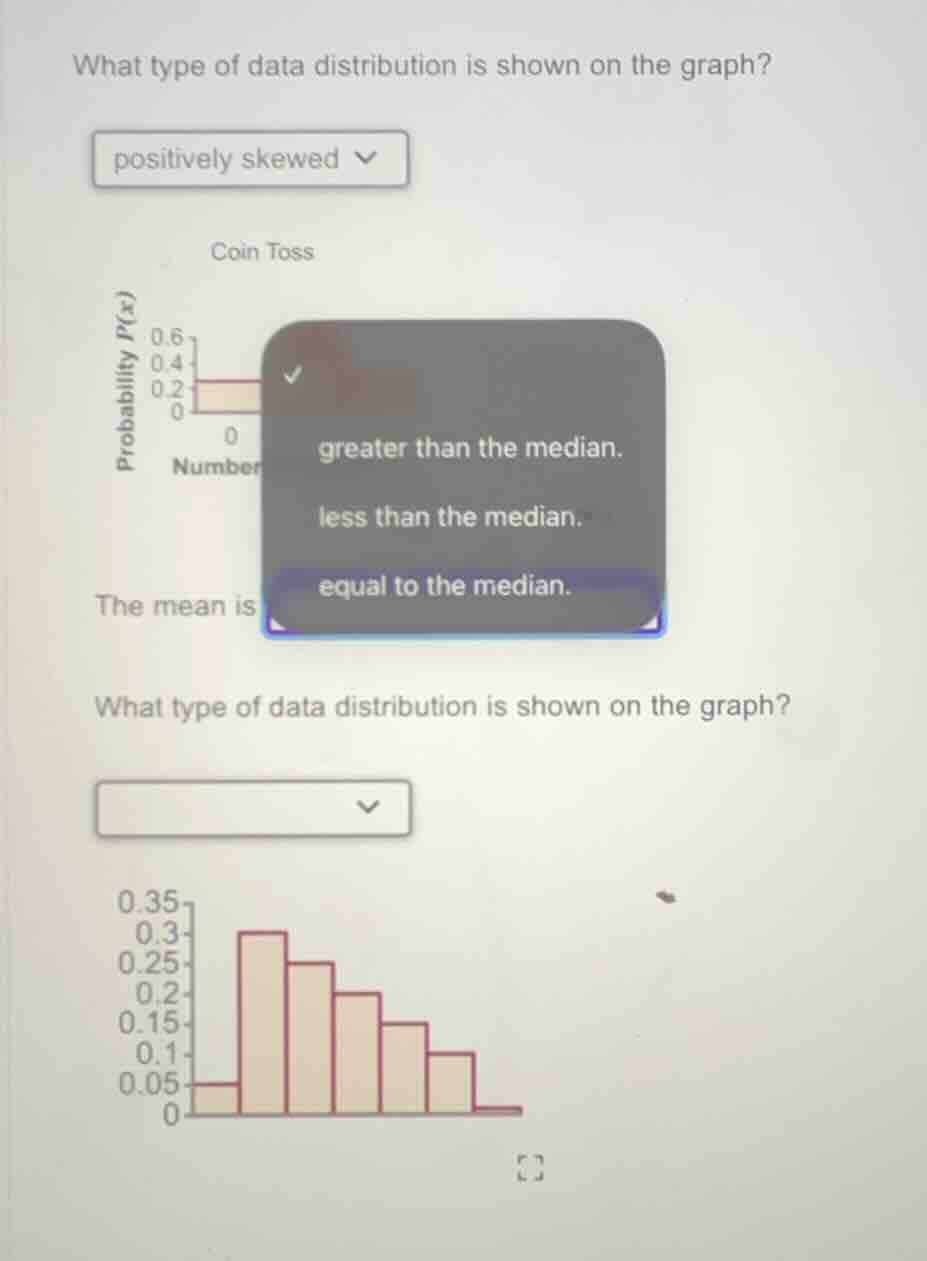
what type of data distribution is shown on the graph?
positively skewed
coin toss
probability p(x)
0.6
0.4
0.2
0
0
number
greater than the median.
less than the median.
the mean is equal to the median.
what type of data distribution is shown on the graph?
0.35
0.3
0.25
0.2
0.15
0.1
0.05
0
To determine the data distribution, we analyze the shape of the histogram. A positively skewed distribution has a longer tail on the right (higher values), while a negatively skewed distribution has a longer tail on the left (lower values). A symmetric distribution has equal tails. The given histogram has a longer tail on the right (values decrease as we move right, but the tail extends to the right with lower probabilities), indicating a positively skewed distribution. Wait, no—wait, the bars: the first bar is small, then a tall bar, then decreasing. Wait, actually, in a positively skewed distribution, the mean is greater than the median, and the tail is on the right. Wait, the graph here: the bars start with a small bar at 0, then a tall bar, then bars decrease in height as we move to the right (higher x - values). So the tail is on the right (since the probabilities for higher x - values are lower, creating a right - tail). So the distribution is positively skewed. But wait, the first part had a coin toss (maybe binomial, symmetric), but this second graph: let's recall skewness. Positively skewed: mean > median, tail on right. Negatively skewed: mean < median, tail on left. Symmetric: mean = median, tails equal. The second graph's bars: the left - most bar (x = 0) is small, then a peak, then bars get shorter as x increases (right - tail). So it's positively skewed. Wait, but maybe I misread. Wait, the y - axis is probability. So the first bar (x = 0) has low probability, then a high probability at some x, then decreasing. So the tail is on the right (higher x, lower probability), so positively skewed.

Snap & solve any problem in the app
Get step-by-step solutions on Sovi AI
Photo-based solutions with guided steps
Explore more problems and detailed explanations
positively skewed