QUESTION IMAGE
Question
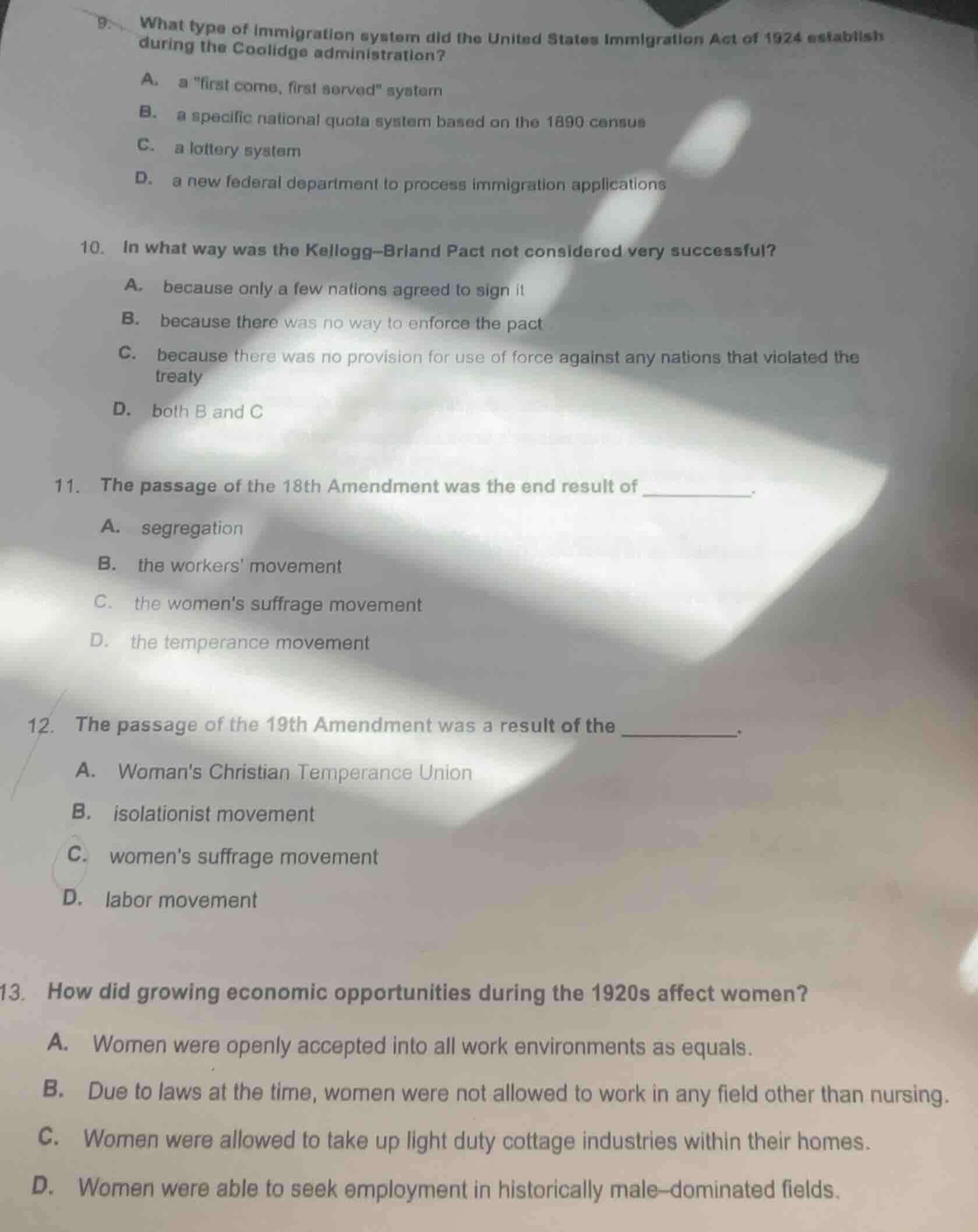
- what type of immigration system did the united states immigration act of 1924 establish during the coolidge administration?
a. a \first come, first served\ system
b. a specific national quota system based on the 1890 census
c. a lottery system
d. a new federal department to process immigration applications
- in what way was the kellogg–briand pact not considered very successful?
a. because only a few nations agreed to sign it
b. because there was no way to enforce the pact
c. because there was no provision for use of force against any nations that violated the treaty
d. both b and c
- the passage of the 18th amendment was the end result of ______.
a. segregation
b. the workers movement
c. the womens suffrage movement
d. the temperance movement
- the passage of the 19th amendment was a result of the ______.
a. womans christian temperance union
b. isolationist movement
c. womens suffrage movement
d. labor movement
- how did growing economic opportunities during the 1920s affect women?
a. women were openly accepted into all work environments as equals.
b. due to laws at the time, women were not allowed to work in any field other than nursing.
c. women were allowed to take up light duty cottage industries within their homes.
d. women were able to seek employment in historically male - dominated fields.
Question 9
The Immigration Act of 1924 established a national quota system based on the 1890 census to limit immigration, especially from Southern and Eastern Europe. Option A is incorrect as it's not a "first come, first served" system. Option C (lottery) and D (new federal department) don't match the act's provisions.
The Kellogg - Briand Pact aimed to outlaw war but had no enforcement mechanism and no provision for using force against violators. So both B (no enforcement way) and C (no force provision) are reasons for its lack of success, making D correct. A is wrong as many nations signed it.
The 18th Amendment established Prohibition, which was the goal of the temperance movement (to limit/ban alcohol). Segregation (A), workers' movement (B), and women's suffrage (C, about voting rights) are not related to Prohibition.

Snap & solve any problem in the app
Get step-by-step solutions on Sovi AI
Photo-based solutions with guided steps
Explore more problems and detailed explanations
B. a specific national quota system based on the 1890 census