QUESTION IMAGE
Question
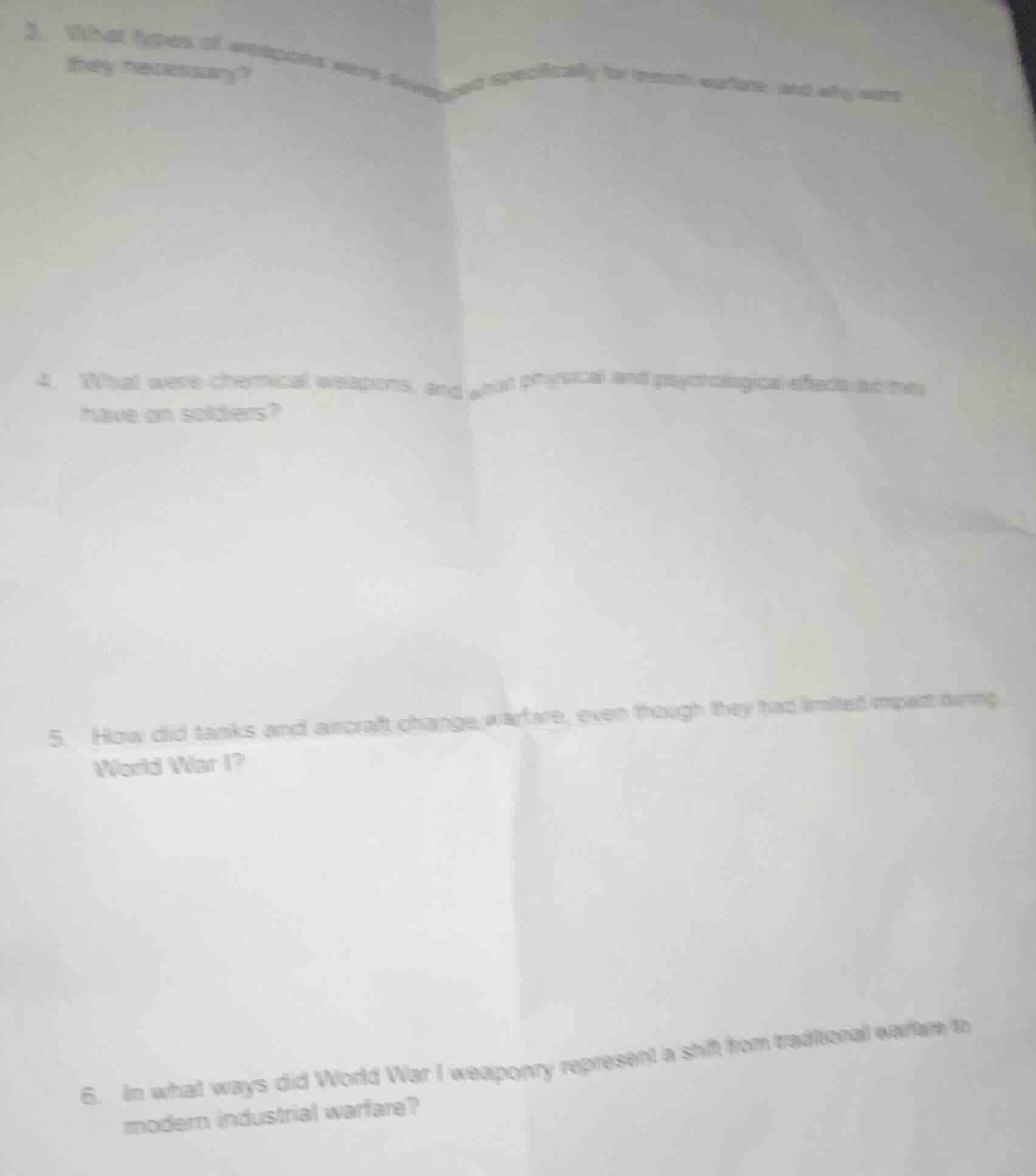
- what types of weapons were developed specifically for trench warfare, and why were they necessary?
- what were chemical weapons, and what physical and psychological effects did they have on soldiers?
- how did tanks and aircraft change warfare, even though they had limited impact during world war i?
- in what ways did world war i weaponry represent a shift from traditional warfare to modern industrial warfare?
For Question 3:
Trench warfare-specific weapons addressed the static, fortified nature of trench lines. Barbed wire slowed enemy advances, machine guns mowed down mass charges, and mortars/grenades targeted troops in trenches. They were necessary because traditional weapons could not break the stalemate of fixed trench defenses.
For Question 4:
Chemical weapons are toxic substances used to harm or kill enemies, like chlorine, mustard gas, and phosgene. Physically, they caused burns, lung damage, blindness, or death. Psychologically, they induced constant fear of surprise attacks, leading to anxiety, panic, and long-term trauma.
For Question 5:
Tanks overcame trench obstacles and barbed wire, enabling breakthroughs in static lines. Aircraft introduced aerial reconnaissance, artillery spotting, and early bombing, shifting warfare to a three-dimensional fight. Though their WWI impact was limited, they laid the groundwork for mobile, combined-arms warfare in future conflicts.
For Question 6:
WWI weaponry shifted to industrialized mass production, with weapons like machine guns, artillery, and chemical weapons designed for large-scale, lethal attrition. It moved away from small-scale, infantry-focused traditional warfare to mechanized, long-range, and total war that relied on industrial infrastructure and caused unprecedented casualties.

Snap & solve any problem in the app
Get step-by-step solutions on Sovi AI
Photo-based solutions with guided steps
Explore more problems and detailed explanations
- Weapons developed for trench warfare included barbed wire, machine guns, mortars, and hand grenades. They were necessary to counter the static, fortified trench lines, as traditional weapons could not break the stalemate of close-quarters, fixed-position fighting.
- Chemical weapons are toxic chemical agents deployed to harm or disable enemy forces. Physical effects: blistering skin, lung damage, blindness, organ failure, or death (depending on the agent). Psychological effects: chronic fear of surprise attacks, anxiety, panic, and long-term psychological trauma.
- Tanks allowed forces to cross barbed wire and trench obstacles, enabling potential breakthroughs in static lines. Aircraft introduced aerial reconnaissance, artillery targeting, and early bombing, creating a three-dimensional battlefield. While their immediate WWI impact was limited, they established the template for mobile, combined-arms warfare in later conflicts.
- WWI weaponry represented this shift through industrial mass production of standardized, lethal weapons (e.g., machine guns, heavy artillery), the use of non-human-powered/mechanized tools (tanks, aircraft), reliance on industrial infrastructure to sustain supply, and the focus on large-scale attrition warfare that caused massive, unprecedented casualties, moving beyond the small-scale, infantry-centric traditional warfare.