QUESTION IMAGE
Question
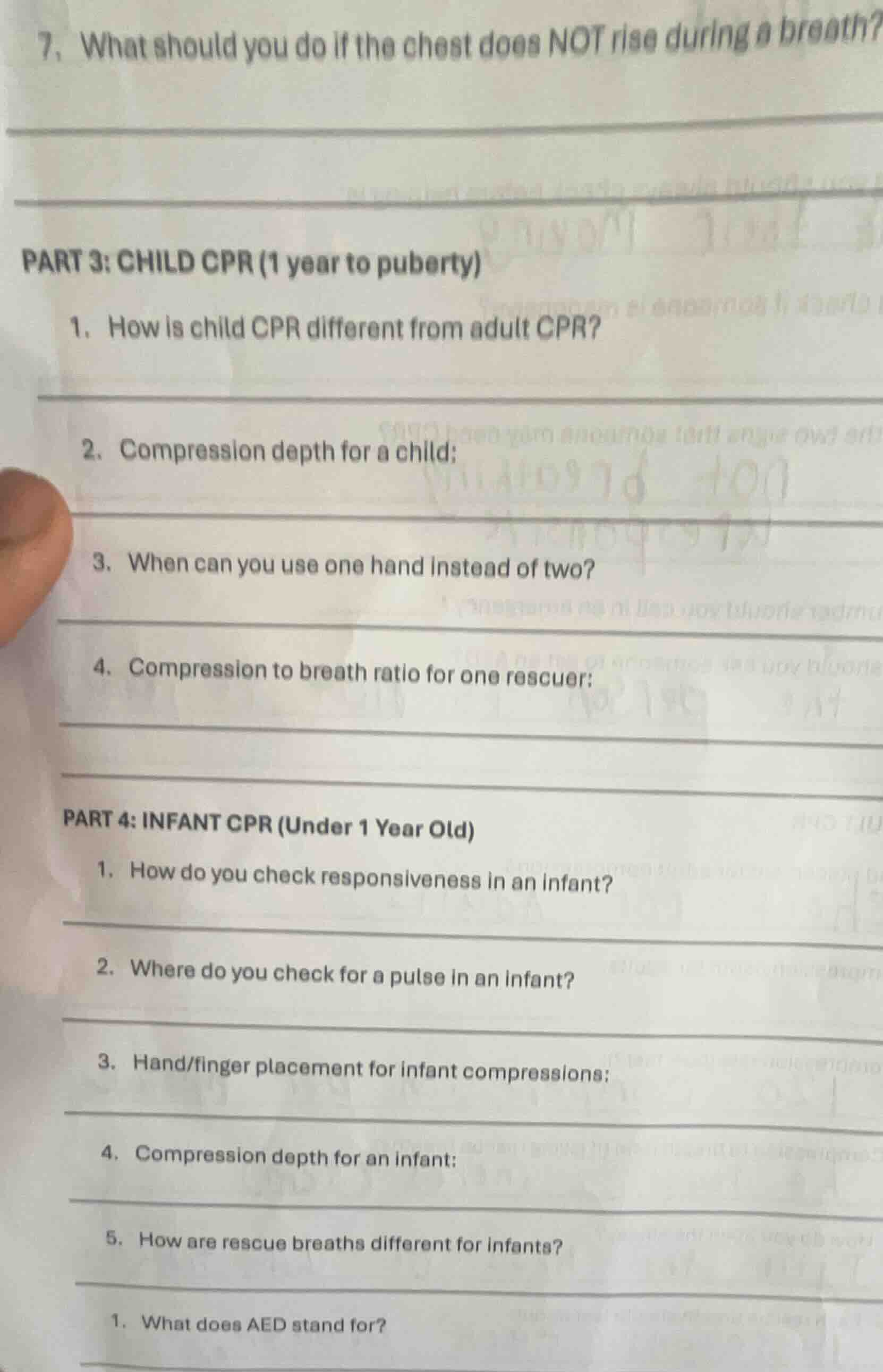
- what should you do if the chest does not rise during a breath?
part 3: child cpr (1 year to puberty)
- how is child cpr different from adult cpr?
- compression depth for a child:
- when can you use one hand instead of two?
- compression to breath ratio for one rescuer:
part 4: infant cpr (under 1 year old)
- how do you check responsiveness in an infant?
- where do you check for a pulse in an infant?
- hand/finger placement for infant compressions:
- compression depth for an infant:
- how are rescue breaths different for infants?
- what does aed stand for?
Brief Explanations
All answers are based on standard CPR guidelines for emergency care.
- For the chest not rising during a breath: Reopen the airway, reposition the head, ensure a proper seal over the mouth/nose, and retry the breath. If still not rising, start CPR as the airway may be blocked.
- PART 3: CHILD CPR (1 year to puberty)
- Key differences include shallower compression depth, modified hand placement, and a focus on possible airway obstruction as a common cause of arrest.
- Compression depth is one-third the anterior-posterior depth of the chest, about 2 inches (5 cm).
- One hand can be used if the rescuer can achieve adequate compression depth with one hand on the child's chest.
- The ratio is 30 compressions to 2 rescue breaths.
- PART 4: INFANT CPR (Under 1 Year Old)
- Tap the infant's foot and shout to check for responsiveness; watch for any movement, noise, or eye opening.
- Check the brachial pulse on the inside of the upper arm, between the elbow and shoulder.
- Place two fingers (index and middle) on the center of the infant's chest, just below the nipple line.
- Compression depth is one-third the anterior-posterior depth of the chest, about 1.5 inches (4 cm).
- Rescue breaths are gentler; cover the infant's mouth and nose with your mouth, deliver small puffs (1 second each) to make the chest rise visibly.
- AED is a device used to deliver an electric shock to the heart to treat life-threatening arrhythmias.

Snap & solve any problem in the app
Get step-by-step solutions on Sovi AI
Photo-based solutions with guided steps
Explore more problems and detailed explanations
- Reopen the airway, reposition the head, ensure a proper face seal, and retry the breath. If the chest still does not rise, begin CPR as the airway may be obstructed.
---
PART 3: CHILD CPR (1 year to puberty)
- Shallower compression depth, modified hand placement, and airway obstruction is a more common arrest cause.
- 2 inches (5 cm), or 1/3 of chest depth
- When the rescuer can achieve adequate compression depth with one hand
- 30:2 (30 compressions to 2 breaths)
---
PART 4: INFANT CPR (Under 1 Year Old)
- Tap the infant's foot, shout, and observe for movement/response.
- Brachial pulse (inside upper arm, elbow to shoulder)
- Two fingers on center of chest, below nipple line
- 1.5 inches (4 cm), or 1/3 of chest depth
- Gentler, smaller puffs; cover both mouth and nose with rescuer's mouth, deliver 1-second breaths that make the chest rise.
---
- Automated External Defibrillator