QUESTION IMAGE
Question
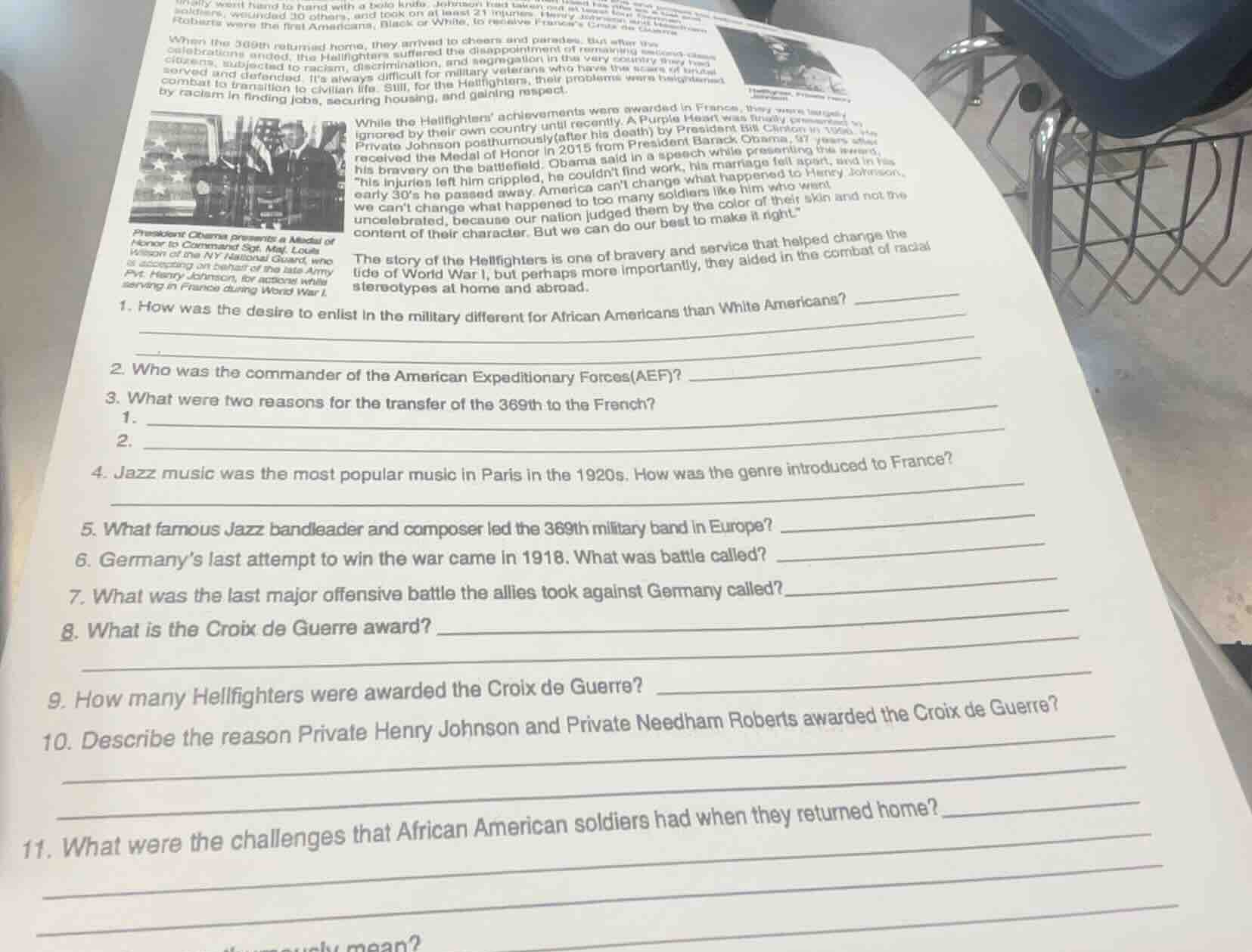
when the 369th returned home, they arrived to cheers and parades. but after the celebrations ended, the hellfighters suffered the disappointment of being treated as second-class citizens, subjected to racism, discrimination, and segregation in the very country they had served and defended. its always difficult for military veterans who have the scars of brutal combat to transition to civilian life. still, for the hellfighters, their problems were heightened by racism in finding jobs, securing housing, and gaining respect.while the hellfighters achievements were awarded in france, they were largely ignored by their own country until recently. a purple heart was finally presented to private johnson posthumously(after his death) by president bill clinton in 1996. he received the medal of honor in 2015 from president barack obama, 97 years after his bravery on the battlefield. obama said in a speech while presenting this award, his injuries left him crippled, he couldnt find work, his marriage fell apart, and in his early 30s he passed away. america cant change what happened to henry johnson, we cant change what happened to too many soldiers like him who went uncelebrated, because our nation judged them by the color of their skin and not the content of their character. but we can do our best to make it right.the story of the hellfighters is one of bravery and service that helped change the tide of world war i, but perhaps more importantly, they aided in the combat of racial stereotypes at home and abroad.president obama presents a medal of honor to command sgt. maj. louis wilson of the ny national guard, who is accepting on behalf of the late army pvt. henry johnson, for actions while serving in france during world war i.1. how was the desire to enlist in the military different for african americans than white americans? _____________________________________________________________________________________________2. who was the commander of the american expeditionary forces(aef)? ___________________________________________________________________________________________3. what were two reasons for the transfer of the 369th to the french?1. ________________________________________________________________________________2. ________________________________________________________________________________4. jazz music was the most popular music in paris in the 1920s. how was the genre introduced to france?___________________________________________________________________________________5. what famous jazz bandleader and composer led the 369th military band in europe? ___________________________________________________________________________________________6. germanys last attempt to win the war came in 1918. what was battle called? ___________________________________________________________________________________________7. what was the last major offensive battle the allies took against germany called?___________________________________________________________________________________________8. what is the croix de guerre award? ___________________________________________________________________________________________9. how many hellfighters were awarded the croix de guerre? ___________________________________________________________________________________________10. describe the reason private henry johnson and private needham roberts awarded the croix de guerre?__________________________________________________________________________________________________________________________________________________________________________11. what were the challenges that african american soldiers had when they returned home?_____________________________________________________________________________________________
- African Americans often enlisted to prove their loyalty and fight for both U.S. freedom and racial equality at home, while many White Americans enlisted primarily for national service and patriotism.
- The commander of the American Expeditionary Forces was a well-documented WWI military leader.
- The 369th (Harlem Hellfighters) was transferred to French forces due to racial segregation in the U.S. military and the French military's willingness to integrate Black troops.
- Jazz was introduced to France by African American soldiers (like the 369th's military band) stationed there during WWI.
- This bandleader was a prominent figure associated with the 369th's musical unit in Europe.
- Germany's final 1918 offensive is a key WWI battle focused on breaking Allied lines.
- The last major Allied offensive against Germany in WWI led to the end of the war.
- The Croix de Guerre is a French military award for acts of bravery in combat.
- The 369th had a high number of soldiers awarded this French honor, nearly the entire regiment.
- Johnson and Roberts earned the award for their heroic hand-to-hand combat against a German raiding party, holding their position despite being outnumbered and wounded.
- Returning African American soldiers faced racism, discrimination, segregation, difficulty finding jobs/housing, and lack of respect for their military service.

Snap & solve any problem in the app
Get step-by-step solutions on Sovi AI
Photo-based solutions with guided steps
Explore more problems and detailed explanations
- African Americans enlisted to fight for both U.S. loyalty and racial equality, while White Americans primarily enlisted for national patriotism.
- General John J. Pershing
3.
- Racial segregation in the U.S. military
- French military's willingness to integrate Black troops
- Jazz was introduced to France by African American soldiers, specifically the military band of the 369th (Harlem Hellfighters), who performed while stationed there during World War I.
- James Reese Europe
- The Spring Offensive (or Kaiserschlacht)
- Hundred Days Offensive
- The Croix de Guerre is a French military decoration awarded to soldiers for acts of bravery and heroism in combat.
- 171 members of the 369th (nearly the entire regiment)
- They were awarded the Croix de Guerre for their heroic defense during a German raiding party in 1918; they fought off a larger enemy force in hand-to-hand combat despite being outnumbered, wounded, and low on ammunition, preventing the Germans from seizing their position.
- Returning African American soldiers faced systemic racism, segregation, discrimination in housing and employment, lack of recognition for their military service, and difficulty accessing veteran benefits, all in the same country they had fought to defend.