QUESTION IMAGE
Question
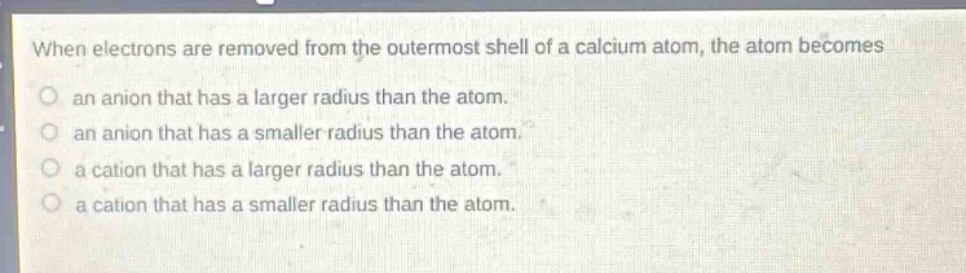
when electrons are removed from the outermost shell of a calcium atom, the atom becomes
an anion that has a larger radius than the atom.
an anion that has a smaller radius than the atom.
a cation that has a larger radius than the atom.
a cation that has a smaller radius than the atom.
Brief Explanations
- First, recall the definitions of cations and anions: A cation is formed when an atom loses electrons (positive charge), and an anion is formed when an atom gains electrons (negative charge). Calcium (Ca) has 2 valence electrons. When electrons are removed from the outermost shell of a calcium atom, it loses electrons, so it forms a cation (Ca²⁺).
- Next, consider the atomic radius change: When an atom loses electrons, the outermost shell is removed or the electron - electron repulsion decreases. For a calcium atom, when it loses its 2 valence electrons, the remaining electron cloud is pulled more tightly by the nucleus because there are fewer electrons to shield the positive charge of the nucleus. So the radius of the cation (Ca²⁺) is smaller than the radius of the neutral calcium atom.
- Option 1: Wrong, because removing electrons forms a cation, not an anion.
- Option 2: Wrong, because removing electrons forms a cation, not an anion.
- Option 3: Wrong, because when a cation is formed (electrons removed), the radius is smaller, not larger.
- Option 4: Correct, as explained above.

Snap & solve any problem in the app
Get step-by-step solutions on Sovi AI
Photo-based solutions with guided steps
Explore more problems and detailed explanations
D. a cation that has a smaller radius than the atom. (Note: Assuming the options are labeled A - D in the order given, with the last option being the correct one.)