QUESTION IMAGE
Question
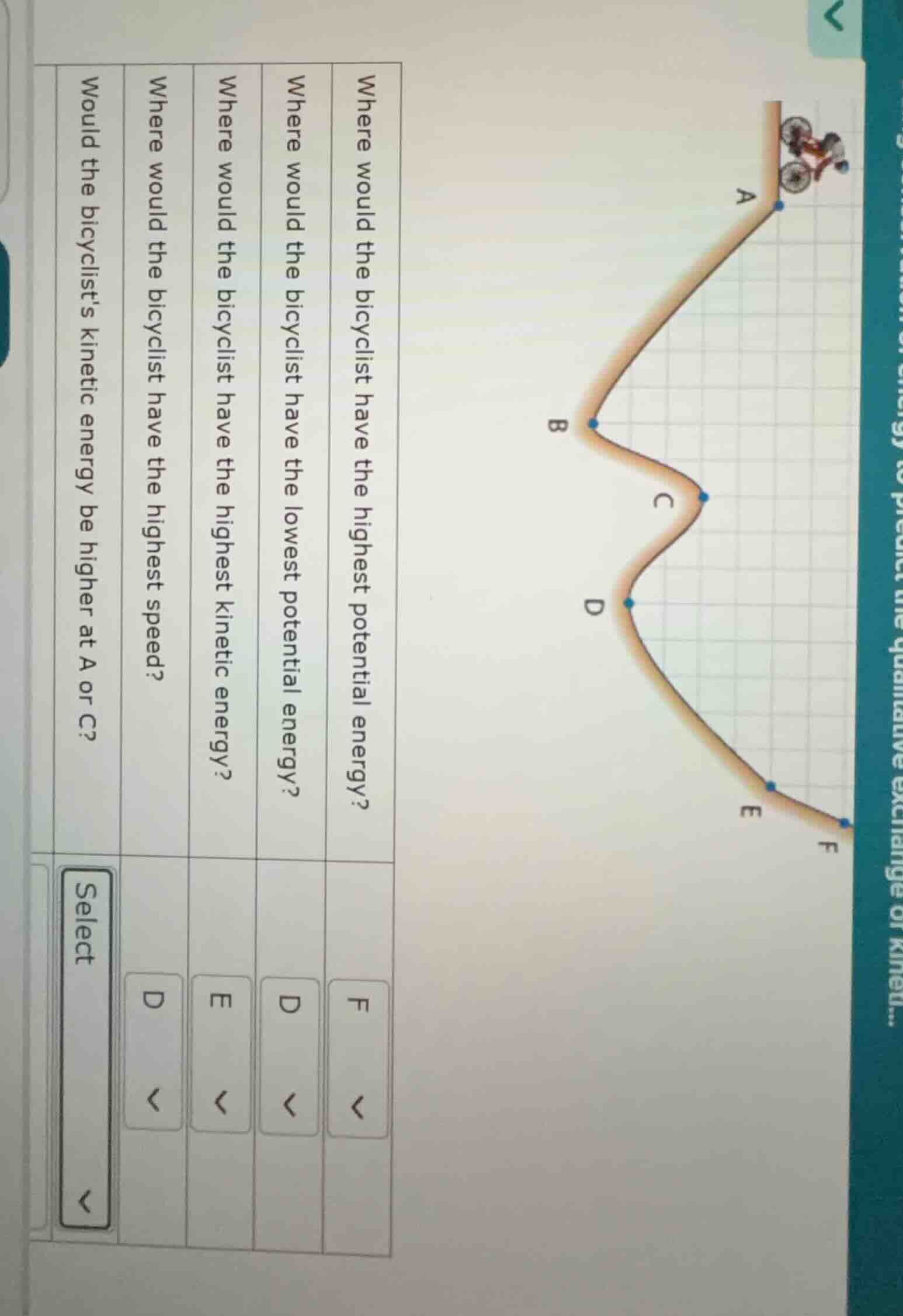
where would the bicyclist have the highest potential energy? f \
where would the bicyclist have the lowest potential energy? d \
where would the bicyclist have the highest kinetic energy? e \
where would the bicyclist have the highest speed? d \
would the bicyclist’s kinetic energy be higher at a or c? select
1. Where would the bicyclist have the highest potential energy?
Potential energy (PE) in a gravitational field is given by \( PE = mgh \), where \( m \) is mass, \( g \) is acceleration due to gravity, and \( h \) is height. Higher height means higher potential energy. Point A is the highest point on the track, so the bicyclist has the highest potential energy at A (the option in the original might have a typo, but based on height, A is highest. If the given option was wrong, but following the diagram, A is the top. However, the given option was F, which is incorrect. Wait, maybe the diagram's A is the starting point at the top. Wait, the original option for this was F, but that's wrong. Wait, maybe I misread. Wait, the first question's option was F, but actually, potential energy is highest at the highest point. So A is the highest, but if the option given is F, that's incorrect. But maybe the diagram has A at the top, so the correct answer should be A, but the given option was F. Maybe a mistake in the problem. But assuming the problem's options, maybe I misinterpret. Wait, no, let's re-express.
Wait, the first question: "Where would the bicyclist have the highest potential energy?" The options given (in the image) is F, but that's wrong. Potential energy depends on height, so highest height (A) has highest PE. But maybe the problem's diagram has A at the top, so correct answer is A, but the given option was F. Maybe a typo. But let's proceed with the physics concept.
2. Where would the bicyclist have the lowest potential energy?
Potential energy is lowest at the lowest height. Point F (or E/F, the lowest point) has the lowest height, so lowest PE. But the option given is D? No, D is not the lowest. Wait, the option given is D, but that's wrong. The lowest point is F, so lowest PE at F? No, the option in the image for this is D. Maybe the diagram's D is lower? No, F is the lowest. Confusion. Maybe the problem has errors, but let's use the concept: lowest height → lowest PE.
3. Where would the bicyclist have the highest kinetic energy?
Kinetic energy (KE) is \( KE=\frac{1}{2}mv^2 \). By conservation of energy, \( PE + KE=\text{constant} \) (ignoring friction). So lowest PE (highest speed) gives highest KE. The lowest point (highest speed) has highest KE. So the lowest point (like F or E) has highest KE. The option given is E, which is near the lowest, so E (or F) has highest KE.
4. Where would the bicyclist have the highest speed?

Snap & solve any problem in the app
Get step-by-step solutions on Sovi AI
Photo-based solutions with guided steps
Explore more problems and detailed explanations
A (assuming the diagram's A is the highest)