QUESTION IMAGE
Question
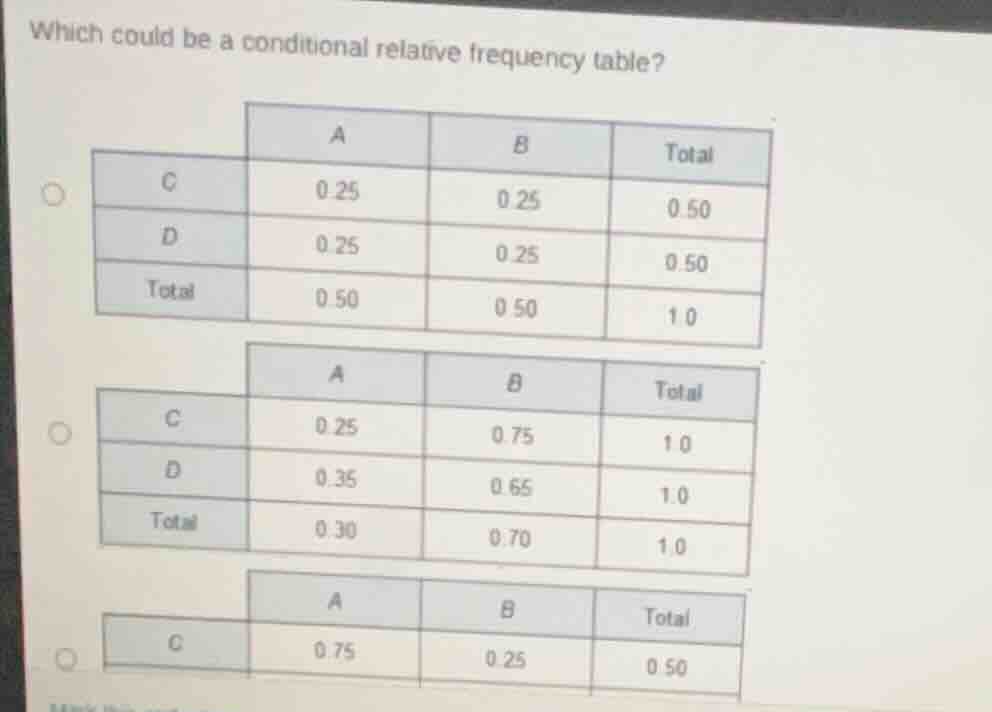
which could be a conditional relative frequency table?
| a | b | total | |
|---|---|---|---|
| d | 0.25 | 0.25 | 0.50 |
| total | 0.50 | 0.50 | 1.0 |
| a | b | total | |
|---|---|---|---|
| d | 0.35 | 0.65 | 1.0 |
| total | 0.30 | 0.70 | 1.0 |
| a | b | total |
|---|
To determine a conditional relative frequency table, we recall that in a conditional relative frequency table (either row - wise or column - wise), the sum of the relative frequencies in each row (or each column) should be equal to 1.0.
Analyze the first table:
- Rows: For row \(C\), the sum of the relative frequencies is \(0.25 + 0.25=0.50
eq1.0\). For row \(D\), the sum of the relative frequencies is \(0.25 + 0.25 = 0.50
eq1.0\). So this is not a conditional relative frequency table (since the row totals are not 1.0, and if we consider column - wise, the column totals are 0.50 as well, not 1.0).
Analyze the second table:
- Rows: For row \(C\), the sum of the relative frequencies is \(0.25+0.75 = 1.0\). For row \(D\), the sum of the relative frequencies is \(0.35 + 0.65=1.0\).
- Columns: For column \(A\), the sum of the relative frequencies is \(0.25+0.35 = 0.60\)? Wait, no, wait the "Total" row for column \(A\) is \(0.30\) and column \(B\) is \(0.70\). Wait, actually, in a conditional relative frequency table, if we calculate row - conditional relative frequencies, each row should sum to 1.0. In this table, row \(C\) sums to \(0.25 + 0.75=1.0\) and row \(D\) sums to \(0.35+0.65 = 1.0\). This is consistent with a row - conditional relative frequency table (where we calculate relative frequencies within each row).
Analyze the third table:
- The table is incomplete (only row \(C\) is shown, and the total for row \(C\) is \(0.50\) instead of \(1.0\) if it were a conditional relative frequency table for row \(C\)). Also, there is no row \(D\) or a total row for columns. So it is not a valid conditional relative frequency table.
So the second table (the one with rows \(C\) and \(D\) where each row sums to 1.0) is a conditional relative frequency table.

Snap & solve any problem in the app
Get step-by-step solutions on Sovi AI
Photo-based solutions with guided steps
Explore more problems and detailed explanations
The table with rows \(C\) (with values \(0.25\), \(0.75\), \(1.0\)) and \(D\) (with values \(0.35\), \(0.65\), \(1.0\)) and column totals \(0.30\), \(0.70\), \(1.0\) (the second table among the given options)