QUESTION IMAGE
Question
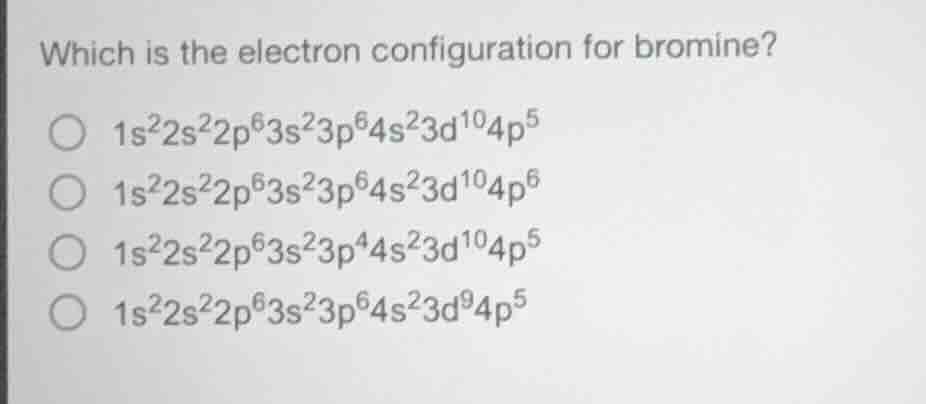
which is the electron configuration for bromine?\
\\(1s^2 2s^2 2p^6 3s^2 3p^6 4s^2 3d^{10} 4p^5\\)\
\\(1s^2 2s^2 2p^6 3s^2 3p^6 4s^2 3d^{10} 4p^6\\)\
\\(1s^2 2s^2 2p^6 3s^2 3p^4 4s^2 3d^{10} 4p^5\\)\
\\(1s^2 2s^2 2p^6 3s^2 3p^6 4s^2 3d^9 4p^5\\)
Brief Explanations
To determine the electron configuration of bromine (Br), we first note its atomic number is 35, meaning it has 35 electrons. The Aufbau principle, Pauli exclusion principle, and Hund's rule guide electron filling.
- The correct order of filling orbitals is \(1s \to 2s \to 2p \to 3s \to 3p \to 4s \to 3d \to 4p\) (and so on).
- For the \(3p\) orbital, it can hold up to 6 electrons (since \(p\) orbitals have 3 sub - orbitals, each holding 2 electrons), so \(3p^6\) is correct (eliminating the option with \(3p^4\)).
- The \(3d\) orbital can hold up to 10 electrons ( \(d\) orbitals have 5 sub - orbitals, each holding 2 electrons), so \(3d^{10}\) is correct (eliminating the option with \(3d^9\)).
- The \(4p\) orbital: Bromine is in group 17 (halogens), so it has 7 valence electrons. The valence electrons are in the \(4s\) and \(4p\) orbitals. \(4s^2\) accounts for 2 electrons, so \(4p\) should have \(7 - 2=5\) electrons, giving \(4p^5\). Also, the total number of electrons in each option is calculated:
- First option: \(2 + 2+6 + 2+6 + 2+10 + 5=35\) (correct number of electrons).
- Second option: \(2 + 2+6 + 2+6 + 2+10 + 6=36\) (too many, like a noble gas configuration, incorrect for Br).
- Third option: \(2 + 2+6 + 2+4 + 2+10 + 5=33\) (too few, incorrect \(3p\) filling).
- Fourth option: \(2 + 2+6 + 2+6 + 2+9 + 5=34\) (too few, incorrect \(3d\) filling).

Snap & solve any problem in the app
Get step-by-step solutions on Sovi AI
Photo-based solutions with guided steps
Explore more problems and detailed explanations
A. \(1s^{2}2s^{2}2p^{6}3s^{2}3p^{6}4s^{2}3d^{10}4p^{5}\)