QUESTION IMAGE
Question
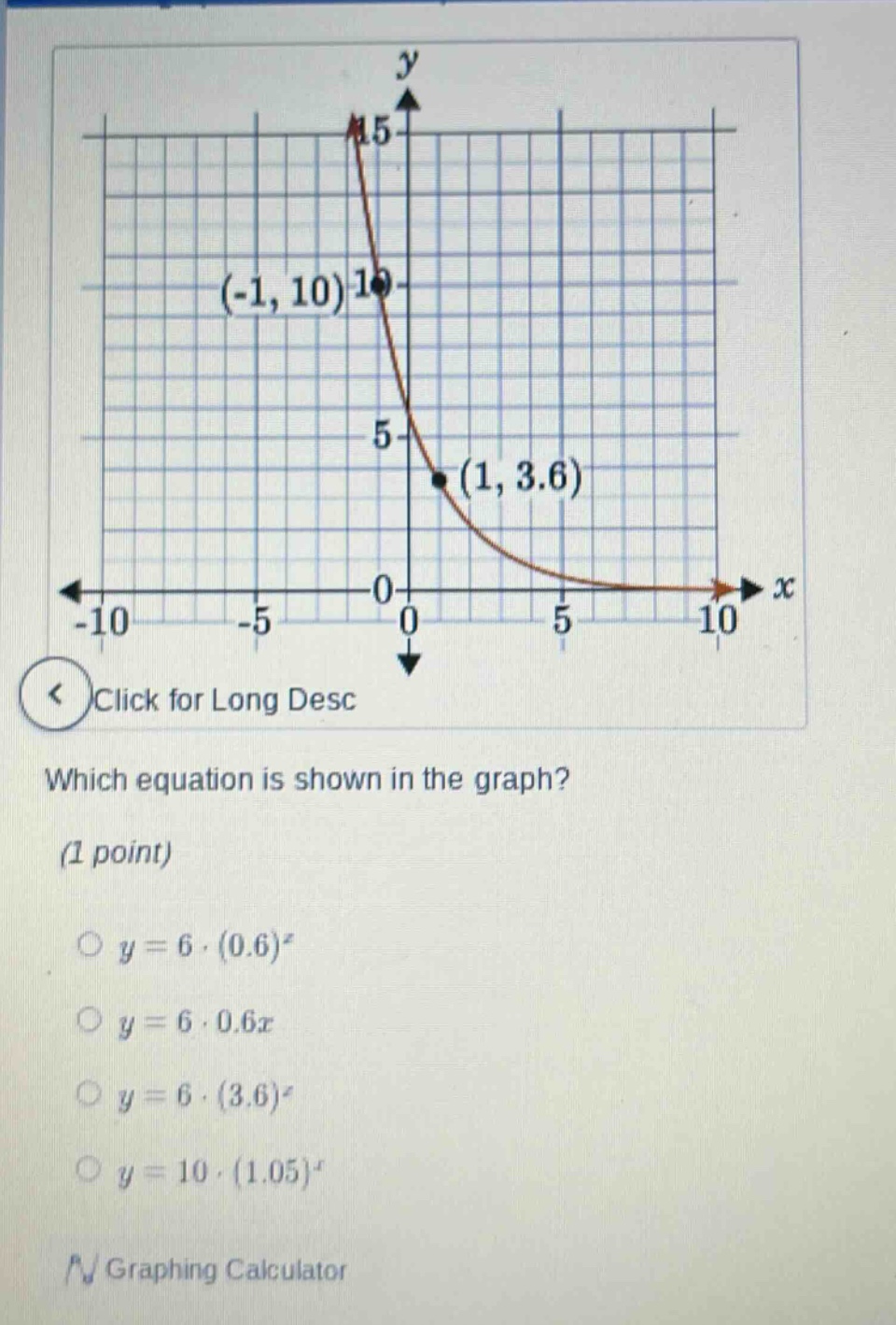
which equation is shown in the graph? (1 point) \\(\circ\\ y = 6 \cdot (0.6)^x\\) \\(\circ\\ y = 6 \cdot 0.6x\\) \\(\circ\\ y = 6 \cdot (3.6)^x\\) \\(\circ\\ y = 10 \cdot (1.05)^x\\)
Step1: Analyze the type of function
The graph is a curve, so it's an exponential function (not linear). So we can eliminate the linear option \( y = 6\cdot0.6x \).
Step2: Test the point \((1, 3.6)\) in the remaining options
- For \( y = 6\cdot(0.6)^x \): Substitute \( x = 1 \), we get \( y = 6\cdot0.6^1 = 6\cdot0.6 = 3.6 \), which matches the point \((1, 3.6)\).
- For \( y = 6\cdot(3.6)^x \): Substitute \( x = 1 \), \( y = 6\cdot3.6 = 21.6
eq 3.6 \), so this is incorrect.
- For \( y = 10\cdot(1.05)^x \): Substitute \( x = 1 \), \( y = 10\cdot1.05 = 10.5
eq 3.6 \), so this is incorrect.
We can also check the point \((-1, 10)\) for \( y = 6\cdot(0.6)^x \): Substitute \( x=-1 \), \( y = 6\cdot(0.6)^{-1}=6\cdot\frac{1}{0.6}=10 \), which matches.

Snap & solve any problem in the app
Get step-by-step solutions on Sovi AI
Photo-based solutions with guided steps
Explore more problems and detailed explanations
\( y = 6\cdot(0.6)^x \) (the first option)