QUESTION IMAGE
Question
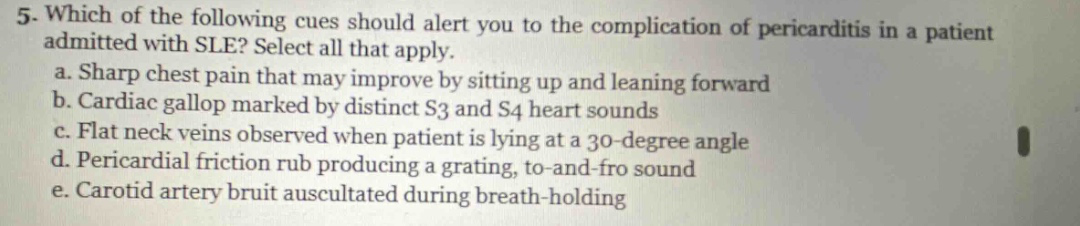
- which of the following cues should alert you to the complication of pericarditis in a patient admitted with sle? select all that apply.
a. sharp chest pain that may improve by sitting up and leaning forward
b. cardiac gallop marked by distinct s3 and s4 heart sounds
c. flat neck veins observed when patient is lying at a 30 - degree angle
d. pericardial friction rub producing a grating, to - and - fro sound
e. carotid artery bruit auscultated during breath - holding
Brief Explanations
- Option a: Pericarditis often causes sharp chest pain that is relieved by sitting up and leaning forward (reduces pressure on the pericardium).
- Option d: A pericardial friction rub (grating, to - and - fro sound) is a classic physical finding in pericarditis, resulting from inflamed pericardial layers rubbing together.
- Option b: Cardiac gallop (S3, S4) is more associated with heart failure or other cardiomyopathies, not typical of pericarditis.
- Option c: In pericarditis with effusion (or some cases), neck veins may be distended (due to increased central venous pressure), not flat.
- Option e: Carotid artery bruit is related to carotid artery disease (e.g., atherosclerosis), not pericarditis.

Snap & solve any problem in the app
Get step-by-step solutions on Sovi AI
Photo-based solutions with guided steps
Explore more problems and detailed explanations
a. Sharp chest pain that may improve by sitting up and leaning forward, d. Pericardial friction rub producing a grating, to - and - fro sound